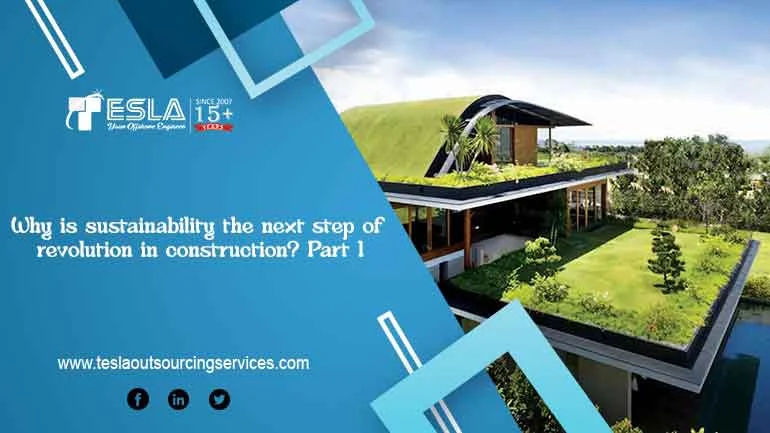
Construction has always been closely linked with economic growth. New buildings, infrastructure, and cities support businesses, housing, and communities. But the industry also has a major environmental footprint. In 2026, the question is no longer whether construction needs to become more sustainable. The bigger question is how quickly the industry can change how buildings are designed, constructed, and operated.
The latest Global Status Report for Buildings and Construction 2025-2026 from the United Nations Environment Programme (UNEP) and the Global Alliance for Buildings and Construction (GlobalABC) reports that buildings and construction are responsible for around 37% of global CO2 emissions and nearly 50% of global material extraction.
This makes sustainability more than an environmental objective. It is becoming an important part of how the construction industry plans projects, manages resources, and prepares buildings for future.
What Does Sustainability Mean in Construction?
Sustainable construction means considering a building’s environmental impact throughout its entire lifecycle, rather than focusing only on the construction stage.
This includes decisions about where a building is located, how it is designed, which materials are selected, how much energy it consumes, how it is maintained, and what happens to its components at the end of its useful life.
One important shift in 2026 is the growing focus on whole-life carbon. A building’s carbon impact does not come only from electricity used for heating, cooling and lighting. It also comes from extracting raw materials, manufacturing products, transporting them, constructing the building, replacing components, and eventually demolishing or reusing them.
This is why sustainable design increasingly considers factors such as:
- Energy efficiency and renewable energy.
- Embodied and operational carbon.
- Efficient use of materials.
- Reuse and recycling.
- Water conservation.
- Indoor environmental quality.
- Climate resilience.
- Building performance throughout its lifecycle.
Digital technologies are also becoming part of this process. BIM can connect geometry, material information, quantities, and building-performance data, allowing project teams to assess design options before construction begins. Open standards such as IFC can also support information exchange between software platforms and across the building lifecycle.
Why Does Sustainable Construction Matter?
The scale of construction makes sustainability particularly important.
According to the latest UNEP report, the world’s building floor area reached about 273 billion sqm in 2024, up 1.7% in one year. UNEP also estimates that half of the buildings expected to exist in 2050 have not yet been built or renovated. This means today’s design and construction decisions can influence energy consumption, emissions, and resource use for decades.
Energy performance is another major concern. Although global building energy intensity has improved, the 2025-2026 report found that progress is still too slow. Global building energy intensity has fallen by 8.5%, while investment in energy efficiency needs to rise substantially, reaching an estimated US$5.9 trillion by 2030 to stay aligned with climate objectives
Materials are equally important. Cement, steel, and other construction products carry significant embodied emissions. The IEA continues to identify cement as a difficult sector to decarbonize, with solutions including material efficiency, alternative fuels, supplementary cementitious materials, and carbon capture.
Therefore, sustainability cannot be addressed only after a building has been designed. The greatest opportunities often begin during early design decisions.
Challenges in Sustainable Construction
1. Balancing Cost and Carbon
Sustainable construction does not always mean higher costs, but some low-carbon materials, efficient systems and technologies can require greater upfront investment. The challenge is to look beyond initial construction costs and consider energy consumption, maintenance, replacement, and operational costs over the building’s lifecycle.
Life-cycle costing and whole-life carbon assessment can help project teams understand these trade-offs before committing to a design.
2. Reducing Embodied Carbon
Improving operational energy efficiency alone is not enough. As buildings become more energy efficient, emissions associated with materials and construction become increasingly important.
Design teams therefore need to consider material quantities, product specifications, durability, reuse, and lower-carbon alternatives from the early stages of a project. Embodied carbon is associated with activities including material production, transportation, construction, maintenance, and end-of-life processes.
3. Managing Construction Waste
Construction and demolition of waste remains a major resource challenge. UNEP’s 2024-2025 assessment estimated that the construction sector generated around 2 billion tonnes of construction and demolition waste every year, representing approximately one-third of global waste.
Reducing this waste requires more than better disposal. Accurate quantity planning, prefabrication, material reuse, design for disassembly and digital coordination can help prevent unnecessary material consumption in the first place.
4. Turning Digital Data into Decisions
BIM has become an important part of modern construction workflows, but simply creating a 3D model does not automatically make a project sustainable.
The real value comes when project teams use reliable model data for quantity take-offs, energy analysis, material evaluation, clash reduction, lifecycle planning, and facility management. BIM services can support these workflows by providing coordinated and accurate project information. OpenBIM approaches can further support interoperability and information exchange between different project platforms.
The Road Ahead
Sustainable construction is no longer just about adding solar panels or choosing materials labelled as environmentally friendly. It now involves looking at how a building is designed, constructed, used, maintained, and eventually adapted or dismantled.
The construction industry has already made progress. UNEP reports that green building certifications have nearly tripled over the past decade. However, the environmental impact of buildings and construction remains substantial, so the industry needs to make faster, more practical changes.
The next phase of construction will therefore depend on how effectively designers, engineers, contractors, owners, and technology providers work together. Better design decisions, efficient resource use, digital coordination, and whole-life thinking can make sustainability part of the construction process rather than an additional requirement.
In Part 2, we will explore practical strategies for sustainable construction, including low-carbon design, responsible material selection, waste reduction, BIM-enabled planning, and the roles of industry professionals and governments.