Construction is a complex process and involves different firms at different points in time to execute the project successfully. Right from the planning stage to design and construction, different kinds of drawings are created.
These drawings are known as Construction Drawings (commonly for an Architectural set of drawings) and Shop Drawings (for a Structural and MEP set of drawings). These drawings are orthographic projections that provide layout plans and details for the construction of every part of the building. They provide technical specifications for the project in a readable format. They are also vital for the project’s approval and commencement. Today, we will discuss the different types of drawings used during Construction.
Architectural Construction Drawings
Architecture drawings are technical representations of a building project and are classified as architecture. These are made with lines, projections, and scales. These drawings can be used to convey the design’s merits to the client.
An Architectural drawing has various details of the project.
Site Plan
The primary drawing used to mark out the plan. The site plan provides a detailed description of the construction site, including the primary building and its adjoining structures. It describes the layouts of various aspects, such as topography, considering the importance of surrounding features, and indicates the road layouts and walkways. It also provides plans for drainage, gardening areas, fencing, and walls, etc., related to the project in question.
Foundation plan
Similar to the floor plan, it focuses on the building’s foundation and highlights areas such as the basement.
Floor Plans
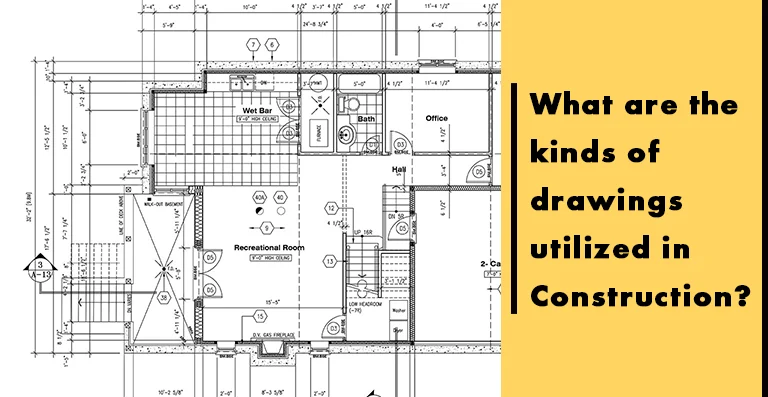
Floor Plans deal with the layout of rooms within the building, i.e., how various sections of a floor, such as the location of rooms, stairs, kitchen, etc., are arranged. They provide instructions for architects and engineers, and can also be used later for interior design.
Roof Plan
A set of drawings that provides a bird’s-eye view of the roof. They are taken from above and provide details on the roof’s size, shape, and dimensions. It also specifies the placement of various materials, such as ventilation and drainage.
Elevation Drawing
An elevation is a two-dimensional drawing of the exterior of a building. Since buildings are rarely simple rectangular shapes, elevation drawings are needed to convey their shapes, heights, etc. An elevation drawing is made considering all four directions: east, west, north, and south.
Section Drawings
A section drawing shows the view of the building as if it’s been cut in half or along any imaginary plane. It removes a selected part of the building to showcase its internal elements.
Detail Plans
They are drawings that provide information about a particular part or elements of the project. They are generally enlarged to showcase specific details, for example, the design of a door, window, or the materials used to construct it.
Explore our Architectural Construction Documentation services and see how we deliver permit-ready, bid-ready sets.
Explore Construction DocumentationMEP Drawings
MEP Drawings provide a set of drawings that detail the components of the mechanical, electrical, and plumbing disciplines. These shop drawings include guidelines, manufacturing standards, and dimensions for all components.
Mechanical Drawings
The mechanical drawings showcase the designs of the mechanical system, ductwork layouts, and its specifications, thermoset locations, air delivery rates, diffuser locations, etc. The mechanical plan shows the location of the heating, ventilation, and air-conditioning system in the building. This step is also considered very important in construction drawings.
Electrical Drawings
They provide information about electrical fixtures, the location of switches, fans, etc. It also details load calculations, wiring paths, and other interventions, such as AC or a heater. It is extremely crucial because it demonstrates the physical layout of the wires and mechanisms they connect to inside the building, as well as the outside power grid.
Plumbing and Sanitary Drawings
These drawings show the system for pumping water in and out. Pipes, pumps, and drains, along with their nature and size, are shown in the drawings. It also shows the process to connect each fixture.
Explore our MEP Shop Drawings services and see how we deliver installation-ready details for every system.
Explore MEP Shop DrawingsStructural Drawings
The structural drawings are the engineer’s drawings and focus on the building’s structural aspects. They are the backbone of the building and contain every minute aspect and description, such as materials, standards, techniques, and so on, required to carry out the work. A key part of any structural building is the general note, which focuses on the codes and laws governing the building.
Column Layout
It determines the design, pattern, and location of each column in the structure. This plan is made floor-wise and also specifies that the spacing should be between two columns. It guides contractors in making sense of the whole building.
Plinth Beam Layout
Plinth beams are structural elements that are crucial to the building’s support system. These, too, are made floor-wise and give information regarding dimensions, position, and section of the plinth beam.
Lintel Beam Layout
Lintel Beams provide support to part of the building made above windows and doors. In these drawings, the numbers, positions, and dimensions of lintel beams on each floor are mentioned.
Roof Beam and Shuttering Layout
A roof beam is installed at the top of the building to support the roof. It is generally made from wood, but can also be made from steel or concrete. These drawings show the reinforcement of the roof beam and its sections and shuttering details.
Roof Slab Layout
The main purpose of this drawing is to provide a detailed account of floors, roof faces, and other surfaces that require accurate edge information. It also provides information about its sections and openings, for example, for installing starlight or stairs.
Summing Up!
Whether it is an Architectural Construction set or detailed MEP Shop Drawings, these documents form the critical blueprint for any successful project. Overlooking any of these steps can lead to costly on-site errors and disastrous delays. Fortunately, the industry has moved far beyond pen and paper into a highly collaborative digital ecosystem. By leveraging AutoCAD for 2D drafting and advanced BIM platforms like Revit and ArchiCAD, modern AEC professionals can generate these vital drawings with unprecedented speed, precision, and efficiency.
Explore our full range of CAD services designed for architects, engineers, and contractors.
Explore CAD Services