In 2026, there will never be more advanced BIM workflows. The real-time collaboration, AI-assisted clash detection, and digital twins are becoming a routine element of contemporary projects. However, with this advancement, there remains one problem that persists in almost all teams, and that is: how much to model and when. Others fail since all the models are over-modeled too soon, the design process is slowed down, and unwarranted revisions are created.
Some projects run into trouble because everything is over-modeled too early, slowing the design process and creating unnecessary revisions. Others suffer because models lack sufficient detail for proper coordination, leading to clashes and confusion later. In both cases, the root cause is the same: a poor understanding of Level of Development (LOD).
The reality is that LOD is not just a BIM standard to define and forget. It is a decision-making framework that evolves throughout a project’s life.
- In the early stages, it supports flexibility.
- During coordination, it provides clarity.
- In construction, it defines accuracy.
See how LOD fits into the bigger BIM delivery picture — BEP, ISO 19650, and more.
Mastering BIM DeliverablesWhen chosen correctly, LOD helps teams move smoothly from concept to construction. When not understood, it may result in delays, rework, and miscommunication.
The breakdown of LOD in this blog will consider how projects operate in the field of architecture, structure, and MEP, so that you may make smarter decisions when modeling in the field.

Choosing the right LOD
Understanding LOD: It is About Reliability, Not Just Detail
Before we go discipline by discipline, let us clear up one of the biggest misunderstandings about LOD.
Many people casually define LOD as Level of Detail. In actual projects, however, LOD is less about how detailed something looks and more about how reliable the information is.
This distinction matters because, in BIM, appearance can be misleading. Two elements may look equally “finished” on screen, but their actual usability can be very different:
- One may be a rough assumption at LOD 200.
- Another may be dimensionally accurate and ready for coordination at LOD 300+.
They can be physically identical, and they are totally the opposite.
Discover why top firms are shifting to Model Development Specifications (MDS) in 2026.
Is LOD Dead? Read Here More!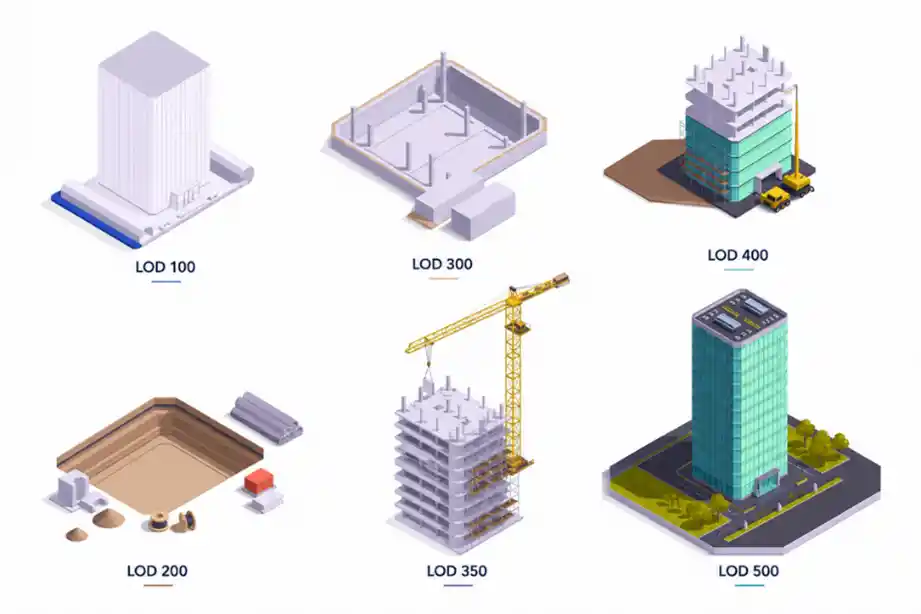
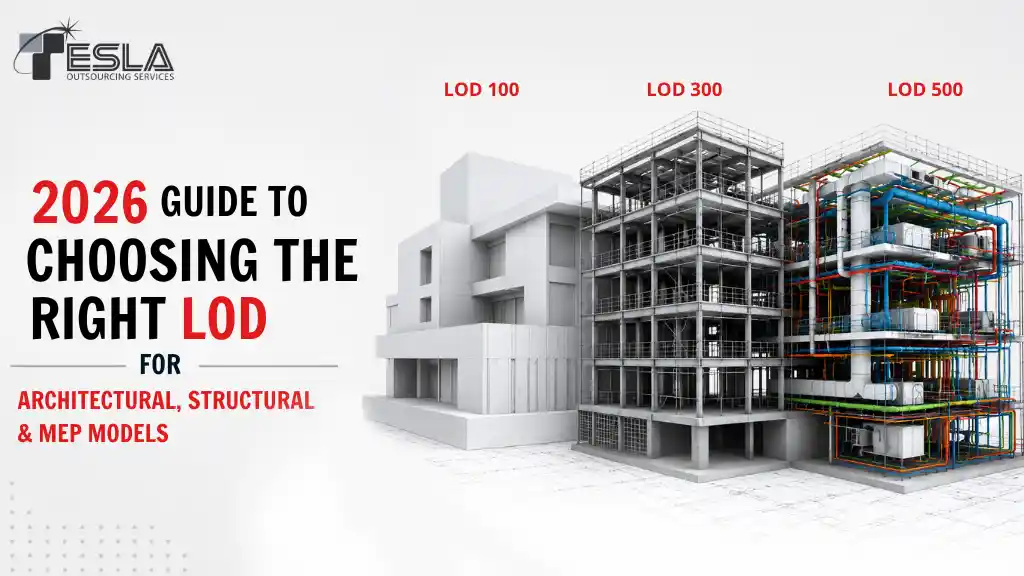
Standard LOD levels and detailing
Standard LOD Levels
Here’s how LOD typically progresses across a project:
| LOD Levels | Description |
| LOD 100 | Conceptual stage (massing, basic forms) |
| LOD 200 | Approximate geometry and placement |
| LOD 300 | Accurate size, shape, and location |
| LOD 350 | Coordination-ready with interfaces and connections |
| LOD 400 | Fabrication-level detail for construction |
| LOD 500 | As-built, reflecting real-world conditions |
Importance of LOD
LOD defines the extent to which the model can be depended upon at each phase of a project, and that degree of reliance varies as the project goes on.
- In the initial phases, it can be concluded that flexibility is more important than precision.
- During coordination, accuracy becomes essential.
- At the construction stage, there is little to no room for approximation.
The challenge begins when teams apply the same modeling approach across every phase, either adding excessive detail too early or carrying underdeveloped models too far into coordination.
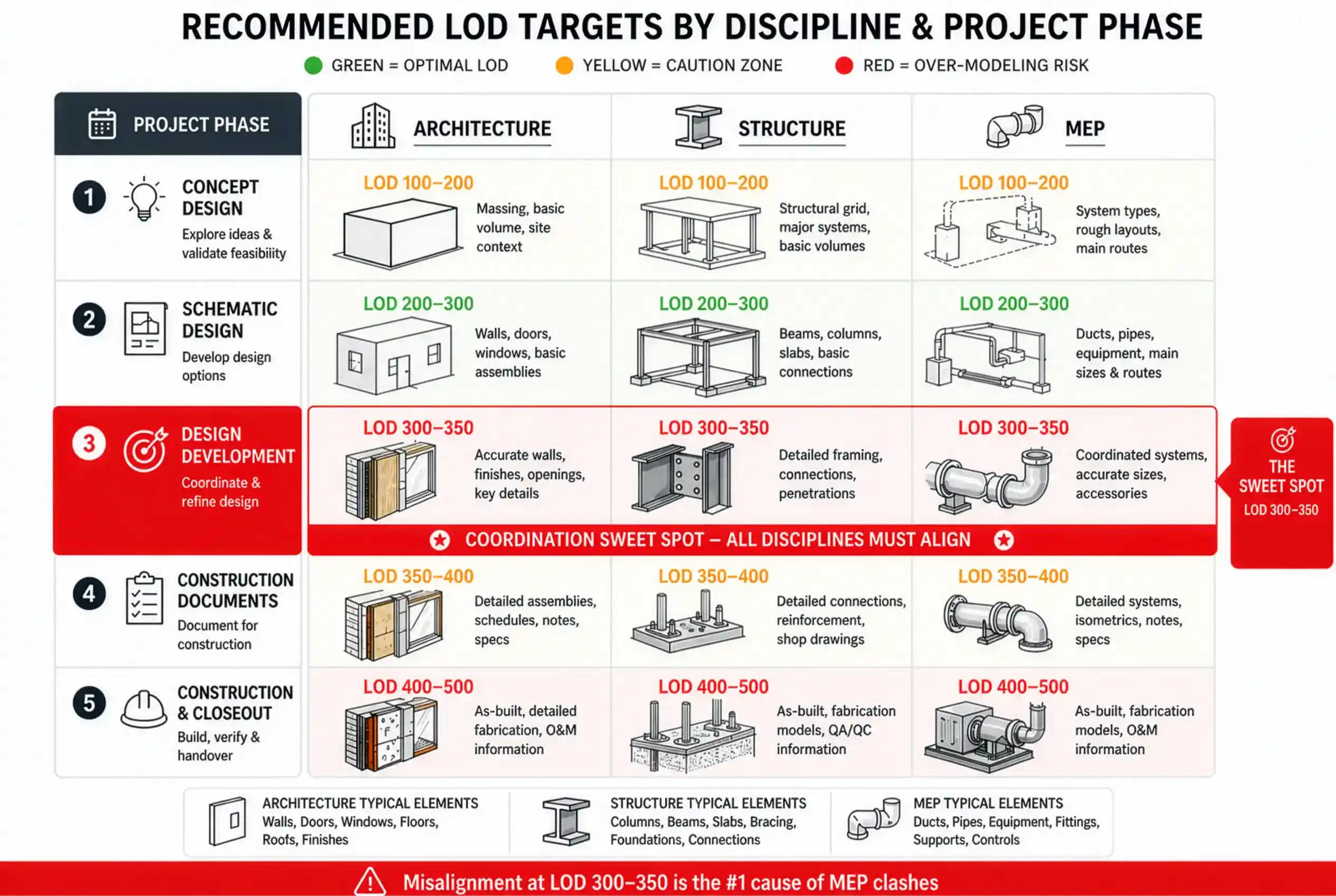
The objective is straightforward: align the Level of Development with the level of decision-making required at each stage.
Architectural Models: Do not Kill Design with Early Detail
Architectural models are usually the first to be developed and the easiest to overcomplicate. During the initial phases, it is natural that architects wish to experiment with concepts, materials, and designs. There is a danger, however, of over-detailing at too early a stage, which, besides retarding the design process, inhibits decision-making.
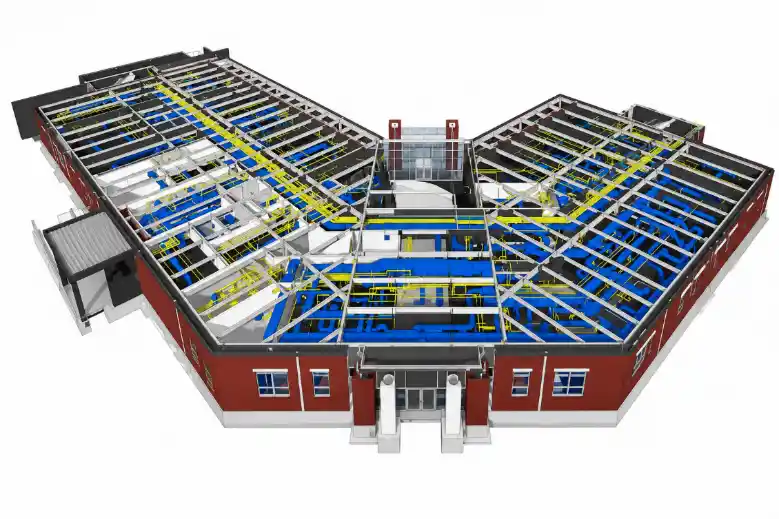
Architectural Models creating concept and design
LOD 100–200 (Concept & Schematic Stage)
At this point, the idea is to present the idea well as opposed to perfection.
- Massing models
- Basic walls and floor layouts
- Rough zoning and spatial planning
LOD 300 (Design Development Stage)
At this stage, the model begins to become reliable. This is the point where the architectural model is ready for coordination.
- Accurate wall thickness
- Doors and windows with real dimensions
- Defined room layouts
LOD 350–400 (Construction Stage)
When the design is complete, it is worthwhile to add some detail. At this point, the exploration phase is changed to implementation.
- Façade systems and layers
- Interior finishes
- Joinery and built elements
Common Mistake
A common mistake is modeling furniture, finishes, and minor details at LOD 200. Architectural LOD should increase only when key design decisions have been finalized.
This creates:
- Heavy models
- Slower workflows
- Unnecessary revisions
Structural Models: Accuracy Starts Earlier Here
Unlike architectural models, structural models cannot remain undefined for long. They establish the building’s physical framework, and every other system depends on their accuracy and stability.
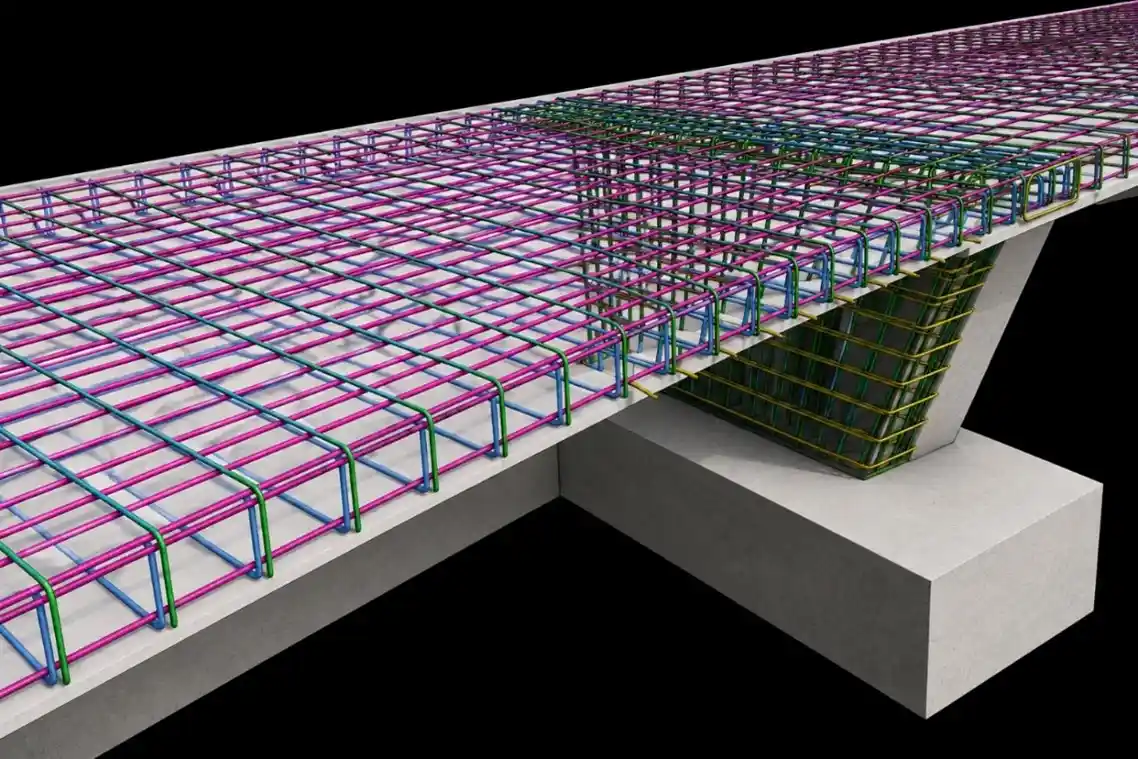
Structure Modelling building the physical framework
LOD 200 (Early Stage)
At this point, the structural system is already in place, but still can be refined.
- Grid systems
- Preliminary beam and column sizes
- Basic slab thickness
LOD 300 (Design Development)
At this point, structural accuracy becomes critical. This stage is especially important for clash detection and coordination with MEP systems.
- Exact member sizes
- Finalized framing system
- Correct positioning
LOD 350 (Coordination Stage)
Here, the structural model begins to fully interact with building services and coordination requirements.
- Openings for ducts and pipes
- Connection details
- Embedded elements
LOD 400 (Construction Stage)
At this stage, the model becomes fabrication-ready and supports construction execution.
- Reinforcement detailing
- Steel connections
- Shop drawings
Common Mistake
Structural models often need to stay slightly ahead of MEP development. If the structural model is inaccurate, every other system is affected.
This is because:
- MEP routing depends on structural openings and clearances
- Late structural changes can lead to significant rework across other disciplines
MEP Models: Where LOD Decisions Make or Break the Project
MEP is where projects become truly complex. Although small mistakes in architecture may in many occurrences be dealt with, and certain structural elements may still be modified, MEP systems work in a tight space where even small inaccuracies can result in major conflicts.
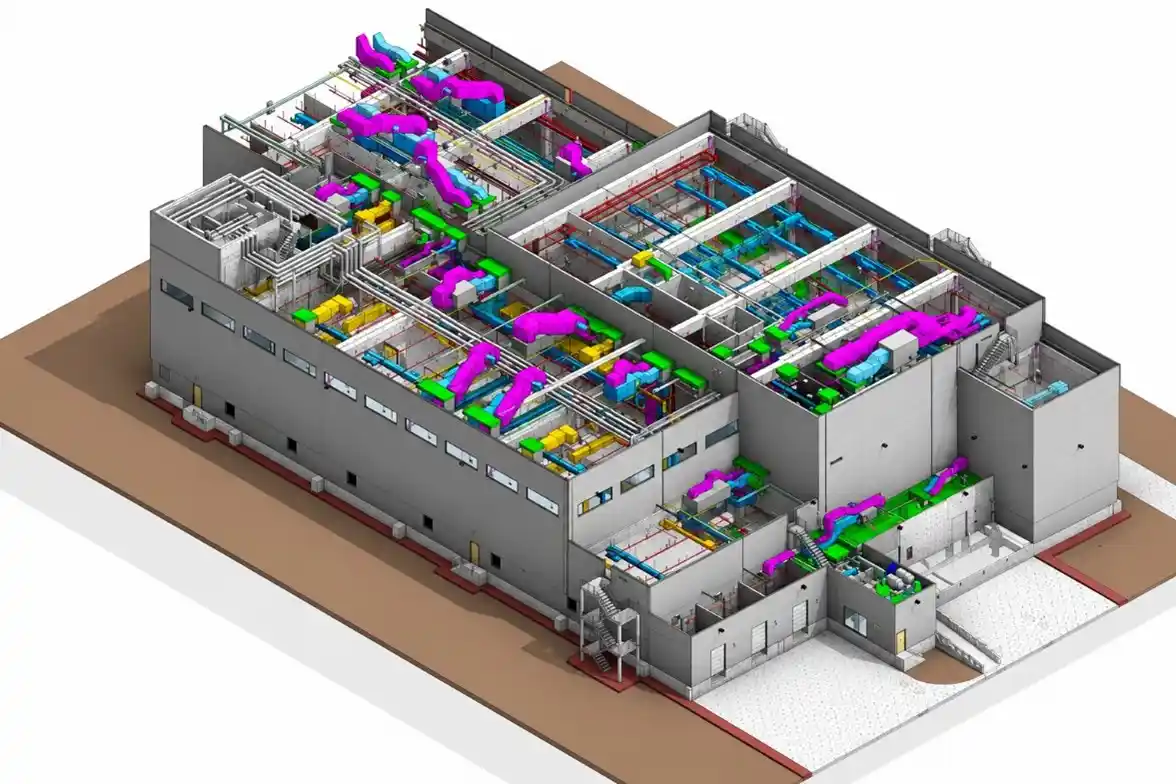
MEP modelling, the core of building
LOD 200 (Early Planning)
At this stage, the focus is on defining design intent.
- Routing zones
- Equipment placeholders
LOD 300 (Coordination Stage)
At this stage, accuracy becomes essential. This is the minimum level required for effective coordination.
- Actual duct, pipe, and cable tray routing
- Equipment with real dimensions
LOD 350 (Clash Resolution Stage)
This is the most critical stage for MEP, as it is where clashes are actively identified and resolved.
- Supports and hangers
- Clearance zones
- Penetrations through structure
LOD 400 (Fabrication Stage)
At this stage, the model includes the final level of detail required for execution.
- Spool drawings
- Manufacturer-specific components
- Prefabrication models
Common Mistake
A common mistake is jumping directly to LOD 400. Without proper coordination at LOD 350, this can result in:
- Rework
- Site conflicts
- Fabrication errors
How to Choose the Right LOD?
Instead of guessing or over-modeling, use this practical approach.
Start with the project stage.
Whether you are designing, coordinating, or building will define how much detail is needed.
Define the model’s purpose
Visualization – LOD 200–300
Coordination – LOD 300–350
Fabrication – LOD 400
Align all stakeholders early.
Architects, engineers, MEP teams, and contractors should agree on LOD expectations from the beginning.
Use an LOD matrix
Clearly define element-wise LOD, responsibilities, and purpose to avoid confusion later.
Learn the 10 most common BIM Execution Plan mistakes teams make — and how to fix them.
10 BEP Mistakes to AvoidAvoid over-modeling
More detail means more time and cost — focus only on what adds real project value.
2026 Trends Changing LOD Decisions
The way we approach LOD is evolving rapidly as new technologies and delivery methods reshape project workflows.
- Digital Twins require LOD 500 accuracy because they support operations and maintenance after construction.
- Modular Construction requires LOD 400 much earlier in the project lifecycle to support prefabrication workflows.
LOD 400 usage has expanded significantly in 2026 due to the shift toward off-site fabrication and modularization, fabricators use LOD 400 models to produce steel joints, MEP ducting, and precast slabs to exact dimensions-SOURCE
- AI & Automation perform best with structured LOD 300–350 models, helping teams improve clash detection efficiency.
- Cloud Collaboration depends on consistent LOD standards across teams, reducing miscommunication and improving coordination.
Conclusion
The point is that LOD does not imply the appearance of a model that will be more impressive; it is about making the whole project work better. When strategically used, they enable the architects to be free in their design, they enable the engineers to coordinate with confidence, they enable the MEP teams to solve clashes before they become expensive issues, and they enable the contractors to understand what to do to build efficiently. The real value of LOD: not creating heavier models, but creating smarter ones, which will help to make better decisions at every stage of the project.