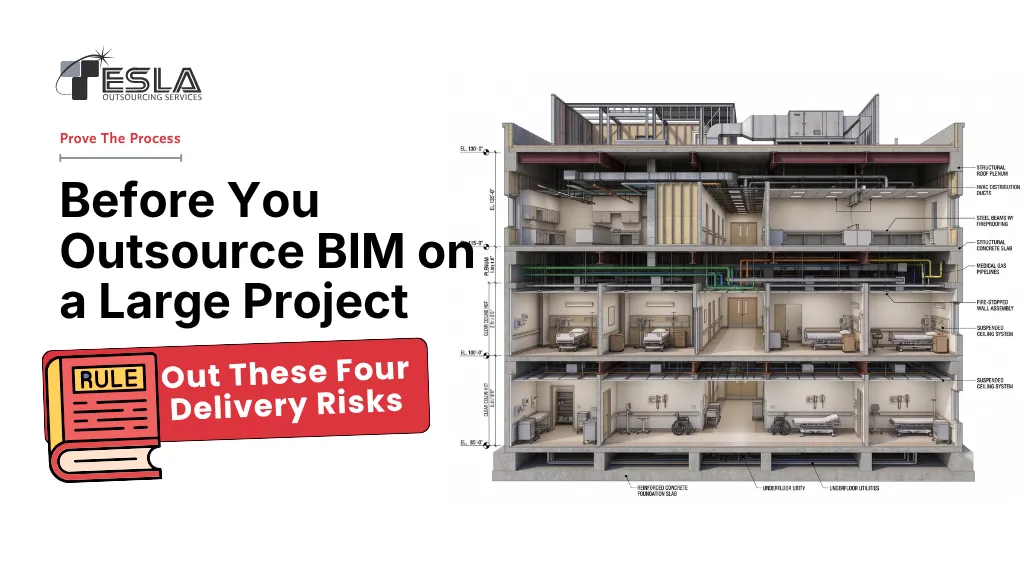
On a large project, outsourced BIM production is only useful if your team can act on it without checking it twice. When a package arrives late, is built on an outdated revision, or is unclear about who approved what, the cost lands on fabrication, procurement and site work, and on the person who appointed the partner.
On a large project, the general contractor needs to release installation zones, the specialty subcontractor needs shop drawings approved, and the engineering firm needs its documentation complete on time. When the expected support becomes another management burden, the person who appointed the production partner has to explain why. This guide helps those three buyer groups evaluate a partner for a large BIM package before they commit.
- Treat outsourcing as a delivery-risk decision, not a production-rate decision.
- Evaluate four risks separately: model integrity, schedule, contract and reputation, and capacity. Each needs evidence, an owner and a plan for when things change.
- Ask what checks are done and how exceptions are recorded, not whether the partner “does QA”.
- Write down who owns production, technical decisions, technical approval and construction release.
- Prove the proposed team on one bounded package that includes a revision cycle, and keep editable files and issue histories in scope.
Why Large Projects Change the Outsourcing Question
On a large project, one wrong input travels. A drawing error on a small assignment may be contained within one revision. Now imagine a service route developed against outdated structural geometry. The route may influence openings, supports, access panels and trade drawings, and correcting the original model does not automatically correct every downstream document.
This is why production volume alone is a weak selection measure. A partner can supply a lot of sheets, and the buyer can still spend days finding errors caused by outdated inputs, mixed revisions and unstated assumptions.
98% of US and Canadian contractors had projects with serious quality issues (errors, omissions and rework) in the last three years. Coordination problems added an average of 9% to project budgets.
Source: Dodge Construction Network, SmartMarket Brief with Dusty Robotics, 2024
What a large project buyer actually needs is the ability to:
- Review a package against agreed acceptance criteria.
- See missing information before it becomes a hidden assumption.
- Identify which decision threatens the next milestone.
- Trace a model change back to its approved instruction.
- Receive files the next project participant can use.
Price still belongs in procurement. Compare commercial proposals only after the scope, checking requirements, review effort and responsibilities are understood. Otherwise, similar quotations may cover very different services.
On a large project, the cheapest option is the expensive one.
The Four Delivery Risks to Evaluate
The four risks are connected, but each fails in its own way. A strong modeler cannot work around an undefined approval process. A named manager cannot protect a schedule if critical inputs never arrive.
Model integrity risk
Your internal BIM or VDC lead needs information that can be trusted for its intended purpose. That takes more than a file that opens and a clean clash run.
Verify before production:
- Source files, revisions, coordinates and units are correct.
- A model breakdown exposes missing disciplines or zones.
- Geometry and information requirements are agreed by element or package.
- Exports are controlled and preserve the intended model scope.
- Recorded checks and known limitations travel with every dispatch.
14% of all rework in 2020, about $88.7 billion worldwide, was caused by bad project data, from a survey of 3,900+ construction professionals.
Source: Autodesk and FMI, Harnessing the Data Advantage in Construction, 2021
A warning sign is a partner promising a clean model before reviewing the inputs. Understanding the uncertainty in the inputs matters more than adding production capacity.
Schedule risk
The project manager needs early visibility of anything that may become a blocker, and realistic commitments from the production team. Silence from a team working through a difficult revision creates more uncertainty than extra capacity resolves.
Ask for a progressive dispatch plan with review periods and escalation contacts. A useful status update names the owner, the missing decision, the affected package and the next step. Check that the plan leaves time for your own review, and that a package is not already late for release once technical approval is added.
Contract and reputation risk
The principal who signs the appointment carries this risk. The partner should operate under the same boundaries of confidentiality, ownership and permitted use as the rest of the project team.
Are you contracting with the correct entity, and can it work under your terms and conditions? Have your commercial and legal reviewers seen those terms? Is the production scope written so it does not imply approval authority for engineering or construction decisions?
Capacity risk
Operations leaders need support through workload peaks without losing project knowledge. Adding people without standards, context or review rarely helps, so ask who will review the work of anyone added at a peak.
Find out who will do the work, who will verify it, and who covers when someone is on leave. A handover process for staff changes should be part of the delivery plan.
45% of US contractors named worker shortages as the leading cause of project delays in 2025, and 92% reported difficulty hiring for open positions.
Risk Ownership and Evidence
Each risk has a natural owner on the buyer’s side. Give that person the evidence list below and let them sign off their part of the shortlist.
| Risk | Typical buyer owner | Evidence to request |
| Model integrity | BIM or VDC lead | Input audit, project checklist, QA records, sample native files |
| Schedule | Project manager or executive | Dispatch plan, review periods, open RFI register, escalation route |
| Contract and reputation | Principal or commercial lead | Entity details, NDA, agreed scope, responsibility boundaries |
| Capacity | Operations or department lead | Named team, allocation plan, cover arrangements, handover process |
Is your shortlisted partner ready for a large package
Tick only what the partner has shown you in writing or on a sample, not what they have promised.
What General Contractors Should Verify
General contractors need coordination that supports construction decisions. Running clash tests is one task in that workflow. The scope should also define who assigns an issue, where decisions are made, and how changes are verified.
Clash detection, resolution tracking and federated model management across every discipline, with coordination meetings in US time zones.
Explore MEP BIM coordinationStart with the packages that carry real construction dependencies:
- Congested corridors and ceiling zones.
- Plant rooms and equipment access routes.
- Openings and penetrations before structural work progresses.
- Interfaces between trade packages and specialist systems.
- Existing conditions that affect proposed installation.
For each package, specify the required models and their revisions. List excluded systems in the register so their absence stays visible. A coordinated zone may still depend on a specialist package that has not arrived.
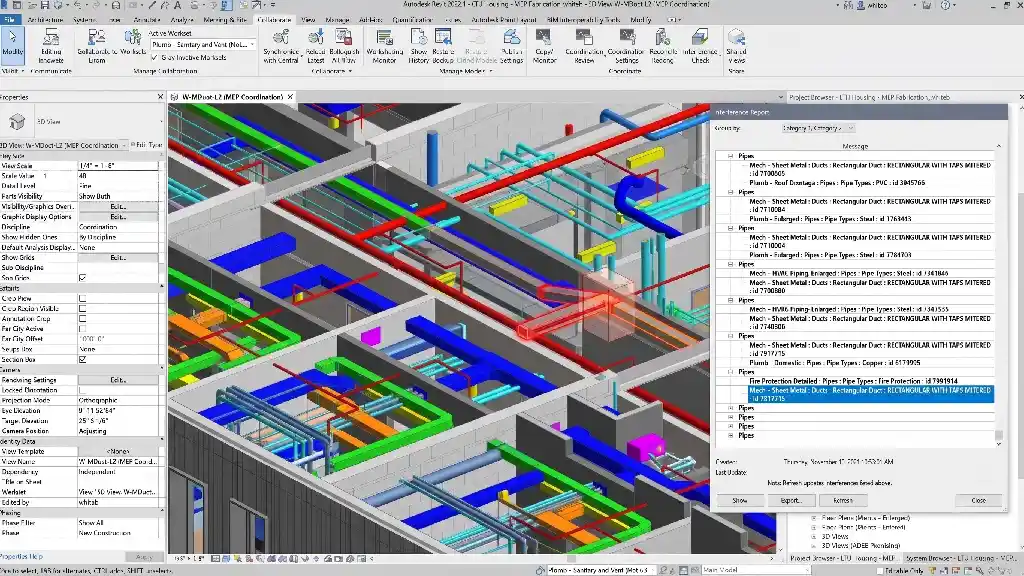
Check the complete issue history
Marking a clash as resolved does not resolve it. The author must implement the change, the required reviewer must check it, and the coordination team must check every other interface the change affects.
A clash is closed only when all five records exist
- 1Conflict and locationThe original clash and where it sits
- 2Next action ownerThe organization responsible for the next step
- 3Solution and reviewThe proposed fix and the technical review it needs
- 4Revised modelA reference to the updated model
- 5Closure checkVerified, with any accepted residual limitation
Keep construction release with the authorized project parties. The outsourced team should produce the work and the evidence behind it, exactly as your in-house team would, but it should not give approvals that were never assigned to it.
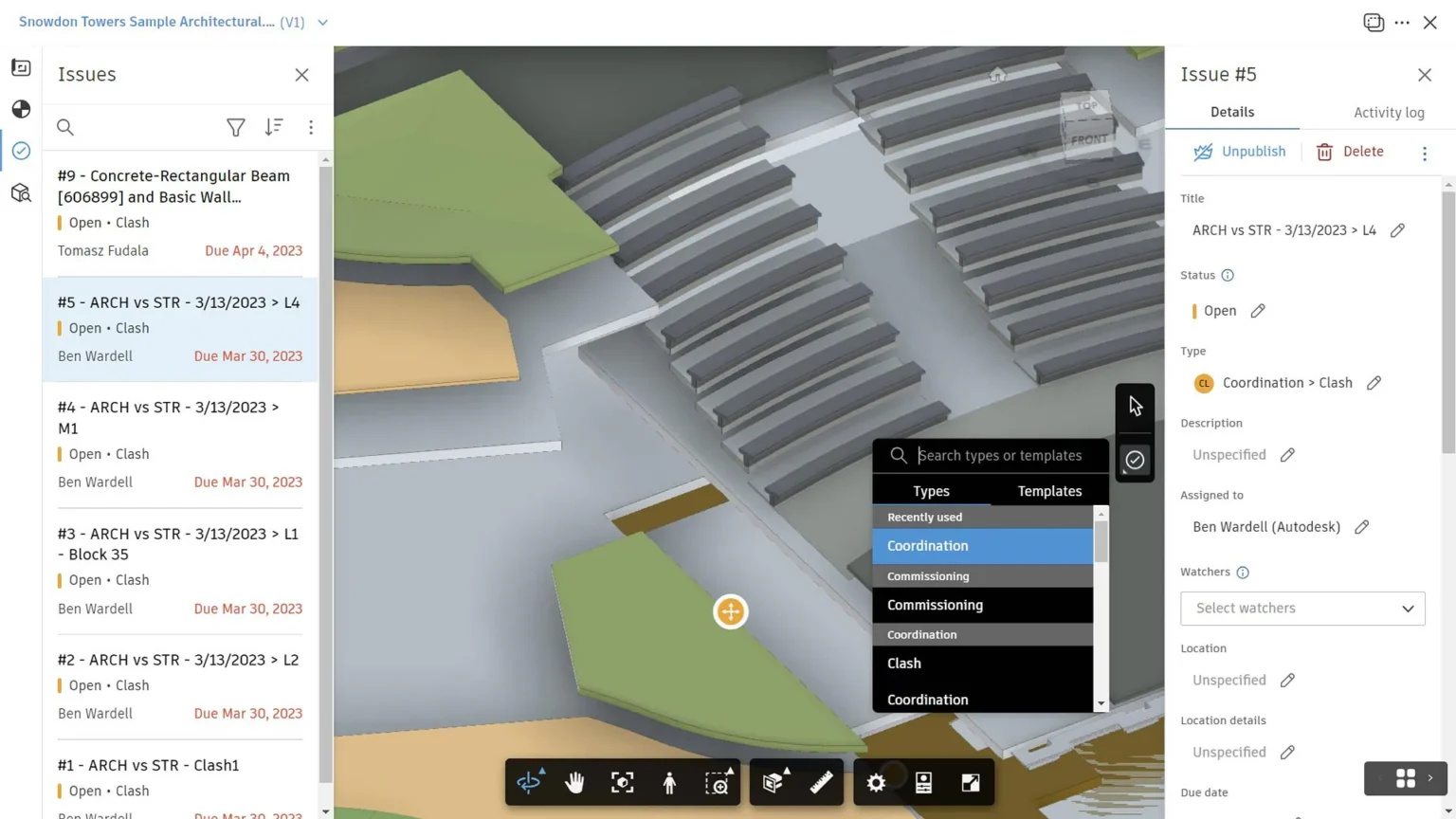
Traceable issue ownership – AUTODESK
What Specialty Subcontractors Should Verify
Production support needs to understand the subcontractor’s trade and what happens to the information next. A coordination model, an approval drawing and a fabrication deliverable are not interchangeable outputs.
Write down which services the partner will provide:
- Trade modeling from agreed engineering and vendor inputs.
- Shop drawing production and revision updates.
- Structural detailing where it forms part of the appointed package.
- MEP routing and interface coordination.
- Schedules, spool information or fabrication outputs, where expressly included.
Fabrication and installation drawings by trade, at the volume large projects generate, checked twice before dispatch.
Explore steel shop drawingsWrite down the information each task needs before it starts: product, connections, supports, insulation and installation method, for example. Preliminary geometry should stay identifiable until those inputs are accepted.
What Structural and Mep Engineering Firms Should Verify
The engineering firm keeps the key technical work and needs sustained capacity for modeling and documentation. When handing work to a production team, state clearly which activities the technical lead keeps and which move to production, such as model development, documentation updates to the latest model, and new schedules.
Confirm the following before allocating live packages:
- Templates, families, naming rules and browser organization.
- Required parameters and information exchanges.
- Instructions for incorporating revisions from the engineer.
- Responsibilities and technical approval points.
- How questions are raised, instead of unauthorized decisions being made.
Keep the engineering review process intact
Internal reviewers need a summary of the changes, a link to the updated documents, and a list of what is still incomplete. An equipment change, for example, affects layouts, connections, schedules and coordinated space.
Ongoing work across many submittals needs a dedicated team. Familiarity with your standards shortens onboarding, but changes and outputs still need to be documented and verified.
| Buyer | Main delivery need | Acceptance focus |
| General contractor | Reliable coordination for construction planning | Current federation, issue closure evidence, package dependencies |
| Specialty subcontractor | Trade information for approval and downstream production | Trade inputs, model and drawing consistency, agreed fabrication scope |
| Engineering firm | Modeling and documentation capacity under technical direction | Office standards, revision traceability, retained technical approval |
Choose Between Package Production and a Dedicated Delivery Center
The staffing model should match the work. A bounded task with stable inputs may suit package-based production. Continuing delivery across connected submissions usually needs stronger continuity of people and project knowledge.
Per sheet production is bought around defined output quantities. Buyers should still verify staffing, review arrangements and revision coverage, because the commercial unit alone does not show how a partner manages its work.
A dedicated delivery center provides named resources for an agreed term and scope. The team learns your standards and keeps supporting your projects, within the agreed allocation and service arrangements.
Which delivery arrangement fits your next package
Tick the factors that matter most on your next package. The table highlights the arrangement that fits each one.
| Factor | Package or per sheet production | Dedicated delivery center |
|---|---|---|
| A one-off, bounded output with stable inputs | Best fit | Possible, but more than you need |
| Continuing workload across connected packages | Re-scoped each time | Best fit |
| The same people from one package to the next | Confirm staffing per assignment | Named team for the agreed engagement |
| Your office standards retained without re-onboarding | Onboarding for each new team | Retained project and office knowledge |
| A named manager and defined reporting | Agreed per package | Named manager, defined reporting |
| Paying only for defined output quantities | Bought by output | Bought by resource and term |
Scaling is not just adding modelers. Before you choose, find out who manages cover, how new staff are introduced to your projects, and how quality review scales as production increases.
Capacity you can plan around: A dedicated delivery center, badged as yours. Deploy within 48 hours of scope being agreed.
See how the DRA worksVerify Quality Through the Checking Process
Quality needs a visible method. Ask the partner to show how requirements become checklists, how exceptions are recorded, and who decides that a package can be dispatched.
Tesla Outsourcing Services LLC checks every deliverable twice: first by the project lead, then by a separate QA team that did not produce it. Client feedback is incorporated and checked again before final dispatch. Each engagement starts with a project-specific checklist, built on a 319-check set mapped to US, UK, European, Australian and Canadian standards.
Whoever you shortlist, make sure the same steps will be applied to your package, not only described in a proposal.
Four checks before a package reaches you
- 1Project checklistStandard checks plus your office requirements
- 2Project lead checkAgainst the checklist, before anything leaves the team
- 3Independent QAA team that did not produce the work
- 4Feedback recheckYour comments incorporated and checked again before final dispatch
Use a checklist written for your project
A generic checklist usually needs to be supplemented with the terms of the engagement, the project’s BIM execution plan, the team’s templates and the deliverables the appointment requires.
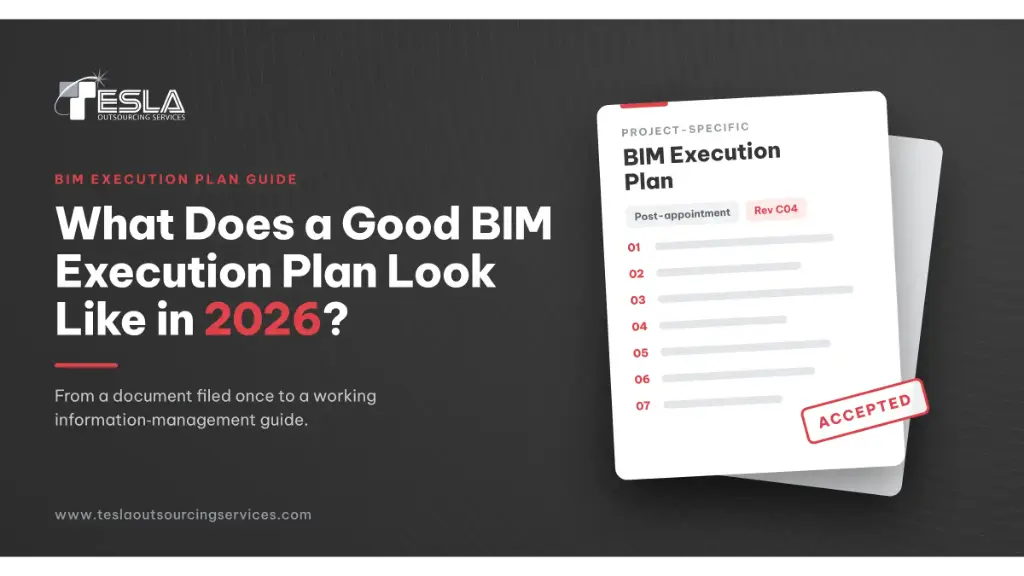
Your project checklist should start from the BEP. See what a working BEP includes, section by section.
What does a good BIM execution plan look like in 2026Useful check categories include:
- Input revision and model completeness.
- Coordinates, units and model organization.
- Geometry and required information.
- Model-to-drawing consistency.
- Coordination exceptions and unresolved RFIs.
- Export settings and dispatch contents.
Make Information Management Work in Daily Delivery
Standards language should connect to observable behavior. Ask how inputs are identified, how work in progress is kept separate from deliverables, and how outdated revisions are kept out of use.
The practical checks are straightforward:
- A current register of inputs and deliverables.
- Agreed naming, revision and status conventions.
- Defined permissions and exchange locations.
- Recorded review and approval steps.
- An accessible history of decisions and superseded information.
ISO 19650 alignment should be explained precisely. TOS states its position plainly: delivery is aligned to ISO 19650 information management practice, TOS does not currently hold ISO 19650 certification, and it will not imply that it does. Require the same clarity from every shortlisted partner. A claim about a standard is no substitute for a demonstration of the workflow on your project.
“Aligned to ISO 19650” and “holds ISO 19650 certification” are different claims. Ask which one a partner is making, and for evidence of the workflow either way.
Agree on the Delivery Process Before Mobilization
An effective delivery process gives the buyer useful checkpoints throughout production. It should reveal missing inputs early and create chances to review completed work before the final submission.
Three stages, three buyer checkpoints
- 1InitiationNDA, named contacts, input review, scope and resource plan. You confirm inputs, responsibilities, acceptance criteria and the dispatch plan
- 2ExecutionKickoff, production, RFIs, progressive dispatch, lead and QA checks. You review representative outputs and resolve priority decisions
- 3CloseFeedback incorporated, changes rechecked, final dispatch and handover. You verify accepted outputs, open exceptions and editable records
Separate responses from completed resolutions
A response confirms ownership and the next action. A resolution may need engineering input, vendor information or a client decision. Agree the difference before you measure performance. TOS commits to a 24 hour response from the named project manager; confirm the working arrangements and escalation route when you define the engagement. Package completion dates need their own agreed schedule.
Use progressive dispatches
Each dispatch should identify:
- The package boundary and included revisions.
- Checks completed and review status.
- Known limitations and outstanding decisions.
- Feedback required from the recipient.
- The next planned exchange and its dependencies.
This keeps review effort tied to the production plan, and it makes a delayed decision visible before it affects several later packages.
Settle Contract and Confidentiality Questions First
Sign the NDA before sharing project information. Confirm the entity entering the agreement, the permitted use of information, and whether any additional production resources will be involved.
Tesla Outsourcing Services LLC is a US-registered entity with an office in Chicago. Buyers should still verify entity details and master service agreement readiness during procurement rather than relying on a brand name.
Have the right reviewers address:
- Scope, exclusions, deliverable ownership and permitted reliance.
- Technical authorship and authorized approval roles.
- Change instructions and additional work.
- Confidentiality and project-specific information.
- Handover, termination and continuity arrangements.
An NDA establishes obligations. Permissions, exchange procedures and access removal need their own operational checks.
Prove One Bounded Package Before Scaling
A pilot should test the real delivery workflow. Select a manageable package with representative interfaces and enough revision activity to show how the team handles change. Do not rely on an isolated modeling task if the main appointment needs ongoing coordination.
How to run the pilot
- 1Sign the NDA and share inputsOnly the trial files agreed for the pilot.
- 2Define scope and acceptanceResponsibilities and acceptance criteria in writing.
- 3Name the peopleThe manager, the production team and your reviewers.
- 4Build the checklist and planA project-specific checklist and submittal plan.
- 5Review a progressive dispatchTogether with the open RFI register.
- 6Introduce a revisionIssue a relevant input revision and watch how it flows through.
- 7Verify the closeCorrections, handover records and suitability for the next participant.
What TOS Can Show a Prospective Buyer
Tesla Outsourcing Services has 19+ years of delivery behind it, 10,000+ projects and 600+ clients. Its 150–200 architects and engineers work from a dedicated delivery center in Ahmedabad, India, with offices in Chicago, London and Melbourne.
These figures are company context. Your decision should still rest on the proposed team, relevant examples and the delivery evidence for your scope. Three projects show the range:
- Memorial Hospital, United States. A 306,230 sq ft, 14-floor hospital modeled at LOD 350 across architecture, structure and MEP in 4 weeks, held to ±15 mm of the point cloud. Read the case study.
- Everett Alvarez Performing Arts Center, California. Six disciplines at LOD 350, with clash detection and coordination meetings held in US time zones.
- McDonald’s store program, United States. About 300 stores completed ahead of deadline, 7 sheets per outlet, with a 3-step quality check on every sheet.
Frequently Asked Questions
How does a dedicated delivery center differ from per sheet production?
A dedicated delivery center provides named resources and continuity for an agreed engagement, while per sheet production buys defined outputs. In both cases, check the people actually assigned and the review process, not just the commercial terms.
Does TOS hold ISO 19650 certification?
No. Delivery is aligned to ISO 19650 information management practice. TOS does not currently hold ISO 19650 certification and will not imply that it does.
Can the partner work under a US master service agreement?
Tesla Outsourcing Services LLC is registered in the United States, with an office in Chicago. Verify the entity and the specific terms in your RFP and agreement during procurement.
How quickly can a dedicated team start?
TOS deploys dedicated resources within 48 hours of scope being agreed. Confirm input readiness, onboarding, working overlap and the dispatch schedule separately, because allocating a team is not the same as completing and accepting a package.
Who remains responsible for engineering decisions and approvals?
The parties appointed in your responsibility matrix. A production partner produces the models and drawings; technical approval, trade acceptance and release for construction stay with the appointed project parties.
Send us one package. We sign the NDA first, name your manager and team, and put the scope and dispatch schedule in writing before work starts.
Start with one package