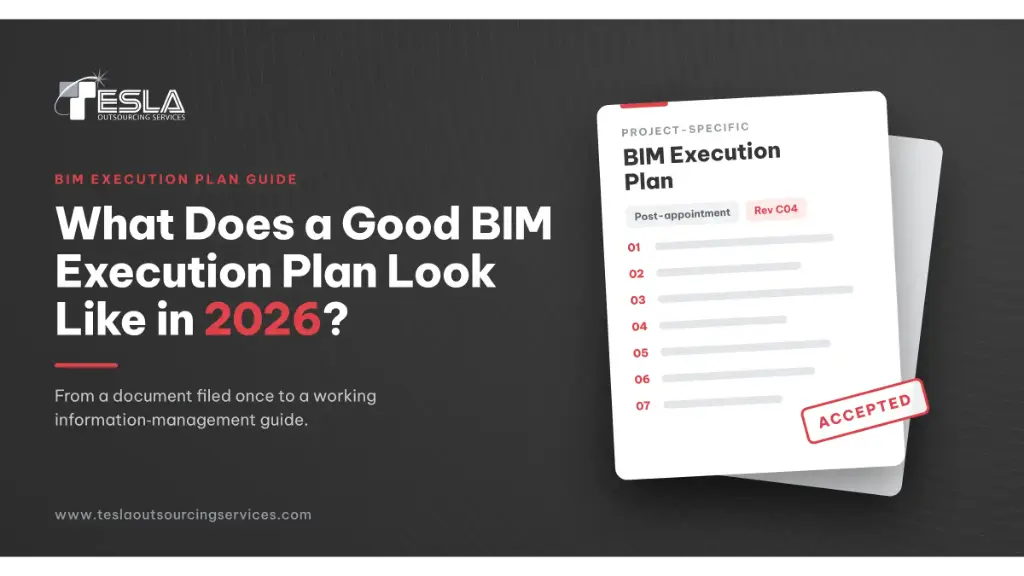
The BIM Execution Plan (BEP) is often a document that is created and then never seen again. It is therefore not delivering what it was supposed to do in terms of information management on a project.
By 2026, a good BIM Execution Plan will function as a working information-management guide, connecting the client’s requirements with the delivery activities of the project team, and listing out the software that will be used to deliver the information.
Many information management processes in design and construction have now been automated via cloud-based Common Data Environments (CDEs), data validation check processes, OpenBIM data exchange processes between applications and increased use of AI within construction workflows. Therefore, the new BIM Execution Plan must be even clearer.
What is a BIM Execution Plan
What Is a BIM Execution Plan?
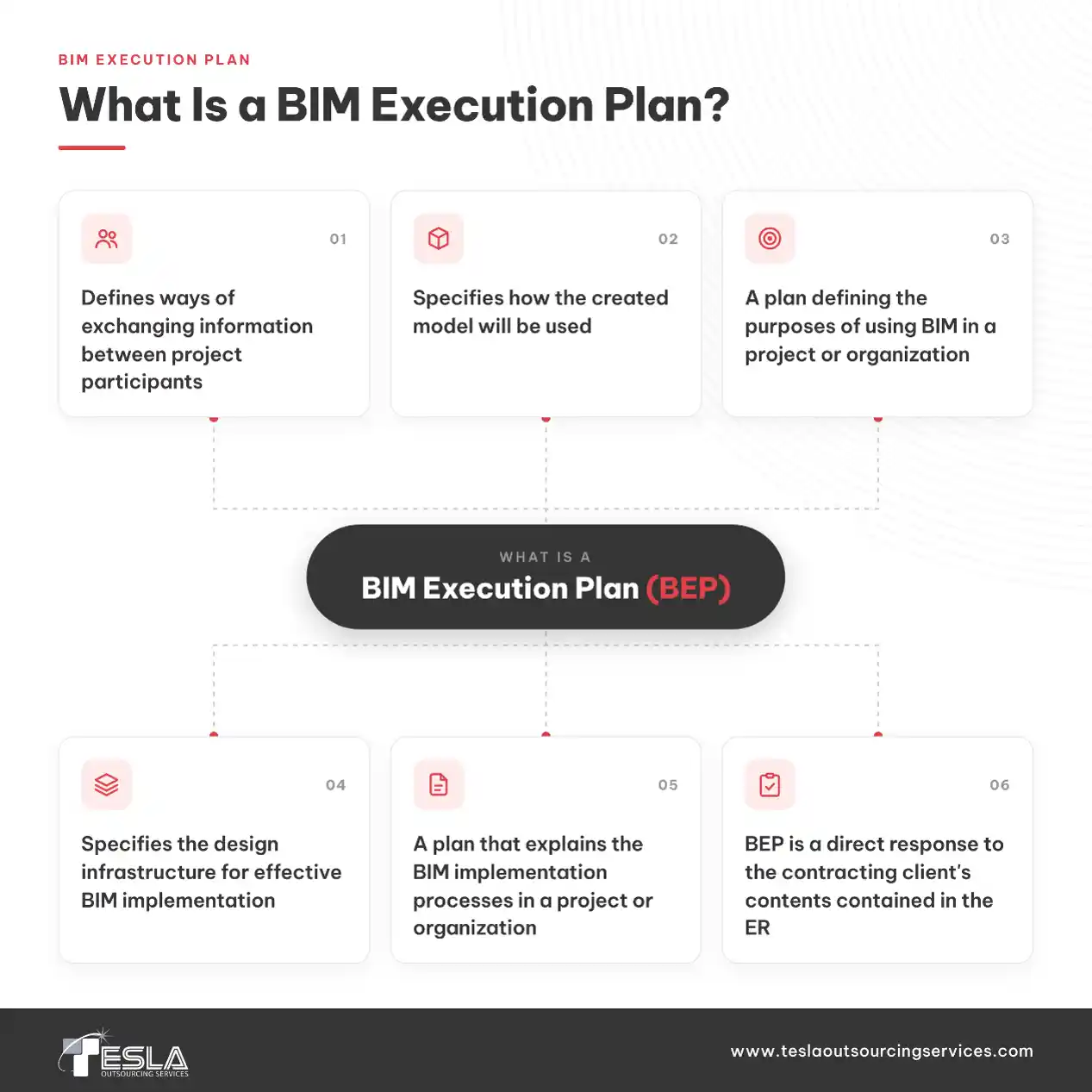
The BIM Execution Plan is a document that outlines the information management for a specific project. It details the BIM to be used on a project and the workflow of the project’s information to meet the specific client requirements for the project’s delivery.
Under an ISO 19650-aligned approach, teams may develop:
- A pre-appointment BEP outlining the proposed approach of the prospective delivery team, their capability, capacity to deliver, high-level responsibilities and federation strategy.
- A post-appointment BEP setting out the agreed ways of working after the appointment of the project delivery team and referencing the responsibility matrix, TIDPs, MIDP, CDE and project program.
The BEP does not replace the project’s Exchange Information Requirements (EIR) or other information requirements; the BEP simply describes how the agreed information requirements of the project are to be delivered by the proposed delivery team.
What Makes a BEP Effective in 2026?
The best BEPs are project-specific, measurable, and simple to use and describe the teams’ workflows as used on the project instead of only listing BIM-related terms and conditions.
A practical BEP should be:
- Requirement-led: Every important workflow should support a defined information requirement or project outcome.
- Role-specific: Clearly set out the roles and responsibilities of the producers, checkers, approvers, authors, and acceptors.
- Measurable: Model quality, information completeness, coordination status, and exchange acceptance need to be measurable using well-defined criteria.
- Interoperable: The native and open file formats shall be specified, including the version number, configuration, intended use and the validation method for each file format.
- Maintenance: Specific Person Responsible for the BEP document, with a revision history and subject to regular review and change control.
- Lifecycle-focused: Meaning the BIM Execution Plan (BEP) deals with the Construction, Commissioning, as-built, and Asset information requirements throughout the whole lifecycle of the asset.
The BEP is one part of the picture. See how LOD, the BEP and ISO 19650 information requirements fit together across a project.
Mastering BIM Deliverables: LOD, BEP, and ISO 19650 Compliance (2026)Template for a Good BIM Execution Plan (BEP)
Note that a good BIM Execution Plan (BEP) will always refer to a specific project, appointment, location, etc., and refer to local applicable standards. The following sections will be used as a starting point only and will form part of the document structure.
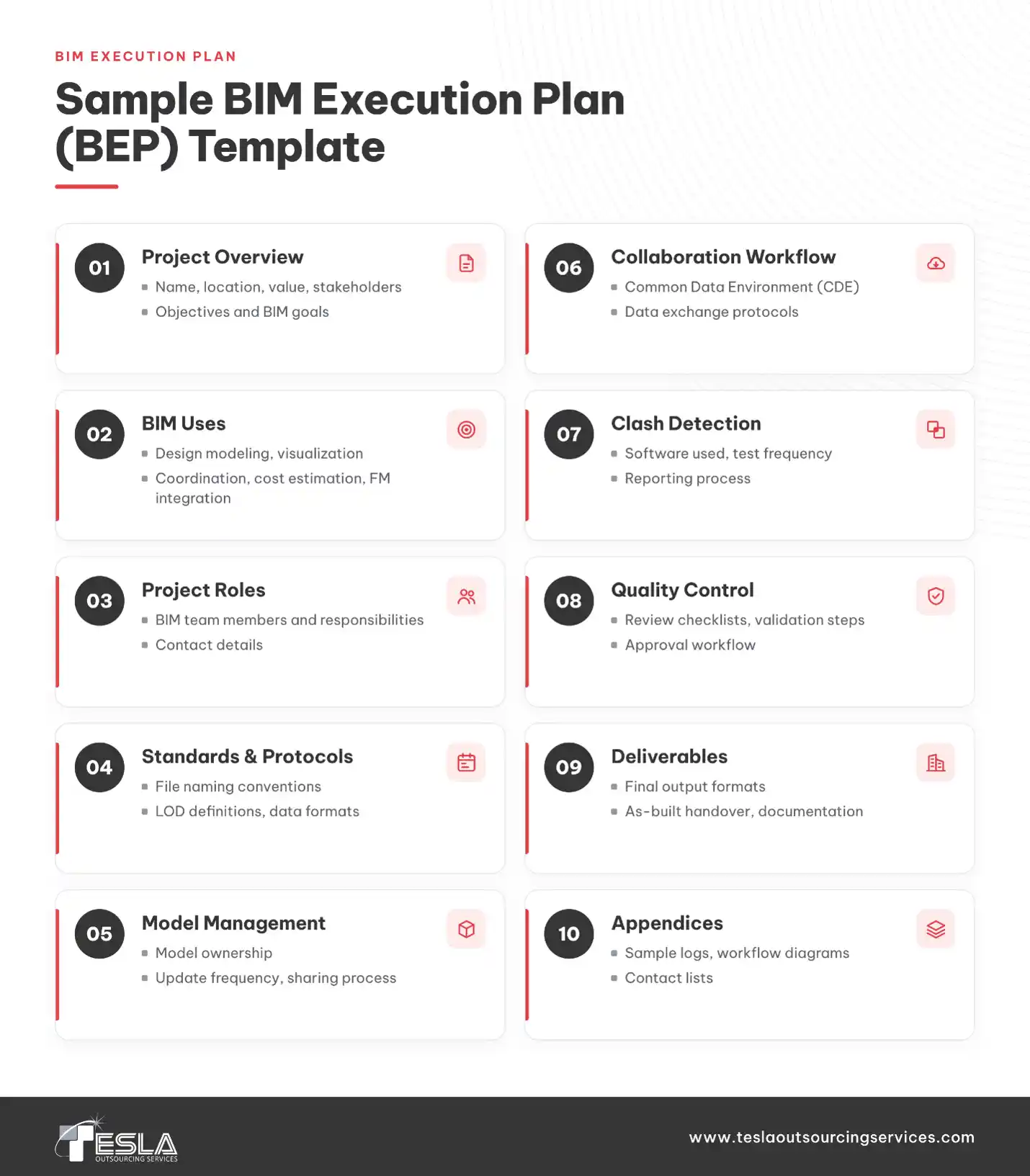
Sample Template for BEP
Document Control and Project Overview
It is important to provide the basic information about the project, such as the asset, the stage of the asset’s life cycle, the procurement method of the project, and the organizations involved. It also outlines the major milestones, project scope, and what has been excluded from the BEP. This is crucial in order to avoid converting the BEP into a company-specific guideline.
This section outlines the key points of the Project Overview. In order to make sure the BEP remains a project-specific document and does not become a generic company document, all relevant information regarding the asset, stage, procurement method, organizations, key dates, scope, and exclusions should be described.
BIM Objectives and Uses
Limit BIM uses to the actual objectives of the project. I.e., BIM design authoring and multidisciplinary co-ordination. BIM quantity take-off and 4D planning and cost planning. BIM digital fabrication and field checking. BIM progress recording. BIM asset information for operational handover. Each use has
- Design authoring and multidisciplinary coordination.
- Clash detection and issue management.
- Quantity extraction, 4D planning, and cost planning.
- Digital fabrication, field verification, and progress monitoring.
- Asset information and operational handover.
We must now list the different uses of BIM to support each objective. Each use must have an owner and we list the inputs, outputs, review process, and results for each. “Improve collaboration” is too vague to be included as an objective without also outlining specific methods and how success will be measured.
The Common Data Environment market was valued at roughly $1.45 billion in 2024 and is projected to reach $5.87 billion by 2033 – a 16.8% annual growth rate driven largely by firms trying to cut rework and formalize exactly the kind of WIP/Shared/Published/Archived workflow this section describes
Information Requirements and Delivery Planning
The delivery plan should set out to map out the required information models, drawings, schedules, reports etc. that will be required to meet the purpose of using BIM and against which delivery milestone they will be handed over.
| Requirement | What the BEP should confirm |
| Deliverable | Model, drawing, schedule, report, data set, or document |
| Responsibility | Producer, checker, approver, and accepting party |
| Format | Native, IFC, PDF, spreadsheet, COBie, or another required format |
| Information need | Required geometry, properties, classification, and documents |
| Timing | TIDP/MIDP milestone and review period |
| Acceptance | Validation rules, tolerances, and rejection process |
Make sure that your TIDPs and your MIDP remain aligned with the current project program. An updated BEP that is only reviewed prior to audit does not help support the real exchange of information.
Roles and Responsibilities
Organizational charts are not enough. Responsibility for CDE administration, model generation, model federation, CDE coordination, CDE delivery planning, QA/QC and asset data must be assigned.
Define all categories in the responsibility matrix and define the necessary escalation routes to handle late delivery, poor quality, interfacing problems and ambiguous responsibilities.
CDE and Information-Container Workflow
Simply calling a CDE platform by name does not define a workflow. The BEP needs to outline a workflow for file management within the CDE platform.
- Folder or information-container structure.
- Work in Progress, Shared, Published and Archived states where the CDE is used to manage information.
- File naming, metadata, revision, status, and suitability codes.
- Permissions and access responsibilities.
- Review, approval, authorization, and acceptance steps.
- Transmittals, notifications, audit trails, and issue records.
Will information be moved between various software platforms? If so, define the authoritative platform and how changes, approvals, etc. will be tracked and maintained by that platform.
Model Structure, Coordinates, and Federation
- BEP Purpose: To outline how models are to be separated by discipline, building, zone, level, system, work package, etc., and their respective model ownership. It also outlines the process of link management and the required frequency of model federation reviews, along with the related performance controls.
- Scope of Survey: Reference points, coordinate system, datum, unit system, rotation, and vertex levels. Verify the test point agreed upon with the Design Team to confirm that it looks right on screen and that it looks right on site.
Software and Interoperability
Approved versions of software including add-ins and file formats, plus any restrictions on upgrades, as well as processes for exporting and importing information.
IT Managed Workflows – Note that stating “IFC required” is not sufficient; it is necessary to detail the schema, purpose of data exchange, coordinates, model partitioning, property mapping, and settings. Validation of the receiving application must also be conducted during mobilization and confirmed that ISO 16739-1:2024 IFC-based data exchange is supported.
Level of Information Need
Generally, it is not recommended to assign one general LOD number to a complete discipline. The BEP should define geometry, information (alphanumeric) and required documentation for the relevant elements and systems on each milestone.
It is better to clearly identify the standard being referred to and define the project’s interpretation of LOD, rather than simply referring to “LOD 400.” A general reference to LOD 400 can leave others wondering whether it refers to fabrication geometry, parameters, documentation, or the conditions upon which reliance is to be placed.
Coordination and Issue Management
The coordination strategy outlines the model cut-off dates, the clash-check combinations to be checked, the applicable tolerances and exceptions, as well as the issues’ priority, their owner, the related due dates, check-ups and decision-making meetings and the closure confirmation.
It is better to use indicators such as the number of overdue issues with high priority, repeated clashes, unresolved issues between involved parties, closure time, and construction readiness to hand over construction information.
Simply writing “IFC required” into a BEP genuinely isn’t enough. Most Revit and ArchiCAD installations still export the 2018 edition of IFC (ISO 16739-1:2018) by default, not the current IFC 4.3 standard (ISO 16739-1:2024). Software adoption of a new ISO edition typically lags the standard itself by one to three years, which is exactly why the BEP needs to specify schema and version explicitly rather than just naming “IFC.”
Quality Assurance and Model Validation
Set out the checks to be completed before sharing or release of the information, e.g.:
- Naming, metadata, revisions, and model structure.
- Coordinates, levels, grids, links, and units.
- Warnings, duplicates, unused content, and file performance.
- Required classifications, properties, and parameter values.
- Drawing-model consistency and information completeness.
- IFC integrity and asset-data validation.
Specify each of the checks described above in detail, including method, frequency, Responsible Party, threshold for action, report, and corrective action. Automated checks are governed by a controlled set of rules while Design and Constructability Reviews are inherently dependent on professional judgment.
Automation, AI, Security, and Safety Information
For automation and AI-assisted processes, outline approved tools for use, who owns them, use of version control software, tests, human review, and auditability of output. Identify restrictions on confidential or sensitive information and ensure such use is secure.
Proportionate security measures and access controls need to be defined in the BEP based on roles of users (e.g. PMs, designers, engineers, contractors). The health and safety information as defined in ISO 19650-6:2025 needs to be classified, reviewed, shared, and handed over in a structured way where this applies.
Construction, Asset Information, and Handover
Distinguish between coordinated models and approved construction information for fabrication. Define ownership of fabrication information for shop drawings, approved-for-construction status, field-updated information, red-lined information, and as-built verification information.
Define how you will progressively develop the asset information from the point at which an asset is determined to be maintainable, through the identification of the appropriate asset identifier and associated properties (and associated documents), through commissioning and verification, to the creation of the final Asset Information Model (AIM) in the form of designated sheets within the designated CDE.
A Quick BEP Review Checklist
Before approving a BEP, confirm that:
- Deliverables are defined with an owner, and release dates, file formats, and acceptance criteria.
- The BEP matches the responsibility matrix, TIDPs, MIDP, and the Program.
- The project’s coordinates (features such as folders, data names, etc.) for the sharing of important data have been tested by the parties.
- CDE states, permissions, reviews, and approvals are clearly defined.
- Model health, coordination, and data requirements are measurable.
- Open-format exchanges include settings and validation rules.
- Construction and asset handover requirements are planned early.
- Changes and exceptions follow a controlled approval process.
Conclusion
A good BIM Execution Plan in2026 is not of great value because of the number of pages it covers. It is of value if it can be used for decision-making by the project team.
Incorporate into the BEP the necessary connections between the Information Requirements of the Project and the Roles and Responsibilities of the Team Members; between the production methods that will be adopted and the technologies that will be used; between the corresponding delivery dates and the corresponding acceptance criteria.
The BEP reduces ambiguity and improves model and data quality when used as a working delivery framework rather than a single document submitted once.