Scan to BIM Modeling has become nothing short of the rage in the construction industry today. Ever-increasing consumer demand for green buildings implies using better processes and technologies that reduce wastage and are energy efficient. To put this into perspective, consider the fact that Construction and Demolition (C&D) activities have been the largest contributors to waste generation across several countries and continents.
Why is it important to control waste?
According to the latest statistical study published by the Government Statistical Service of UK, C&D accounted for more than half (59%) of the total waste produced. For France, this figure is close to 75% while it stands at around 55% for the US. With the demand for better living and housing increasing day by day, if not controlled, these percentages have the potential to increase.
Governments in various countries have set their own targets in terms of recycling waste which needs to be adhered to. The onus of achieving this lies in the construction industry as a whole. More and more contractors are aware of the benefits that Point Cloud to BIM Modeling offers in terms of minimizing waste while calculating and segregating it.
Scan to BIM Modeling for Waste Reduction
Construction Waste Minimization (CWM) has gained a lot of traction over the past two decades. Virtual Design and Construction have been employed in new construction projects to create sustainable buildings, increase energy efficiency, and reduce carbon footprints. Several types of research indicate that utilizing Building Information Modeling during the conceptual and design developmental stages has a great potential to minimize waste. Enhanced VDC practices such as Clash Detection, MEP Coordination Services, detailing, simulation, visualization, etc. impact waste reduction by eliminating on-site rework and bringing clarity to the designs.
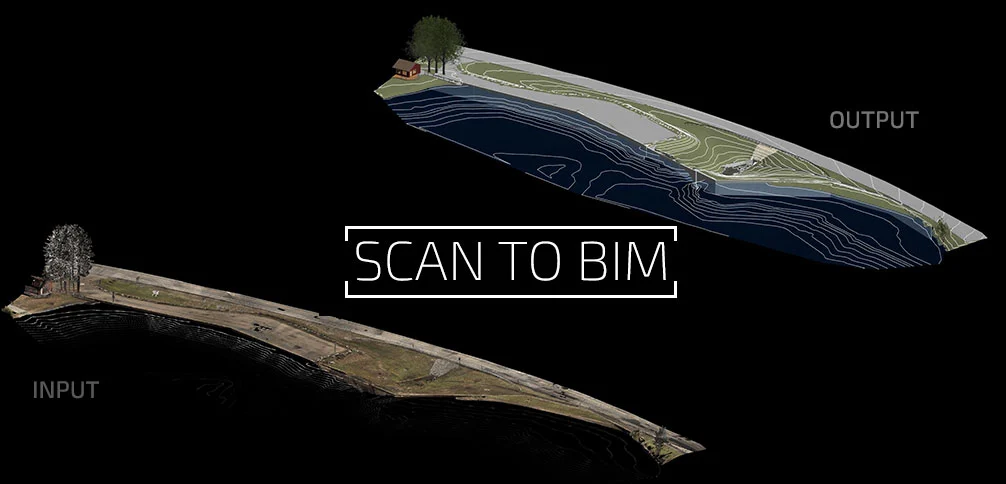
By using Scan to BIM Services, the above advantages of Building Information Modeling can be leveraged for demolition and renovation projects. The point cloud data is an as-built status of a building and the 3D model generated from these registered scans is data-rich. This model can now be used for the demolition and renovation of the building. Read our blog here to understand how this model can be further used for renovation.
Scan to BIM Modeling for Waste Management
There is ongoing research that focuses on separate project stages in order to manage on-site waste. Architectural, Structural, and MEPF BIM models that are created from the point cloud data make a preventive evaluation of waste that is generated during the demolition and renovation phase possible.
Scanning various elements of the buildings such as facades, interiors, common areas, landscape, etc., and generating a three-dimensional model that replicates all the elements of the building with unmatched precision and level of detail is now plausible. This model is complete with all the technical data such as the materials and their characteristics. From this model, it is easy to identify the need for replacement and the resultant waste can be characterized to address it in the proper recycling stream. For e.g. the MEP virtual three-dimensional model has the exact locations and material quantities of pipes tagged with it. The wastage resulting from the replacement of these pipes can be identified and channeled to the appropriate stream for either recycling, re-use, or another appropriate channel.
Closing:
The ongoing digital revolution in the construction industry has brought about a huge transformation in the way buildings are conceptualized, designed, built, managed, and renovated. Initially, BIM Modeling Services was limited to the construction of new buildings only. With the advent of high-quality scanners, the scenario is changing rapidly. An increase in awareness and stress on using environment-friendly techniques that reduce wastage during demolition and renovation of a building has seen a rise in the use of Point Cloud to BIM technology.
The ongoing digital revolution in the construction industry has brought about a huge transformation in the way buildings are conceptualized, designed, built, managed, and renovated. Initially, BIM Modeling Services was limited to the construction of new buildings only. With the advent of high-quality scanners, the scenario is changing rapidly. An increase in awareness and stress on using environment-friendly techniques that reduce wastage during demolition and renovation of a building has seen a rise in the use of Point Cloud to BIM technology.