Within the last ten years, Building Information Modeling (BIM) has ceased to be a modern design instrument, but a strategic requirement for the Architecture, Engineering, and Construction (AEC) industry. Although collaboration and visualization are among the benefits of BIM embraced by many companies, one of the most interesting reasons as to why companies engage in the adoption of BIM is its Return on Investment (ROI).
To the owners of the projects, the contractors, and the consultants, the real question is not whether BIM is useful or not, but what level of value it provides. Is it indeed possible to save money using BIM? Does it really save time on projects? And does it enhance the quality of construction in quantifiable ways?
According to many project implementations, the answer is yes. When there is a good application of BIM in organizations, there are improvements in three areas that are very critical, and they are measures:
- Cost efficiency
- Project timeline reduction
- Improved construction quality
These advantages are that BIM provides the team with a data-rich digital representation of a building, which allows the team to simulate, analyze, and coordinate before the construction starts. BIM helps teams to find out and solve problems at the design phase, which is much cheaper and easier than finding out the problems at the site.
This blog will discuss the BIM in terms of providing a quantifiable ROI using real-life success stories and practical examples.
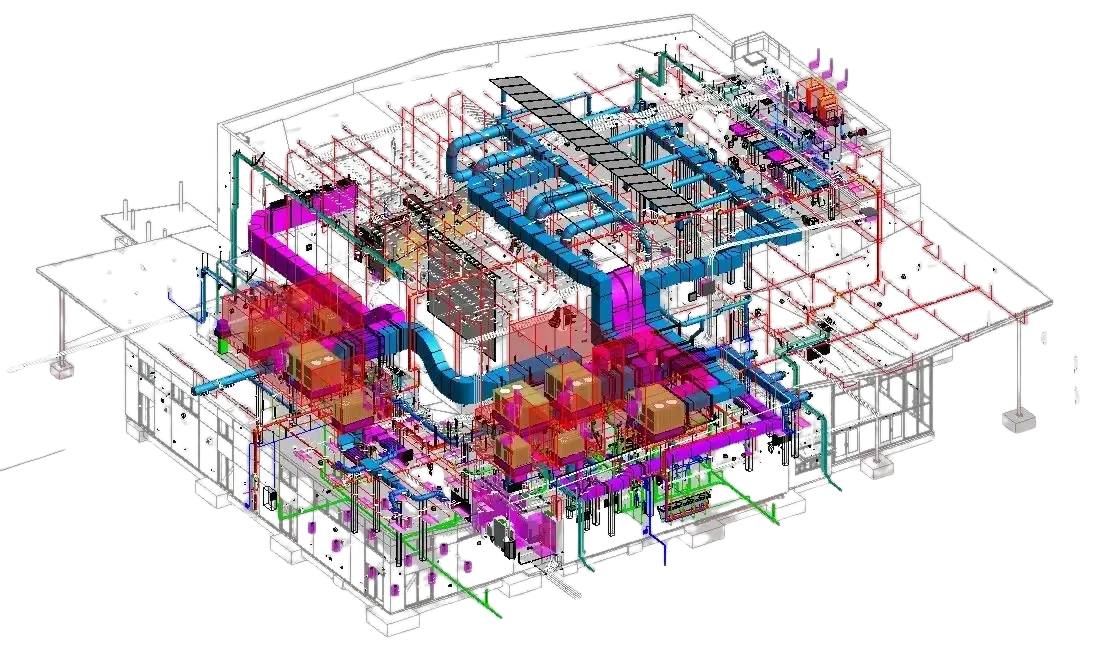
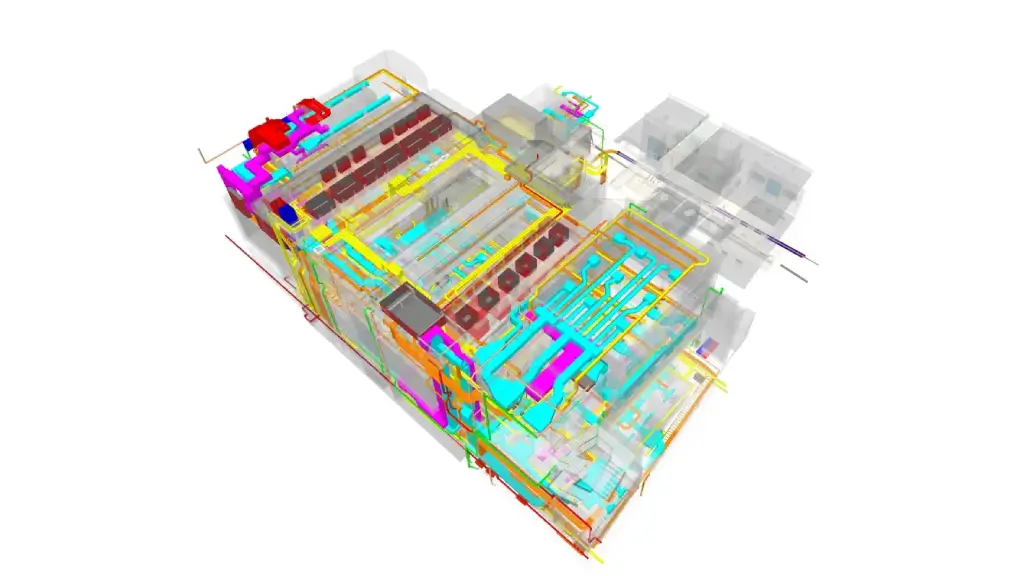
BIM Coordination Model
Understanding BIM ROI in Construction
It is necessary to know what BIM ROI is before going into detail and discussing some examples. Return on Investment in BIM is the financial and operational advantages that the organizations would have relative to the expenses involved in executing BIM workflows, software, and training.
In contrast to the conventional workflows, which are very dependent on 2D drawings and non-linear communication, BIM incorporates the project information within one smart model, which all the stakeholders can use and collaborate on. This centralized model is a common truth for the architects, engineers, contractors, and project managers.
Key Areas Where BIM Generates ROI
These measurable benefits directly contribute to higher profitability and reduced project risk. The benefits of BIM typically fall into three categories:
Cost Savings
- Reduced rework and change orders
- Improved cost estimation accuracy
- Optimized material usage
Time Efficiency
- Faster design coordination
- Reduced approval delays
- Improved workflow automation
Quality Improvement
- Early clash detection
- Better design accuracy
- Improved construction outcomes
Build smarter and eliminate rework. Learn how our expert team can support your next project with building information modeling.
View Our BIM ServicesBIM and Cost Reduction in a Project
Among the financial benefits of BIM, one can distinguish the possibility of detecting possible problems before the construction process. In the conventional construction processes, conflicts between the systems of the building are usually realized during the construction process, where the rework, delays, and change orders are costly. BIM has addressed this issue since it assists the team in building the project in a virtual setting before the real building process commences. This will help to recognize the design contradictions in the early phases and overcome them without disrupting the construction schedule.
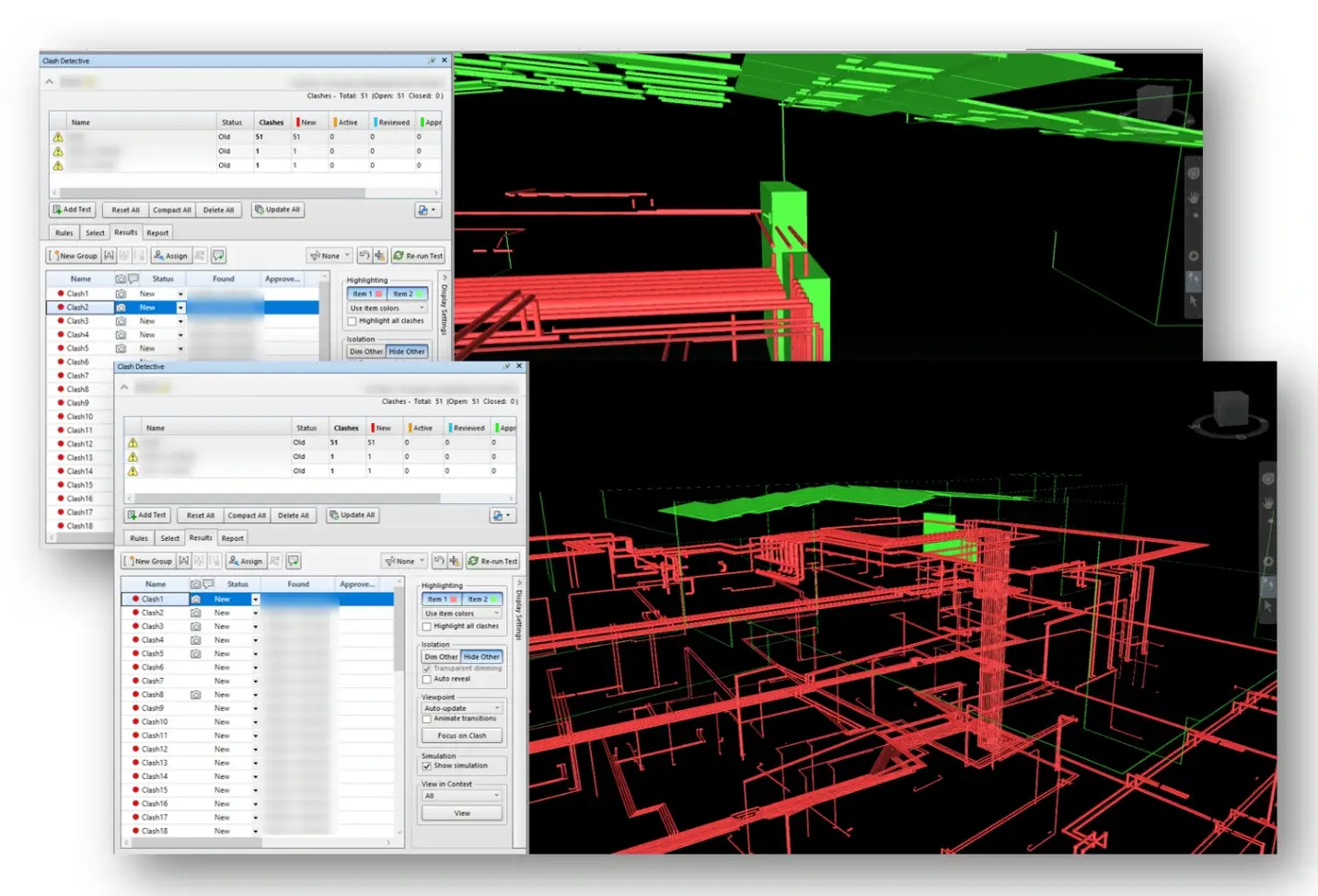
Clash Detection
Clash Detection: Preventing Rework Costs
For example, to design a commercial office in which various engineering systems (structural system, mechanical system, electrical system, and plumbing system) will have to be installed in a small ceiling area.
At the design coordination phase, the BIM model showed that one of the significant HVAC ducts was passing through a structural beam. In case this problem had been identified on-site, the contractor would have been required to:
- Stop construction
- Redesign the duct routing
- Modify the structural system or mechanical layout
This would have cost it much time and more money spent on construction. But since the conflict was detected in the BIM environment, the duct system could be diverted by the engineers at the design stage.
Catch the clash before it costs you. Ensure a conflict-free build with our specialized BIM clash detection services.
View BIM Clash Detection ServicesFinancial Benefits Achieved
According to industry research, with clash detection applied solely, it is possible to save up to 5 0 -10% of the project costs in rework costs. This is millions of dollars that can be saved in case of a large development.
- Eliminated structural rework
- Prevented costly change orders
- Reduced material waste
Precision and Accuracy in Cost Estimation
The project will be delivered successfully only with well-estimated costs. Nevertheless, the traditional techniques of estimating may be based on manual quantity takeoff of a 2D drawing that may introduce human errors.
BIM enhances estimation of costs because the estimation is model-based, and quantities are automatically drawn out of the digital model. Since the BIM models include information regarding the materials, components, and dimensions, it is possible for estimators to create more precise cost estimates by the estimators.
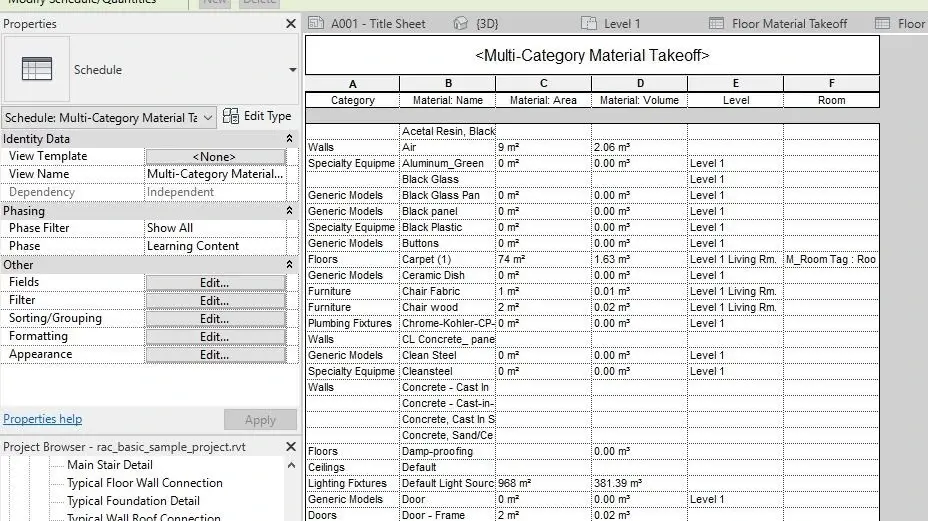
Quantity Takeoff in BIM
Benefits of BIM-Based Quantity Takeoffs
Having good information about costs at an early stage during the design phases, project teams will make good financial decisions and avoid budget overruns.
- Reduced estimation errors
- Faster cost analysis
- Improved budget forecasting
Reducing Change Orders in Construction
Change orders are one of the most significant causes of budget overruns in construction projects.
Many change orders occur due to:
- Design inconsistencies
- Miscommunication between disciplines
- Incomplete documentation
By keeping all disciplines in a coordinated digital representation, BIM will reduce these problems. Stakeholders do not work independently to update each other, and they work in a common environment, with all stakeholders being able to see updates.
BIM Minimizing the Change Orders
Reduction in change orders by products that embrace BIM is very high and thus directly enhances the profitability of projects.
- Early detection of design conflicts
- Improved coordination between teams
- Better documentation accuracy
Optimization of Material and Minimization of Waste
The construction waste is a significant element of cost in most projects. Wrong calculations of quantity and design alterations may result in wasteful purchase of materials and unwarranted wastage. To overcome this problem, BIM can assist in the accurate application of quantity and construction planning. With accurate digital models, project teams can:
- Calculate exact material requirements
- Plan procurement more efficiently
- Reduce excess inventory
Financial Benefits
BIM also helps to cut costs by optimizing the use of materials; not only this, but BIM also helps to promote more sustainable construction practices.
- Lower material costs
- Reduced site waste
- Improved resource efficiency
The Cost Benefits of BIM Adoption
Firms that embrace BIM in several projects have reported similar financial enhancement. These savings can, overall, be substantial to compensate for the investment in BIM software, training, and implementation in the first place.
The common benefits in terms of cost include:
- 5–10% reduction in rework costs
- Improved cost estimation accuracy
- Reduced material waste
- Lower number of change orders
Nevertheless, BIM is valuable in other ways than saving cost. Time efficiency and construction quality are two more significant parameters that define the success of a project. Delay and quality will greatly affect the budgets of the project, satisfaction of the stakeholders, and performance of the building overall.
Improves Project Schedules
The many people engaged in the construction work are usually a host of teams that will be operating at the same time, such as architects, engineers, contractors, and consultants. Lack of proper coordination may result in delays, design, and ineffective workflow between these stakeholders due to a lack of communication.
BIM can be used to overcome these obstacles by facilitating the development of a common digital space to which all the project participants can collaborate with a coordinated model. This enhances communication and helps the teams to solve problems at very early stages of the project life cycle.
Teams can make decisions more quickly and prevent disruptions during the construction process when they can see the whole building on the computer before the commencement of construction.
Reducing Coordination Time
As an illustration, structural, mechanical, electrical, plumbing, and fire protection systems need to be coordinated in a project with excessive service engagements.
- Previously, during coordination meetings, we had several sets of 2D drawings to look through, and this was a burden in finding clashes between systems.
- Engineers used to spend hours of manual examination of drawings to find possible clashes.
- Upon the introduction of the BIM-based coordination, the project team developed a federated model, integrating models of various disciplines into one environment.
- Through coordination meetings, teams could easily be able to see conflicts at a particular time and solve them by working together.
Time Savings Achieved
This improvement allowed the project team to accelerate the design phase and maintain the construction schedule.
- Coordination meetings became more efficient
- Design conflicts were resolved faster
- Coordination time reduced by up to 40%
Are hidden design conflicts threatening your ROI? Let our team help you build with confidence. Explore our BIM Coordination Services to see how we streamline the construction process.
View BIM Coordination Services4D BIM and Construction Scheduling
The other significant benefit of BIM is that it allows the incorporation of time-related information into the model, which is commonly known as 4D BIM. In 4D BIM processes, building schedules are connected to the computer model to model the construction process.
This helps the project teams to see the way the building will be built as time goes by. Teams do not have to use only the traditional scheduling charts; they can also analyze the construction activities in the context of the building model.
Benefits of 4D BIM
Project managers can also adjust by simulating construction activities before the commencement of the work, which can be used to avoid delays and increase project efficiency.
- Improved construction sequencing
- Better planning of site coordination
- Early identification of scheduling conflicts
Fast Decision-Making
The issue of making sure that the complex design information is made known to all the stakeholders in the construction projects is one of the challenges in construction projects. Teams may have misunderstandings when they use technical drawings as the only way of understanding. BIM models are visible in transparent 3D and, therefore, there is ease in knowing the design intent to the stakeholders. The faster decisions can be made using this better visualization because the stakeholders can easily compare design options and accept solutions.
Advantages of BIM Visualization
The project teams, therefore, spend less time explaining the design and more time proceeding with the implementation of the project.
- Improved communication
- Faster design approvals
- Reduced misunderstandings
Construction Quality Improvement using BIM
BIM also enhances the quality of construction, besides the betterment of timelines. Poor information, miscommunication, or poorly coordinated drawings are some of the mistakes involved in many construction errors. BIM reduces these risks since all the stakeholders operate on a data-rich and coordinated model. Since the model includes the correct information about the building parts, construction teams can use it to lead the way in the process of installing and fabricating materials.
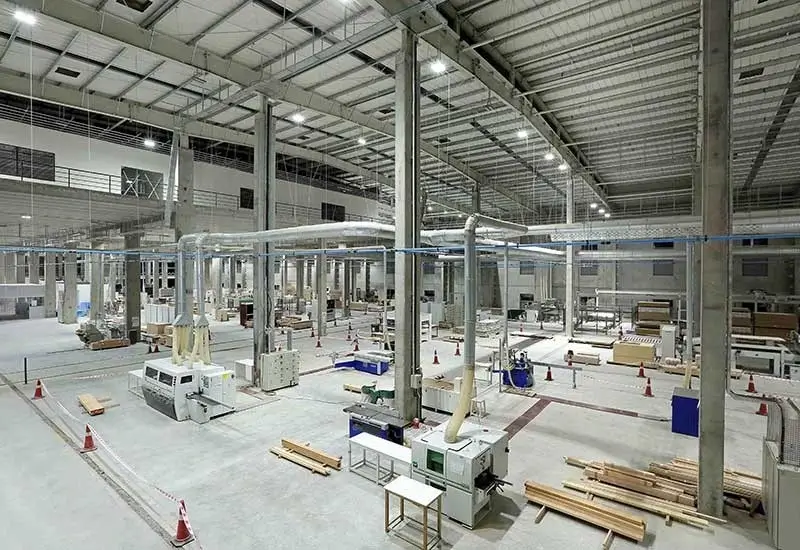
Prefabrication On-site installation
Improving Installation Accuracy
As an instance, A high-rise building construction entails the usage of BIM models to create detailed fabrication drawings on mechanical and plumbing systems. With proper dimensions and well-coordinated layouts in the BIM model, the contractors will be able to prefabricate the components of the system elsewhere. Prefabrication will enable the manufacturer to fabricate parts in a controlled condition, and this will generate more accuracy and quality.
Quality Improvements Achieved
This strategy not only enhanced quality but also helped to reduce the construction schedules.
- Reduced installation errors
- Improved fit between building systems
- Faster on-site assembly
Minimizing RFIs and Construction Errors
Request for Information (RFIs) is typical of construction projects and is usually a result of contractors being faced with vague or opposing design documentation. Construction delays can be slowed down by frequent RFIs. BIM can also minimize RFIs through the provision of coordinated project information in one model.
BIM projects normally have fewer RFIs and field conflicts, a factor that makes the construction processes run smoothly.
- Better coordination between disciplines
- More detailed project documentation
- Clear visualization of building systems
BIM Benefits across Different Project Types
The benefits of BIM cannot be applied to a single project. BIM is useful in the case of a commercial development, infrastructure project, or residential building.
Commercial Buildings
In business ventures, BIM is used to handle intricate building systems, as well as assist in the effective coordination of disciplines.
Key benefits include:
- Reduced MEP coordination conflicts
- Improved cost estimation
- Better construction planning
Infrastructure Projects
Projects like this often involve multiple stakeholders and large-scale coordination. BIM helps teams to:
- Visualize infrastructure systems clearly
- Improve stakeholder communication
- Plan construction more effectively
Residential Developments
BIM is used in residential projects to standardize the design process and prefabrication strategies. In all these categories of projects, BIM assists organizations to achieve projects more effectively and more confidently.
Benefits include:
- Faster project delivery
- Higher construction accuracy
- Reduced material waste
Ensure your project data is lifecycle-ready. Explore our latest guide to structuring BIM deliverables and mastering ISO 19650.
Mastering BIM DeliverablesLong-Term ROI
BIM is not valuable only when the building is finished. Facility management and building operations are one of the strongest benefits of BIM. The information model that is prepared during design and construction can be used as a great source of information throughout the lifecycle of the building. With this information, building owners will be in a better position to operate their facilities more efficiently and lower their operational costs. The value of long lifecycle overall continues to boost the total ROI of BIM implementation. Important information that can be accessed by facility managers through the BIM models includes:
- Equipment specifications
- Maintenance schedules
- Asset information
Conclusion
BIM has evidently demonstrated itself to be worthwhile at all phases of a building project, providing cost, time, and quality benefits, which can be measured. BIM can make teams more efficient, coordinated, and predictable in their work through reducing rework and change orders, accelerating the coordination process, and creating more precise constructions.
The most powerful aspect of BIM is that it can transform the whole project strategy as a whole; not responding to the problems that occur on-site, but addressing them even before construction starts. This not only saves money and time but also results in better decision-making and quality output.
In addition to instant project gains, BIM also introduces long-term value in the management of the facility and lifecycle performance, which makes it a smart investment and not a simple technical upgrade.
Nowadays, in the rapidly changing AEC industry, BIM is no longer a choice. It is a strategic benefit that assists organizations in producing projects that are not only faster and cost-effective but also more reliable and future-ready.
The future of construction is connected. See how AI, digital twins, and advanced aec interoperability platforms are reshaping the industry.
The 2026 AEC Technology