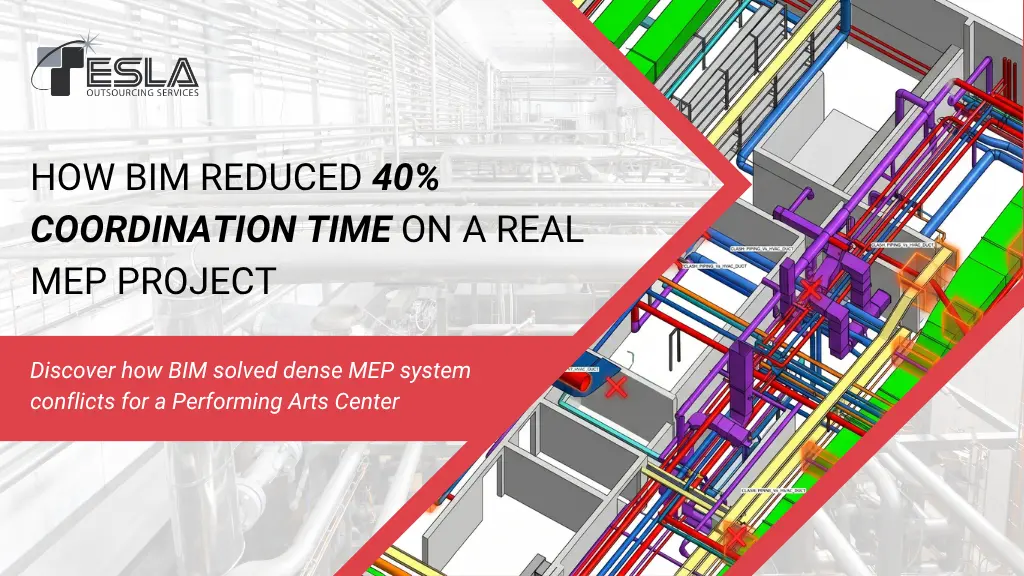
The AEC industry is entering a powerful turning point in 2026. After years of adopting BIM, cloud collaboration, and data-driven processes, this time in 2026, there is a shift with the merging of BIM 6.0. AI, digital twins, IoT, robotics, geospatial systems, and automated project delivery will now work together rather than as separate tools. These technologies are not optional and theoretical anymore. They are establishing themselves as the base of the designs that the modern AEC firms build, construct, and operate buildings throughout the asset lifecycle.
From Digital Adoption to Digital Integration
Organizations over the years used to implement digital tools in isolation: one platform to do design, another to coordinate, and another to report on the field. However, in 2026, the adoption is fragmented into integrated ecosystems. The cloud-based environment has now integrated design, construction, and facility management into a single working flow. Stakeholders operate off a central source of truth instead of moving data between tools, saving thousands of man-hours of accuracy and rework.
According to Dodge Construction Network, 66% of owners who utilize digital workflows report better-informed decision-making when managing project complexity. This data-centric shift is accelerating toward 2026, with over two-thirds of owners now contractually requiring contractors to use digital documentation to mitigate schedule delays.
Buildings Are Now Living, Responsive Systems
The meaning of building is changing. Asset sensors, digital twins, and real-time analytics enable assets to be not fixed structures but dynamic, self-monitoring systems. They can monitor their own performance, anticipate failures, optimize energy consumption, and assist owners and facility managers in making better decisions. 2026 is the year when these characteristics will not be the prerogative of the innovative pilots but the mainstream expectations.
Use of Automation and Artificial Intelligence
Artificial intelligence is reducing the time in the day-to-day workflows. The repetitive nature of construction teams is being reduced by AI clash detection and model audits, forecasted scheduling, and automated quantity takeoffs. The result is obvious, as the professionals spend less time on the issues and more time on the design quality, sustainability, and project results.
Construction Sites Are Becoming Digitally Driven
The jobsite is being redefined because robotics, AR/VR verification, automated layout systems, and real-time field coordination are taking over. It is not just on-site that construction is happening, but also in the virtual world in 2026. This type of combination helps in making decisions faster, safer, and more aligned between the office and the field divisions.
A Cultural Shift toward Lifecycle Thinking
Cultural change is perhaps the most significant change. Companies are embracing a lifecycle mentality, where the performance of assets is considered over the long term as opposed to the immediate delivery of a project. Digital models are no longer ready to be built—they are developed as long-term operational resources on which maintenance plans, financial plans, and sustainability performance are based.
BIM 6.0: The Next Evolution of Modeling & Coordination
BIM 6.0: The next evolution
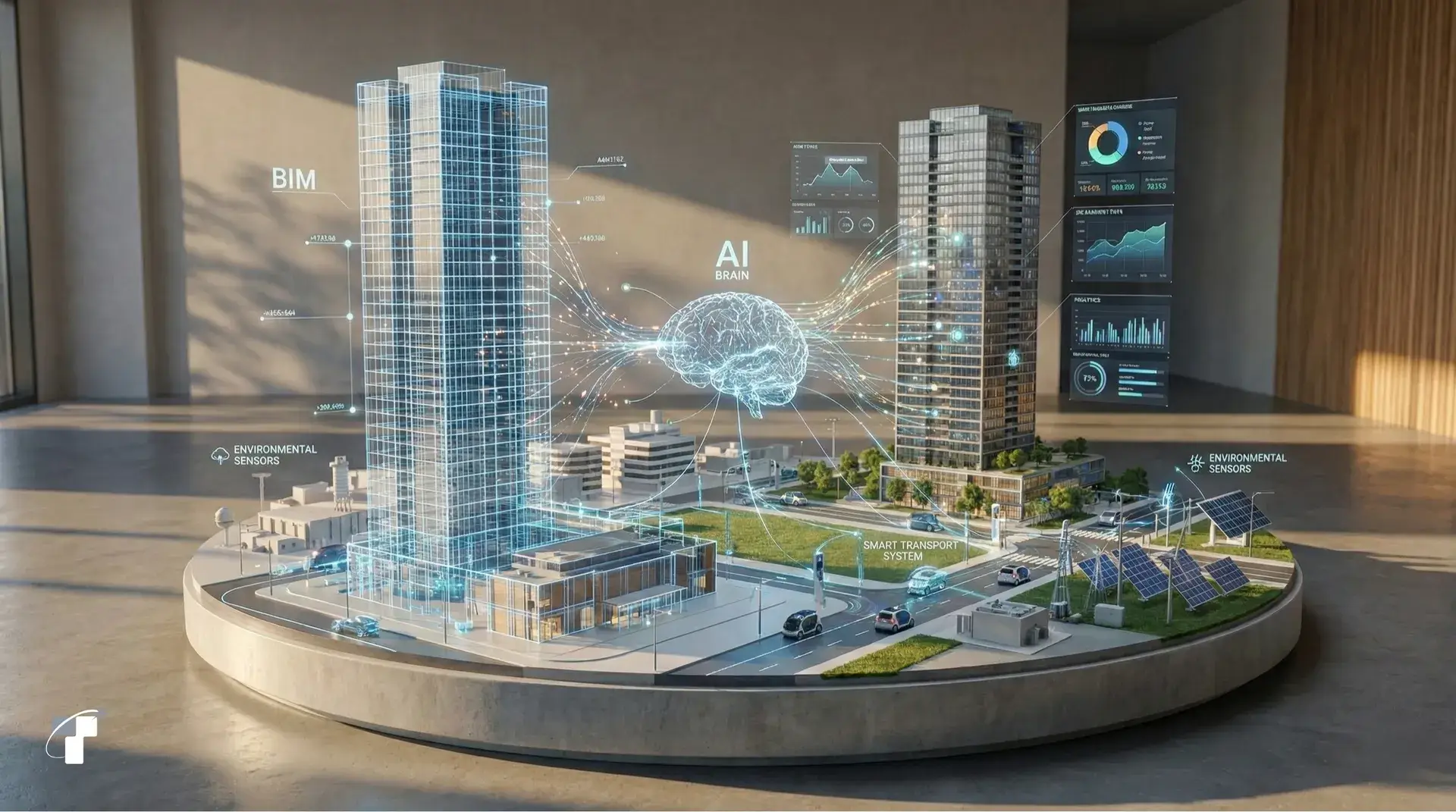
Building Information Modeling has undergone significant changes in the last 20 years, from 2D CAD to 3D coordination to 4D/5D project integration. However, BIM 6.0 is an essential standard in 2026 and a change much more reflective than any other dimension. It marks the shift of model-grounded working processes to data-based ones, from smart to robotic ecosystems. Interoperability, predictive intelligence, automation, and lifecycle continuity characterize BIM 6.0 as one of the greatest advances in the digital transformation process of AEC.
Beyond Geometry to Become a “Living Data System”
The previous BIM generations focused on modeling, clash detection, documentation, and visualization.
BIM 6.0 changes the focus:
- The model has evolved from being the final product to serving as a data-rich digital asset.
- Digital assets now include material details, energy models, operational patterns, and predictive maintenance data.
- With BIM 6.0, models stay current through IoT inputs, cloud updates, and AI insights, preventing them from becoming outdated after handover.
- AEC teams operate with dynamic, living models instead of static design files.
- The benefits extend beyond construction, offering tenants a comprehensive digital overview of facility operations over time.
AI-Assisted Modeling
Artificial intelligence cannot be separated from BIM 6.0. The AI is not applied to the clash detection or model validation anymore; it actively assists in the design, modeling, and documentation process. The important capabilities include
- It enables the creation of generative models by constraining design parameters.
- The automation features include the automatic development of details like dimensioning, annotations, and geometry for fabrication.
- It performs code compliance checks to reduce regulatory delays.
- Real-time checks of the model, such as detection of data gaps, inconsistencies in parameters, and non-compliant modeling practices.
- It helps BIM teams to free up time on doing manual work and to spend more time on problem-solving, increasing design quality and risk analysis, as well as constructability.
Interoperability and OpenBIM
2026’s projects are not bound to a single software ecosystem. The architects can do their work in Revit, the structural teams can do theirs inside of Tekla or Bentley, the contractors can work with Navisworks or Revizto, and field operations, as well as facility management teams, might manage FM systems.
Key drivers include:
- IFC 5.0, which allows more advanced data exchange.
- OpenBIM standards are becoming popular across the world.
- Cloud integrators and APIs that allow for syncing tools in real-time.
- Asset information can be discussed and used across platforms because of data schemas.
Lifecycle BIM Design
The support of the whole lifespan of a building has been seen as one of the most distinguishing attributes of BIM 6.0. As opposed to data transfers of PDFs or other non-interactive models, asset owners are now provided with an ever-changing digital asset that is enriched with:
- Metadata of equipment and assets.
- Maintenance schedules (preventive).
- Prediction of energy performance.
- Real-time IoT sensor streams and analytics of space utilization.
- Digital twin compatibility
Cloud BIM Ecosystems: ACC, Trimble, Autodesk Platform Services
In AEC, cloud transformation is no longer a question of the transfer of files to the online realm but rather the establishment of the centralized digital ecosystem, wherein models, documents, workers, and workflows are in a single location. As of 2026, cloud-first BIM systems such as Autodesk Construction Cloud (ACC), BIM 360, and Trimble Connect have become a fundamental part of project delivery with support of real-time coordination, automated data governance, and continuity of collaboration across geographies.
File-Based Workflow
The traditional BIM was based on file transfers, local servers, and scheduled updates of coordination. The cloud-first systems substitute this with continually interconnected systems where all stakeholders collaborate on the best current version of the model. It has no stores of manual sync delay, no reliance on local storage sources, and no threats of old datasets. The cloud does much more than provide a place to store models—it packages project data into fittable boxes intelligent enough to ensure the submittals, RFIs, markups, schedules, and quality logs are collectively accessible in the same managed environment.
Real-Time Multi-Disciplinary Coordination
A single model could be used by the architects in one city, structural teams in another, and field MEP engineers. Key advantages include:
- Real-time model updates.
- Cross-team visibility.
- Remote site support.
Version Intelligence
Cloud ecosystems also create strict data management controls that have not been feasible in the local environment. Features like
- Automated version tracking.
- Permission-based access.
- Record of activities of each model interaction.
- The workflow of approval is centralized.
Interoperability
Contemporary cloud BIM systems are no longer operating as silos. They interface with availability to ERP systems, IoT dashboards, scheduling applications, and fabrication software, as well as FM databases, by means of open APIs and connectors. This provides a smooth exchange of data from initial design to operational use, eliminating manual data transfers and loss of vital metadata.
Cloud Platform of AI, Robotics, and Digital Twins
The migration to the cloud is not just a change of operation, but it will equip organizations for the future of AEC technology. AI engines are based on structured datasets that are centralized. Precise and updated models are needed in robotics. Digital twins rely on a real-time connection. These advanced technologies cannot operate on a large scale without cloud-first BIM ecosystems.
The U.S. General Services Administration (GSA) now mandates ‘Single Source of Truth’ workflows through its latest Building Information Modeling (BIM) standards to ensure project consistency across the federal portfolio. This move aligns with research from the Construction Industry Institute (CII), which indicates that implementing a Common Data Environment (CDE) can reduce project rework—typically a 5–15% drain on total project costs.
GIS-BIM Convergence for Infrastructure & Urban Planning
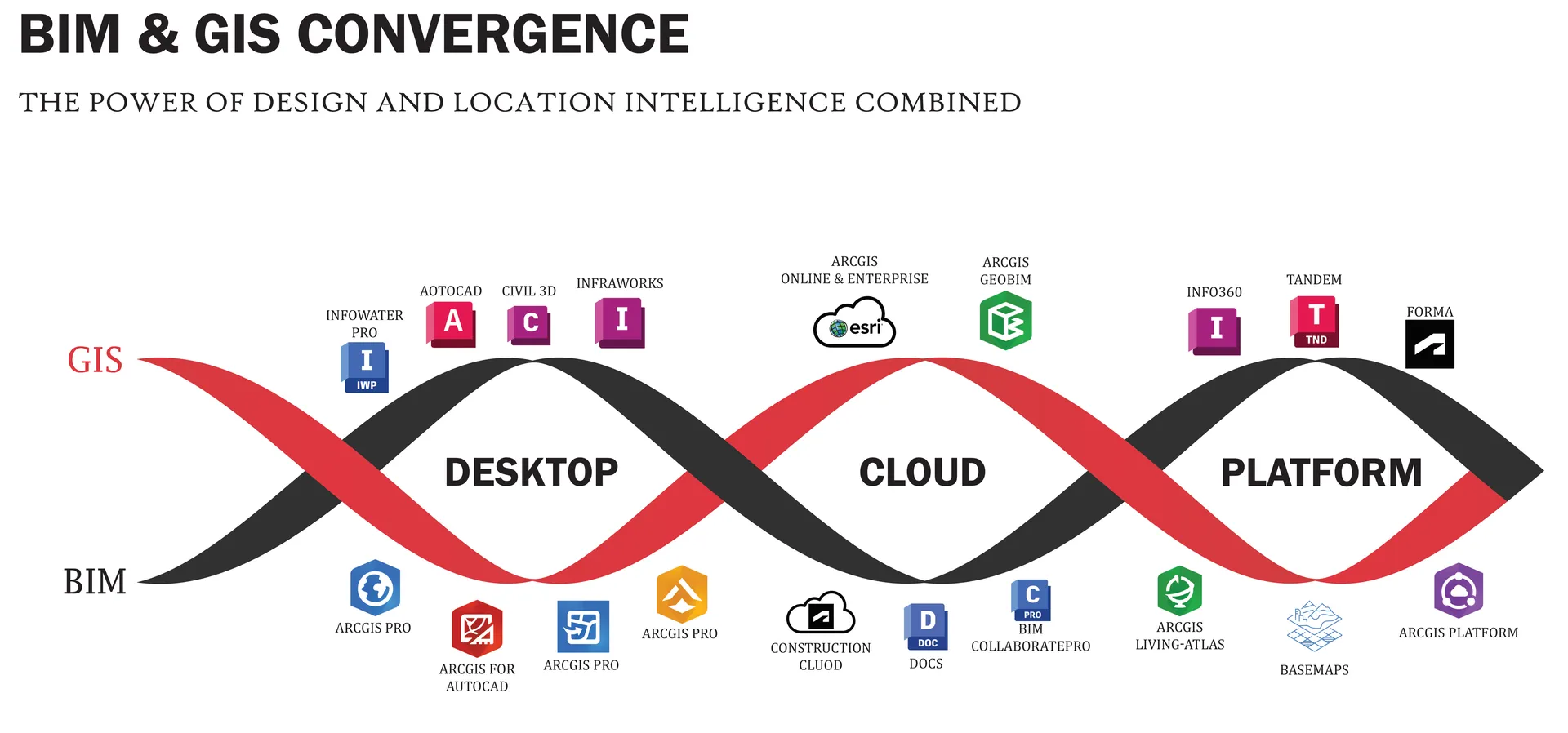
The shift of 2026 in the infrastructure business is this: the decision made by AEC cannot take place in a vacuum in the land occupied. The convergence of GIS-BIM creates bridges between the real world (geospatial intelligence) and the built world (asset-level data), creating clarity in environments improved like never before by project teams.
BIM & GIS
In the case of metro systems, highways, airports, utility networks, and renewable-energy zones, it is no longer possible to rely on traditional BIM. The center of these projects is geography. They are influenced by the environmental factors, the community influence, land limitations, and everything in between. That’s where GIS steps in. It gives you the bigger picture, lets you map all the moving pieces, and helps you manage them at a scale BIM wasn’t built for.
GIS answers questions like
- Where is the project located?
- What are most of the natural and man-made limitations of it?
- What impacts are going to be produced by reforms in one region on the rest?
BIM answers
- What exactly is being built?
- What is the behavior, performance, and connection of the asset?
Accuracy in Preliminary Planning
It is now possible to superimpose BIM ideas on actual geospatial situations. This enables:
- Proper site feasibility studies.
- Access to flood areas, slopes, soil types, and environmental hazards.
- More appropriate alignment of rail, road, and pipeline routes.
- Quick determination of alternative design scenarios.
More Reliable Infrastructure
Spatial accuracy is GIS-coded, and it favors highly coordinated designs. This leads to:
- Improved geometries of terrain.
- Credible grading and earthwork estimates.
- Smarter routing of utility.
- There will be no conflict with established underground networks.
- Massive projects experience reduced redesign.
Practical Smart City Applications
Combined GIS-BIM models are currently employed by planners of cities to simulate:
- Energy and resource demand
- Travel and transportation trends.
- Response plans to disasters.
- City heat islands and environmental effects.
Digital Twins on a City Scale
GIS-BIM convergence creates the premise of the digital twin of the region and city, which allows:
- Infrastructure health surveillance.
- Planning utility loads
- Trial of policy modification before administration.
- One unified, cross-departmental asset management.
Digital Twins: Beyond 3D Models
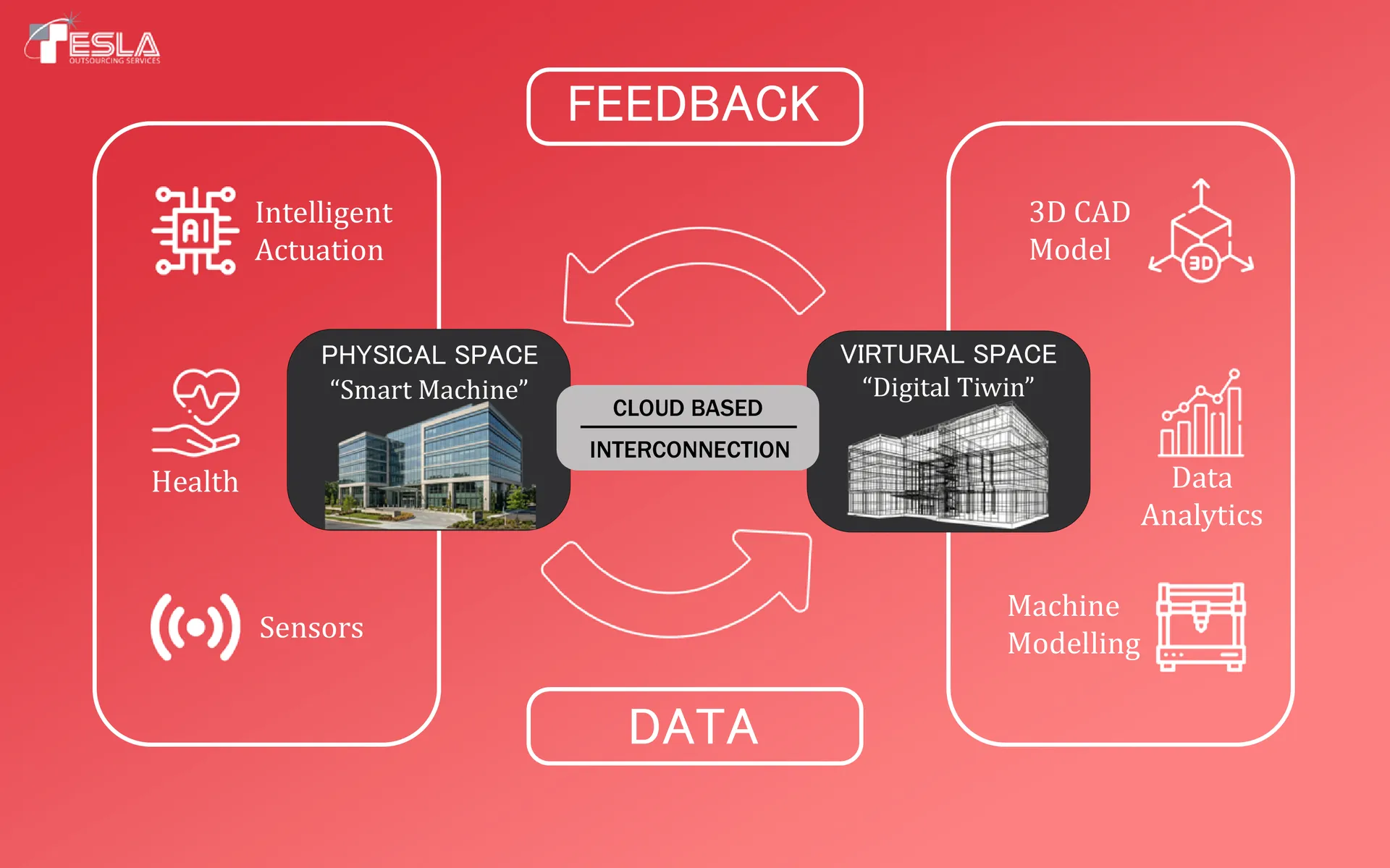
The concept of digital twins has been transformed into real-world building behavior and serves as a smart working system and functionality that reflects the conceptual digital twins. By 2026, they will provide living spaces according to constantly updating sensor information, analytics, and robotic processes. This redefines the process of monitoring, maintenance, and optimization of buildings in their lifecycle.
IoT and Digital Twin Feedback
Real-Time Operations
The current digital twins operate based on concurrent IoT data feeds. Sensors monitor energy consumption, equipment rotations, occupancy changes, and the quality of the environment at each human second. This provides facility teams with a real-time account of the health of the building to enable them to detect problems before they get out of control.
Even a minor deviation, such as a decline in performance or a surge in consumption, is called to attention immediately. Rather than waiting to be checked periodically, teams are prompt in action, and this improves efficiency, and costs are minimized.
Predictive Intelligence System
AI-powered analysis can identify the patterns of behavior and indicate warning messages at an early stage. Such as:
- When equipment starts working not as usual, the digital twin anticipates future failures.
- With this, maintenance teams can work proactively rather than relying on breakdowns.
- The structure is made easier to handle, less expensive to run, and much more dependable.
Lifecycle Support
The twin is automatically updated as space is changed or even as components are changed. This continuity abolishes the disjointed relationship between construction and operations. It also makes the surety that all the decisions are informed by right, up-to-date information, be it in terms of budgeting, renovations, or energy enhancements.
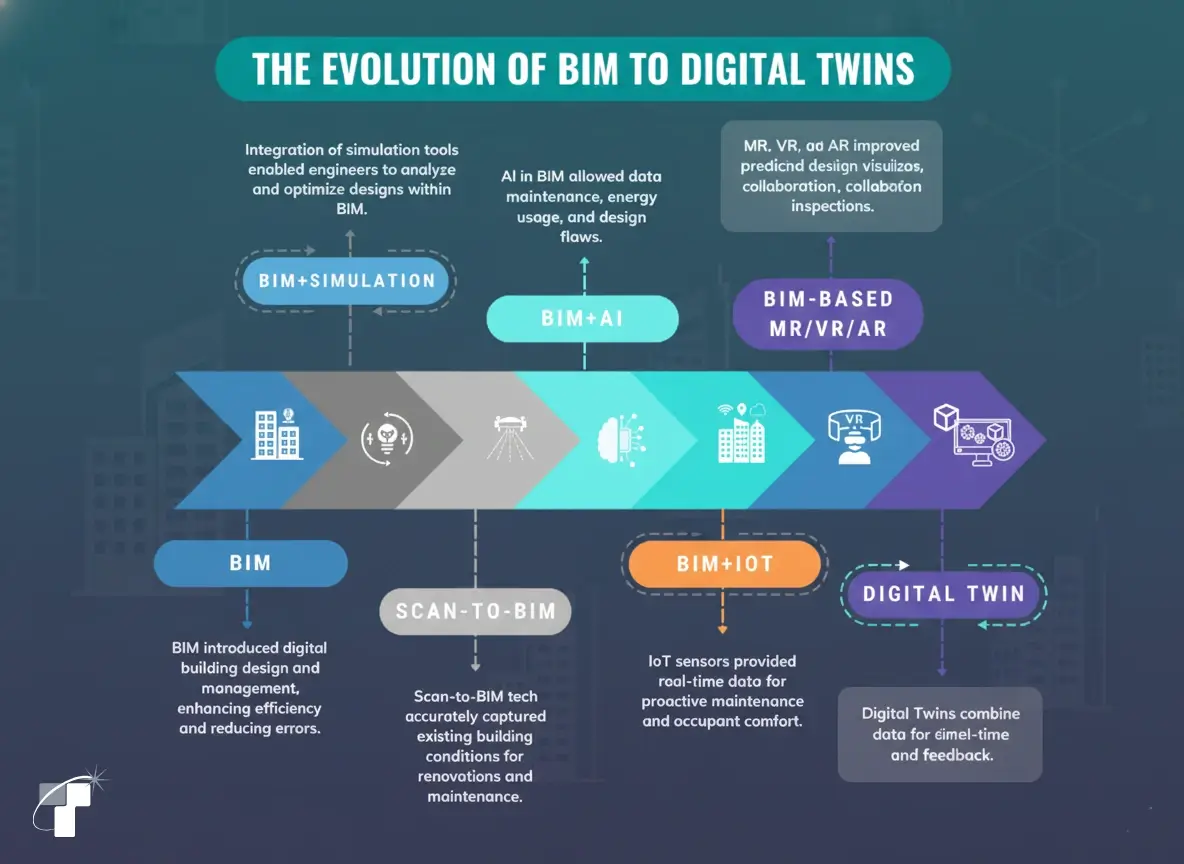
IoT + BIM + Digital Twins
The sensors are IoT devices; the structured asset data is provided by BIM; both are united in a digital twin to form continuous operational intelligence. Practically, these three create building elements that produce data nodes that guide each decision-making.
Sensors have real-time automation: power, temperature, presence, movement, and flow of water. BIM here assists in asset ID, maintenance reports, and installation specifications. They are joined by the digital twin; thus, all the points of data correspond to the appropriate element, subsystem, or space.
Occupancy streams in space management, coupled with BIM room data, are utilized in space management to optimize layouts and minimize leased spaces. The trend of sensors is compared with the modeled baselines in energy teams to identify those retrofit targets that really pay back. The FM teams are assigned priority work orders where the twin interface links a fault to a particular spare part, manuals, and vendor SLA.
From BIM to Digital Twins
Key implementation moves in 2026
- Normalize resource identifiers during delivery for easy integration of sensors with BIM items.
- Implement edge processing for high-frequency data to reduce cloud loading.
- Keep telemetry minimal and essential for cost-efficiency; not all devices need to stream data continuously.
- Develop APIs to enable digital twins to trigger priority events in CAFM/EAM systems.
- Stress that systems are more valuable as operational platforms than as one-time initiatives.
- Make use of analytics, models, and data to continuously improve system performance.
Robotics, Prefab MEP & Industrialized Construction
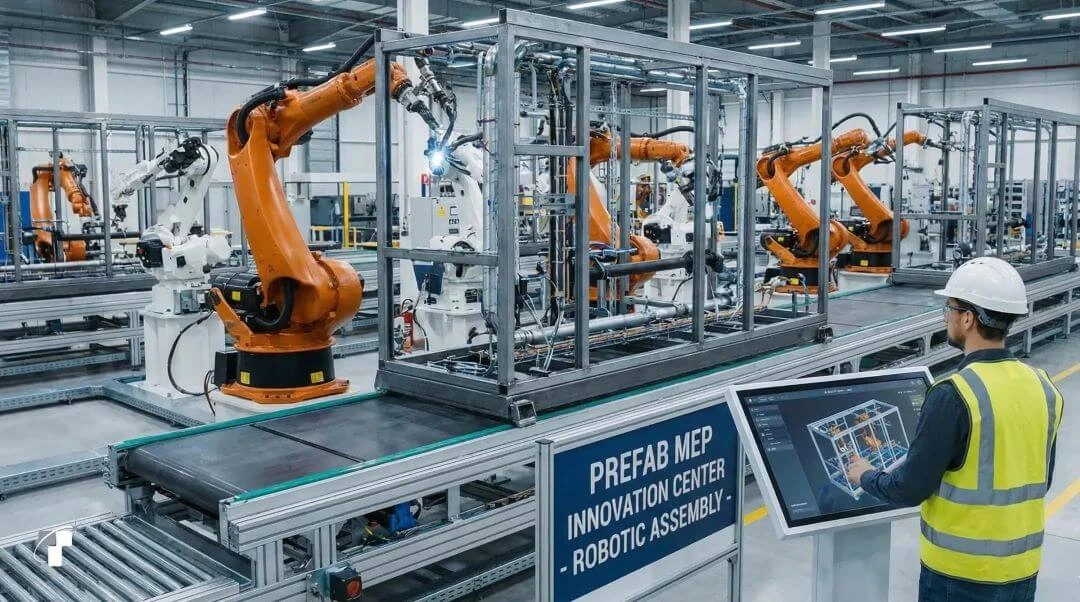
The marriage between the precision of off-site manufacture and smart on-site construction is industrialized construction. Prefab MEP modules save time in the field and remove sophisticated coordination activities. Robotics eliminates the painful, repetitive, and dangerous tasks, e.g., layout, tie-ins, and repetitive assembly, which are done with speed and repeatability.
Robotics in Construction
What this will resemble in 2026: factories are creating fully tested MEP skids that contain BIM metadata. Such modules are delivered to the site as soon as they are ready to install. Anchors are then located on the position of a robotic layout system under the guidance of millimeter-precision assembly of drama that is cut on busy locations.
Advantages
- Quality assurance at the factory reduces the complexity in fragmented operations within the sites.
- Robots perform risky duties, thus minimizing accidents in the workplace.
- A streamlined approach reduces hidden cost variations and mitigates risk distribution.
- Effective operations depend on data accuracy, logistics planning, and change control.
- Prefabrication requires accurate BIM data, while robotics needs current models and reliable surveys.
- Effective staging and sequencing of module deliveries are essential for successful logistics.
- Companies focusing on off-site labor substitution, reduced rework hours, and accurate installation time estimates see quick ROI and project industrialization.
AR/VR Integration
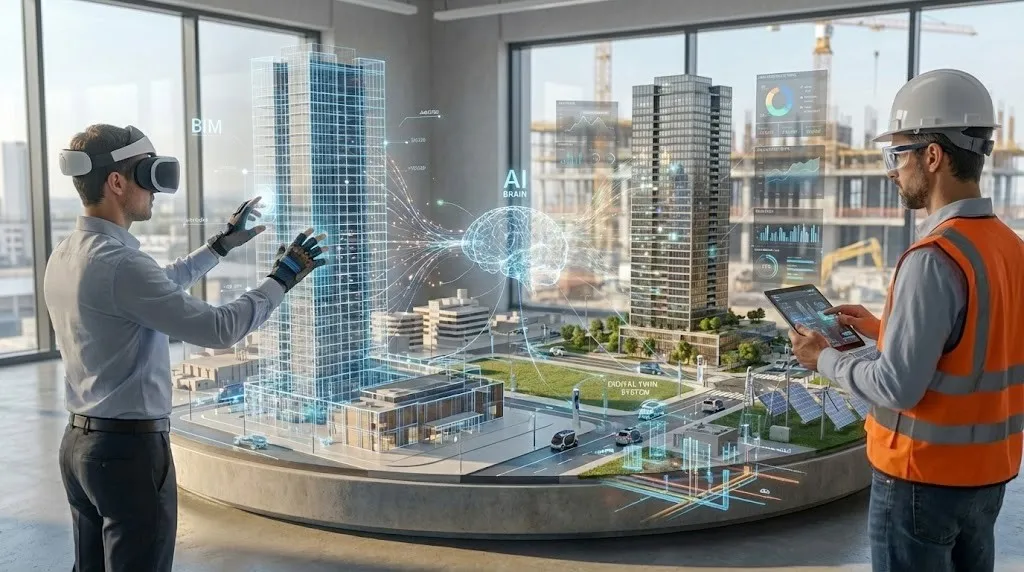
AR/VR eliminates any form of intent ambiguity. AI eliminates the frustrations in planning. They all should help in quickening the decision-making process and reducing the gap between plan and reality.
AR/VR Integration in Construction
The cases include walkthroughs of the immersive models to ensure the contractors approve access/maintenance paths, inspections and viewing of hidden services with a tablet, and sign-off with the client via virtual mockups so that fewer revision cycles can be made.
Instead of monitoring timelines, in 2026, it manages project managers who handle AI; they are feeding complete predictive engines on the history of past performance, on-chain indicators, and live progress reports. The outcome is almost detached. The system identifies the probable delays in advance before they get too big and rearranges the trade sequences in real time and relocates resources without the necessary intervention of anybody.
Layer AR field verification on top of that, and the loop gets even tighter. Crews verify the work in the field, AI ingests that status instantly, then pushes out its own updated plan. It’s a self-correcting cycle that keeps the project moving instead of constantly catching up.
Important Setup Tips
- Prioritize MEP ducts and facade interface checks and leave aside minor coordination tasks, which depend on AR.
- Enhance AI forecasts using diverse data samples—weather, delivery schedule, and level of efficiency.
- Apply the human-in-the-loop method in trade-sensitive decision-making; that way, AI recommendations can be validated by the project managers.
- Reduce the number of surprises, expedite approvals, and have more predictable delivery of projects.
- Co-locate the visualization and automation teams to facilitate reviews, reduce work to be done on-site, and enhance confidence in the stakeholders.
The Future: BIM 6.0
The conclusion is that the reason is very simple. Once a business gets off the ground, the company shifts into differentiation mode so it can stand out from the crowd.
And when we look at 2026, it isn’t just another checkpoint in AEC tech history. It’s the moment when all these tools finally start functioning as one integrated operating model. BIM 6.0 brings structured, evolving data to the table. Cloud platforms hold the single source of truth. GIS allows any project to be reintroduced to reality. That data is made dynamic using digital twins, IoT devices, robotics, AR/VR, and AI.
Lastly, technology adoption is not a mere software upgrade to the organization but a change. Invest in training. Help teams learn what their new duties are. Redo contractual trade in such a way that prefabrication and digital handover become more convenient. And buildings that not only work well on day one but get better as they work. That’s the real payoff. The AEC landscape of 2026 is set to favor companies that treat data as a genuine asset and technology as a disciplined, everyday practice rather than a side project.
Ready to use the newest BIM technology for your projects? Let Tesla Outsourcing Services handle the work. We provide fast, accurate BIM models to save you time and money..
BIM Services