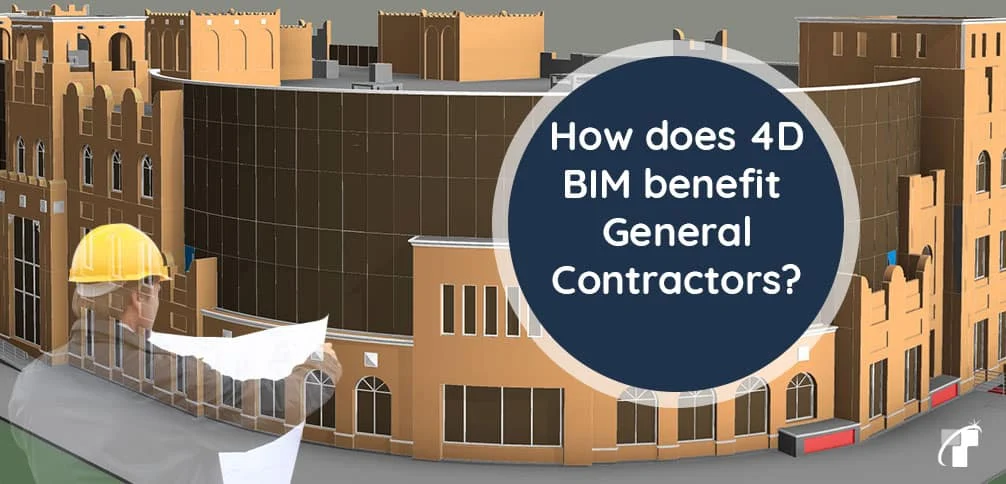
General contractors are accountable for all the activities such as day-to-day monitoring, vendor management, communicating with all concerned parties, etc. during the course of a building project. The main contractor is responsible for providing services, material, equipment & tools, and labor that are required for the construction of the project. Timely execution of projects while adhering to the approved budget and safety guidelines is one of their prime responsibilities.
Building Information Modeling is the process of creating a graphical information model in a shared digital space. It has been in the AECO industry for a while but is starting to gain traction now. It is nowadays used by contractors to deliver their projects better and faster. Using a four-dimensional approach to BIM Modeling can have an added advantage. Before we talk about its benefits, let us better understand what 4D BIM is.
What is 4D BIM?
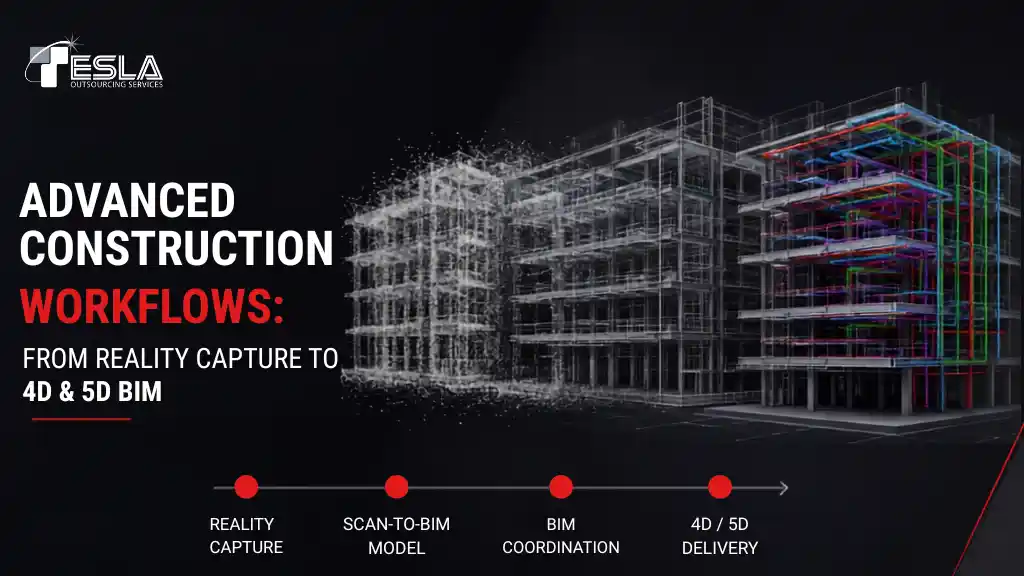
Adding time-scheduling data to the different components of an information model to generate an accurate and step-by-step visual of the project development is known as 4D BIM. 3D visuals created from the 4D BIM Model will show how the building will be constructed with respect to time, and how it will appear during different stages. This is extremely useful in terms of planning and executing the construction project safely while maximizing on-site efficiency.
Benefits
For general contractors, program and visual information like simulation modeling provide a platform to create a prototype asset in the virtual environment first at each stage as per actual timelines. They can provide rapid feedback on any changes that are required to enhance the construction activity. It helps to eliminate the last-minute on-site rework; thereby minimizing waste from the delivery process and helping it to speed up. Since construction sites are expensive to run and constitute a significant portion of the total cost of an infrastructure project, eliminating wastage results in significant cost saving.
Four-dimensional virtual design for construction is a dominant tool for communicating the impact of the building at each stage of construction and once the construction is completed to the stakeholders. In the earlier days, Gantt charts were used alongside the plans to understand the progress of construction. This is very difficult to understand and a lot depends on how the information is collaborated and interpreted by an individual or teams. But with simulation modeling, everyone can visualize and have a clear impression of how the building will appear at each stage.
For prime contractors, the models with 4D information help them simulate the entire construction system and its design, identify and rectify collisions based on the workflow, as well as manage the supply chain for manpower and materials required on-site. Moreover, the contractors can communicate the entire process to their team which improves on-site productivity as all the team members are aware of the timelines for different activities and can communicate any change in the workflow beforehand. This will result in a more efficient working and smooth coordination between cross-functional the teams.
Closing
Similar to 3D virtual design and construction process, precise 4D BIM captures all relevant information that aligns closely to the actual conditions. This requires certain adjustments in the way the models are developed. The final output and its uses justify all the efforts put in creating the four-dimensional model. Simulations such as testing “what if” scenarios are possible with 4D and general contractors can make improvements to the process workflow, if required, based on the outcome of the simulation. Thus, they can take accurate, informed, quick, and effective decisions that ultimately lead to on-time delivery of the project with better control of costs.