
For AEC firms in USA, the future of building design and construction is not just bricks & mortar – it is about bits and bytes. At the intersection of Building Information Modeling (BIM) and the Internet of Tings (IoT) is born a powerful combination – transforming how we conceive, manage, and experience buildings. this convergence is no longer a futuristic concept – it is a real trend gaining momentum rapidly because of the demand for smarter, safer, more efficient, and occupant-centric spaces. This combination of BIM + IoT creates a new value across the asset lifecycle – from design validation, real-time facility monitoring, predictive maintenance, to energy management. This convergence is often realized through digital twins, cloud platforms, and integrated building management systems.
North America accounted for the largest regional revenue share at over 36% of the global IoT in the construction market. This illustrates strong regional investment momentum in integrated technologies like IoT-enable BIM systems—SOURCE
This article takes a look at how this powerful unison is unlocking new revenue streams for firms across USA and Canada – a differentiator which is bringing in more competitive proposals.
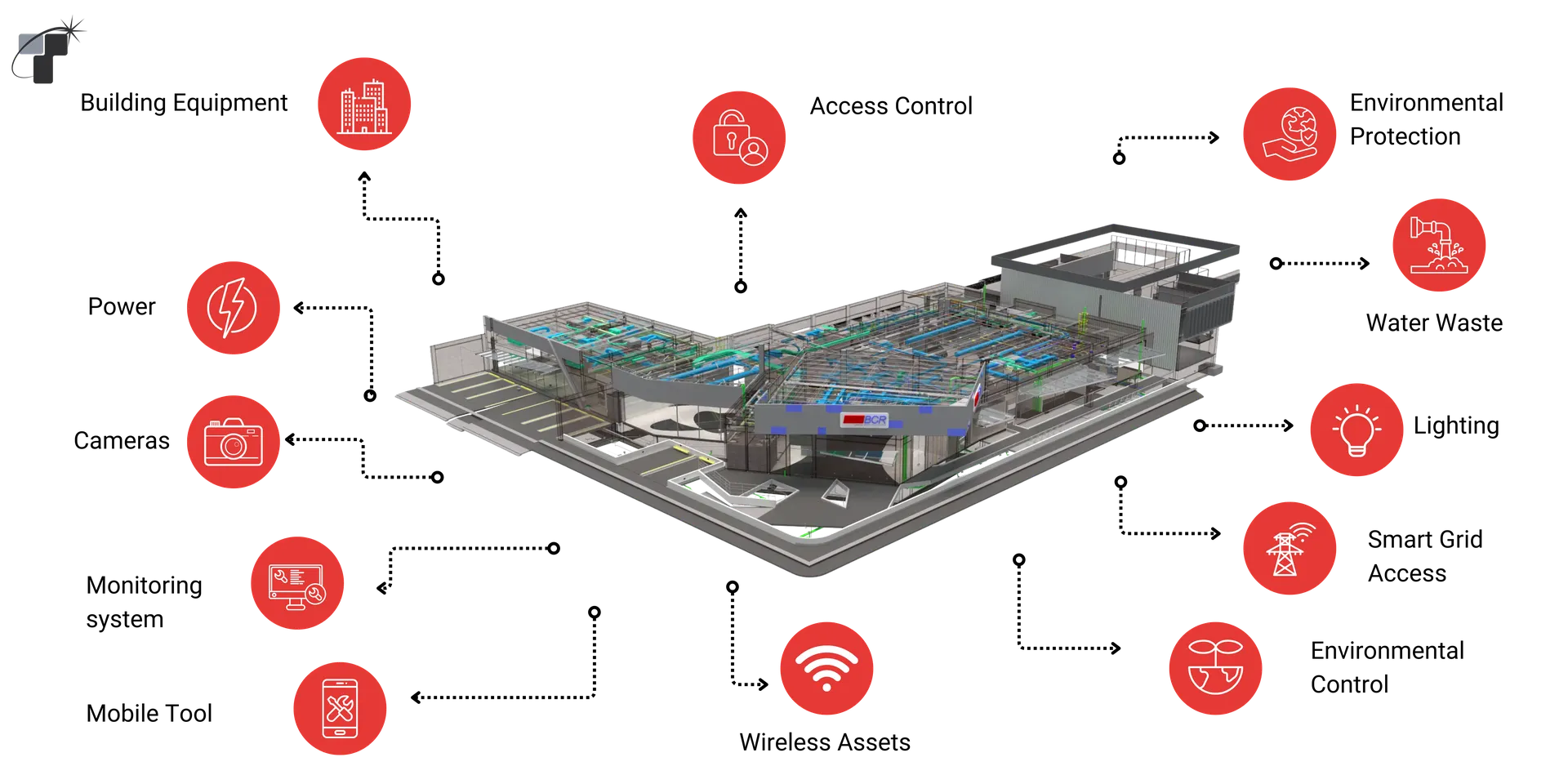
The Smart Building Revolution
Beyond the 3D Model: BIM as the Digital Backbone
Building Information Modeling started as a sophisticated 3D modeling tool, but it has now evolved far beyond this – it is a comprehensive digital representation of a building’s physical and functional characteristics – a digital twin that is alive through the asset’s lifecycle. This BIM model will contain data about everything – geometry, materials, systems (MEP), spatial relationships, and even performance specifications. However, BIM is traditionally static – it represents the intended state of the project at any given time, be it during design or construction. At this point, the integration of IoT makes BIM transformative.
IoT: The Nervous System of the Smart Building
The Internet of Things embeds sensors, actuators, and connectivity into the physical building components and systems. These devices will then continuously collect real-world data on a vast array of parameters, such as:
- Environmental: the data of temperature, humidity, CO2 levels, VOC levels, particulate matter, and light levels.
- Occupancy: this includes the people count, space utilization, and movement patterns.
- System performance: information about energy consumptions – HVAC, lighting, plug loads, equipment status – which includes vibration, temperature, runtime, water flow, and pressure.
- Structural: for post-event monitoring or even critical infrastructure – calculations of strain, vibration, tilt.
- Security & safety: accessing the control logs, fire or smoke detection, water leak detection, and additionally, video analytics.
The Power of Fusion: BIM + IoT in Action
BIM provides a digital model of the building, which is structured and semantic – with geometry, systems, spaces, and metadata – while IoT supplies the continuous stream of data from the sensors about how the building is actually performing. Together, they create the living representation of the building – sensor feeds will update the BIM attributes, while BIM’s spatial content can make the sensor data actionable.
This combination of the two helps in monitoring the condition of the building – along with fault detection, energy visualization, and more – which converts the period site visits’ data into a constant stream of insight. Multiple recent studies and industry implementations show that integrating BIM and IoT enhances facility management and real-time performance visibility. This is how the integration delivers value across core areas:
Facility Monitoring and Operational Efficiency
IoT sensors which are embedded across HVAC, lighting, plug loads, water systems, and access control, will produce high detailed, time-stamped data. This data is connected to BIM’s different spatial hierarchies – floors, zones, rooms, equipment – and this data is available for use exactly at the time and place when the problem exists or surfaces. This combination of IoT and BIM helps for faster fault resolution of AEC, reduced mean time (MTTR), and reduced manual inspection costs – outcomes which are particularly important for hospitals, universities, and commercial portfolios where the uptime and occupant comfort is critical.
Digital twins can further extend this by visualizing the energy flows health of equipment on the BIM canvas – allowing operators to test ‘what if’ control strategies without risking any onsite changes. This will also provide evidence in case you want to make changes in the future, space planning alternatives, and even new construction – all based on actual needs and not just projections. Your clients shall also value data-drive decisions for their real estate portfolios.
A US-based simulation study in small office buildings – leveraging adaptive thermostat control, occupancy-based HVAC, and night-purge free cooling – reported electricity savings of 8.9% to 20.4%, equating to approximately 12.2 to 30.4 kWh/sq.m. every year, especially in hot and dry climate zones—SOURCE
Energy management and predictive maintenance
One of the best ROI for BIM + IoT is energy optimization. When you combine BIM’s system connectivity and attributes with real-time consumption data, you can complete zone-level load profiling, demand response participation, and automate the schedules that reflect actual occupancy patterns. Beyond the short-term savings, you can add analytics and machine learning – along with a digital twin – to identify degradation trends and predict equipment failure, which means you can do condition-based maintenance instead of calendar-based replacements.
Recent research shows that digital twin-enabled building energy management systems (BEMS) can materially improve the control responsiveness and reduce energy wastage. Integrated PdM – Predictive Maintenance – design and implementation are high-value services. This combination shifts firms from pure construction asset lifecycle management partnerships.
When building systems operate in isolation – ‘silo’ – they achieve 5 to 15% energy savings. But when systems are digitally coordinated (that is, integrated via BIM + IoT), energy efficiency can improve dramatically up to 35% or more—SOURCE
Enhanced Occupant Safety & Well-being
IoT + BIM is not just about energy or cost. User-centric sensors detecting CO2, volatile organic compounds (VOCs), temperature, humidity, and occupancy – all these collect metrics that are needed for health, productivity, and safety. These readings can be visualized within BIM, and facility teams can respond to air quality incidents – manage density during emergencies, and optimize ventilation for comfort & AQI compliance. Research on occupant-centered KPIs have shown that approaching sensor data in a structured format improves the service quality and user satisfaction – a selling point when AEC firms are pitching for modern workspaces, schools, or healthcare facilities.
- Proactive environmental quality management: BIM + IoT helps firms become experts in designing and delivering healthy buildings – a major priority for clients after the pandemic.
- Intelligent emergency response: designing buildings with integrated safety systems – powered by BIM + IoT – is a significant differentiator in the AEC industry, especially for complex structures.
- Enhanced security: when physical security design is seamlessly integrated with the digital twin, a holistic security solution is born.
Design & Construction Advantages: Closing the Loop
BIM augmented with IoT will create a feedback loop – operational data from buildings that are in-service will drive future design decisions and contractor scopes. During construction, temporary sensors can be linked into the as-built BIM to monitor the conditions – humidity for concrete curing, temperature of materials, and so on – to improve quality assurance. These closed loops create a constant improvement across AEC firms and their portfolios – turning the AEC industry’s work from a one-off delivery to a lifecycle stewardship. This dynamic system allows you to create truly intelligent buildings – self optimizing, which outperform the standard code compliance – and also offer long-term operational cost savings to the owners.
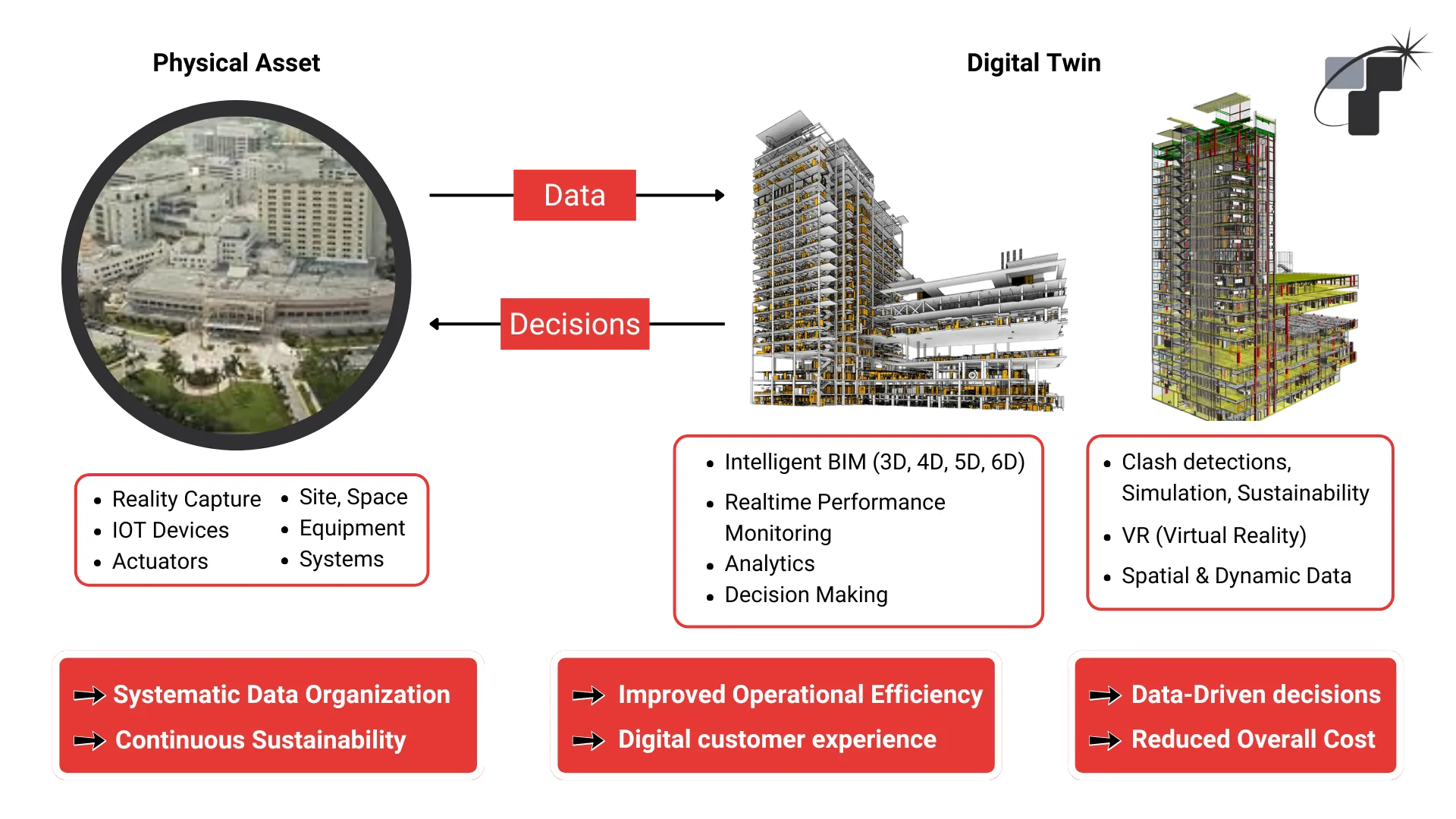
The Digital Twin Feedback Loop
Practical Integration Patterns & Standards
The successful integrations use a pragmatic stack – sensors on the field will stream data to cloud platforms, where it is normalized, time-stamped, and mapped to the BIM objects. Open formats and middleware can reduce vendor lock-in and ease cross-system orchestration. After this, firms must check – map disparate naming conventions, synchronizing asset IDs, and ensuring semantic consistency between the design models and operational systems. Standards and middleware can reduce friction – but it cannot replace disciplined data governance.
Optimized Energy Management & Sustainability
- Data driven energy analytics: the real-time granular consumption of data – from individual circuits to major equipment from the IoT meters – is mapped onto the corresponding systems in the BIM model. Beyond basic energy modeling, AEC firms can use BIM + IoT to provide clients with actionable insights for ongoing operational savings and carbon reduction – supporting ESG goals.
- Performance benchmarking & compliance: against the original energy model predictions, a constant monitoring – stored within BIM – allows for an analysis of the gap in performance. For AEC firms, it is a proof of performance for designs, strengthening the claims of sustainable expertise.
Challenges and Considerations for AEC Firms
The potential of BIM + IoT is immense, but the successful implementation of this combination requires you to address some key challenges:
- Data silos & integration: to ensure the seamless flow of data between different IoT devices, BMS, and the BIM platform – which often requires middleware or even specialized integration platforms.
- Cybersecurity: it is important to protect the increased attack surface which is created by numerous connected devices and critical building data. Security must be designed within the system from the outset.
- Data overload & analytics: it is important for your firm to develop the capacity to manage, process, and derive actionable insights from massive, continuous data streams. You can invest in data analytics expertise or partnerships.
- Skills gap: AEC firms will need to cultivate talent that is proficient in both BIM management and IoT (data) analytics – or else foster a strong collaboration between the disciplines.
- Cost & ROI: some initial investments in sensors, connectivity, and integration platforms shall be significant. AEC firms should develop compelling ROI models for clients that focus on operational savings, risk reduction, and enhanced asset value.
- Standards & interoperability: the continued evolution and adoption of open standards – such as IFC, BACS, MQTT – are critical to avoid vendor lock-in and ensure a long-term system flexibility.
Actionable roadmap for AEC firms in the U.S. market
- Start with a pilot digital twin for a live building: add a limited set of sensors – HVAC, occupancy, and power – and link this to the project’s as-built BIM.
- Since the beginning, define the success metrics of the project – energy per square feet, MTTR, or occupant complaints – and create a dashboard for the stakeholders.
- You must invest in clear ID conventions and a BIM data dictionary – this will future-proof all integrations.
- Move beyond the design deliverables and start offering lifecycle management services – FM handover, analytics subscriptions, and managed digital twin.
- To build trust with clients, prioritize cybersecurity and tenant data polies first.
Ending with this

The strength of digital transformation emerges when technologies connect. BIM, GIS, IoT, and AI deliver maximum value through integration
The integration of IoT and BIM has reshaped what we call ‘building delivery’ today in North America – the processes of designing, building, and operating are now merging into a continuous, data-driven lifecycle service. This means revenue opportunity plus a competitive requirement. Firms who can use real-time IoT to breath life into their intelligent BIM model will be able to unlock these significant advantages:
- Enhanced value proposition
- Improved client outcomes
- Operation efficiencies
- Future-proofing
Focused pilot studies, demonstrating tangible operations, will separate the firms that only draw models from firms that design resilient, efficient, and safe environments. This also ensures repeat business. As the ecosystem matures, an asset owner who expects buildings to work harder, smarted, and cleaner over their lifecycle will require these BIM + IoT model – as a table stake.
Frequently Asked Questions (FAQs)
Is IoT + BIM integration only applicable to new construction projects?
Of course it is not. While integration is easier on new buildings, retrofit projects can also use the IM + IoT integration. The as-built BIM models – created with laser scanning or photogrammetry (Scan-to-BIM) – can be strategically deployed with IoT sensors to target the high-impact areas, such as HVAC, lighting, and security.
What are the main cyber-security concerns with IoT-enabled BIM systems?
Few of the primary risks with IoT-enabled BIM systems are misuse based – misuse of occupant information, unauthorized access to building systems, and interception of sensor data. These risks can be mitigated with network segmentation, strong authentication protocols, and encrypted data transmission – along with aligning to standards like NIST Cybersecurity Framework.
What Return on Investment (ROI) can building owners expect from BIM + IoT integration?
The ROI on BIM + IoT integration can vary according to the scope of work, but there are some common, confirmed benefits – 10 to 30% energy savings through optimized control, reduced maintenance costs from predictive maintenance, and improved tenant satisfaction – which can translate into higher occupancy rates and also rental premiums.
How can AEC firms start offering BIM + IoT services?
In partnership with IoT platform vendors, AEC firms can train design staff on digital twin workflows – to pilot projects with early-adopted clients. As a service, you can also offer post-handover operational analytics – it is a strategic way to expand beyond traditional design and construction revenue schemes.
Ready to build smarter, future-proof buildings that integrate BIM precision with IoT intelligence? Contact us to start your Smart Building transformation today!
Expert Consultation

