By 2026, BIM will no longer be something clients ask whether you do. It is something they assume you already do—and do well. What clients now judge is how smoothly your BIM delivery runs: how fast models are updated, how clean coordination is, and how confidently your teams handle change without delays or confusion.
Behind the scenes, this puts intense pressure on internal BIM teams. Many firms are quietly struggling to scale BIM delivery without exhausting people or inflating costs. This is exactly why outsourcing BIM modeling has shifted from a tactical fix to a strategic operating decision.
Outsourcing in 2026 is not about reducing responsibility. It is about building a flexible delivery engine that allows AEC firms to grow without breaking their teams.
Read the Full Guide: Ultimate Guide to BIM Outsourcing: Strategy, Cost & Vetting Partners in 2026
Read NowThe BIM Pressure AEC Firms are Feeling Today
When all this lands on a limited internal team, the pressure compounds. The more human beings put in more working hours, the more reviews there are, and the quality becomes variable, not because the teams are not skilled, but because there is a limit in capacity.
AEC companies already possess most of the BIM standards and tools, as well as trained personnel. On paper, they look prepared. The real stress appears when several projects reach coordination-heavy stages at the same time.
Suddenly, teams are expected to deliver:
- Higher LOD models earlier than before
- Frequent design revisions with minimal notice
- Continuous coordination updates
- Discipline-specific BIM outputs
- Data-ready models for construction and handover
BIM Market data published in early 2026 indicates that the global BIM outsourcing market reached approximately USD 4.6 billion in 2025, with projections to double by 2032 at an 11.5% CAGR, underscoring its shift from a temporary fix to a core delivery strategy.
Why the “Everything In-House” Model is Breaking Down
This has been the case over the years, as constructing it in-house seemed like the most secure choice. Companies that invested in the recruitment and training of BIM teams to control and ensure quality. The application of that model became effective in situations when project volumes were limited, and BIM needs were less complicated. This strategy began to break in 2026. Hiring skilled BIM staff is expensive and time-wasting. Training takes months. Salaries do not fluctuate because of the workloads. And the departure of even one BIM team member causes the effect to be experienced instantly on active projects. Outsourcing does not eliminate internal teams. It keeps them steady so that when delivery collapses due to peak demand, it is not lost.
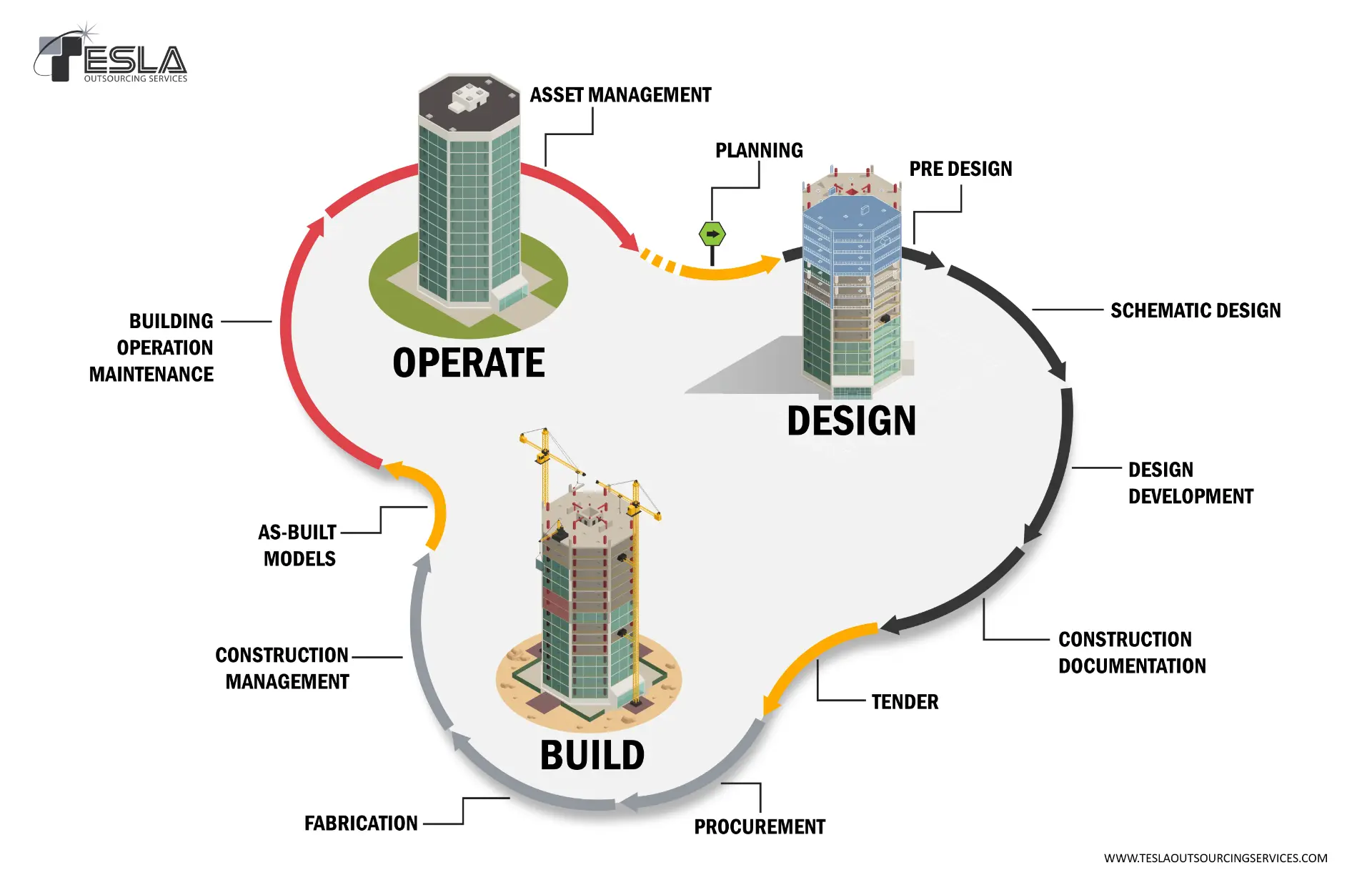
BIM Outsourcing Provide the Complete Lifecycle
Outsourcing BIM is About Shortcuts
Outsourcing remains an illusion that is associated with cutting corners. The opposite is the case in 2026 with strategic outsourcing. Firms can easily expand and contract BIM production on demand without committing to lengthy employment contracts, rather than struggling to hire or overwork employees. The ability to act this way is what makes outsourcing a competitive advantage.
Smart AEC companies outsource to benefit from:
- Elastic delivery capacity
- Faster response to workload spikes
- Parallel execution of modeling tasks
- Consistent output across multiple projects
Solving The BIM Talent Shortage Realistically
The BIM talent shortage is no longer a temporary phase. Good modellers and coordinators are very sought after in the world, and they are becoming harder and harder to keep around. Even the best-endowed firms experience:
- Long recruitment cycles
- Rising salary expectations
- Uneven skill depth across hires
- Attrition at critical project stages
According to the 2025 AEC Inspire Report by Unanet (published April 2025), labor and talent development are now the top concern for 67% of AEC firms, surpassing even economic uncertainty, which drives the urgent need for scalable, outsourced BIM teams.
Outsourcing of BIM modeling minimises the reliance on regular recruits. The companies are provided with ready-trained specialists who only work on BIM production and are already conversant with the workflow, standards, and QA procedures employed in the industry. This allows internal teams to stay lean without limiting delivery capacity.
Faster Delivery Without Burning Out Teams
Speed is no longer a bonus; it is a part of BIM. Clients want rapid updates, quick coordination cycles, and minimal disruption during construction. Under the circumstances of overloading the internal BIM teams, there is generally a trade-off to speed: accuracy, morale or both. People do not need to be firefighting at all times, and when they are not, they can be in a position to reason better, organise better and come up with quality results.
Outsourcing helps firms:
- Run modeling tasks in parallel.
- Unload repetitive, time-consuming tasks.
- Keep schedules that do not involve too much overtime.
- Guard internal teams against burnout.

Remote BIM Collaboration
Focus on High-Value BIM Work
Not all BIM tasks create the same value.
Internal BIM teams are most impactful when they focus on:
- Design and coordination decisions
- Client and consultant communication
- BIM execution planning
- Model review and approvals
- Problem-solving and optimisation
Outsourcing allows firms to shift production-heavy tasks externally, such as:
- Base model creation
- LOD upgrades
- Drafting and documentation
- Construction-stage model updates
This division of work improves productivity and makes internal roles more strategic and satisfying.
Uniformity Between the Office and Projects
Increased size of firms can make it more difficult to ensure that BIM quality remains constant–particularly between offices or regions. This uniformity minimises rework, coordination mistakes, and construction phase conflicts. In the case of firms that have a number of projects running simultaneously, it brings consistency which the clients can depend on. For firms managing multiple projects at once, it creates reliability that clients can trust.
Accomplished outsourcing partners bring:
- Standardised modeling workflows
- Dedicated QA/QC checks
- Experience across building types
- Repeatable delivery structures
Growing Without Financial Risk in the Long-Term
Hiring permanent staff ties firms to fixed costs. Projects, on the other hand, are cyclical. This is not an option, but a strategic consideration in case of economic conditions that are dynamic and may alter in 2026. Outsourcing enables companies to have financial dexterity:
- Scale up during peak workloads.
- Scale down after key milestones.
- Avoid long-term payroll pressure.
- Stay resilient during market uncertainty.
Supporting Advanced and Future-Ready BIM Workflows
BIM in 2026 extends far beyond basic 3D modeling. It is expensive and complicated to retain internal capability in all these sectors. Outsourcing enables companies to use specialised BIM facilities at a time when they are required, rather than reorganising staff whenever the requirements vary.
Projects increasingly demand:
- High-LOD discipline-specific models
- Shop and fabrication drawings
- Construction sequencing support
- Asset-ready handover data
- Digital twin–compatible models
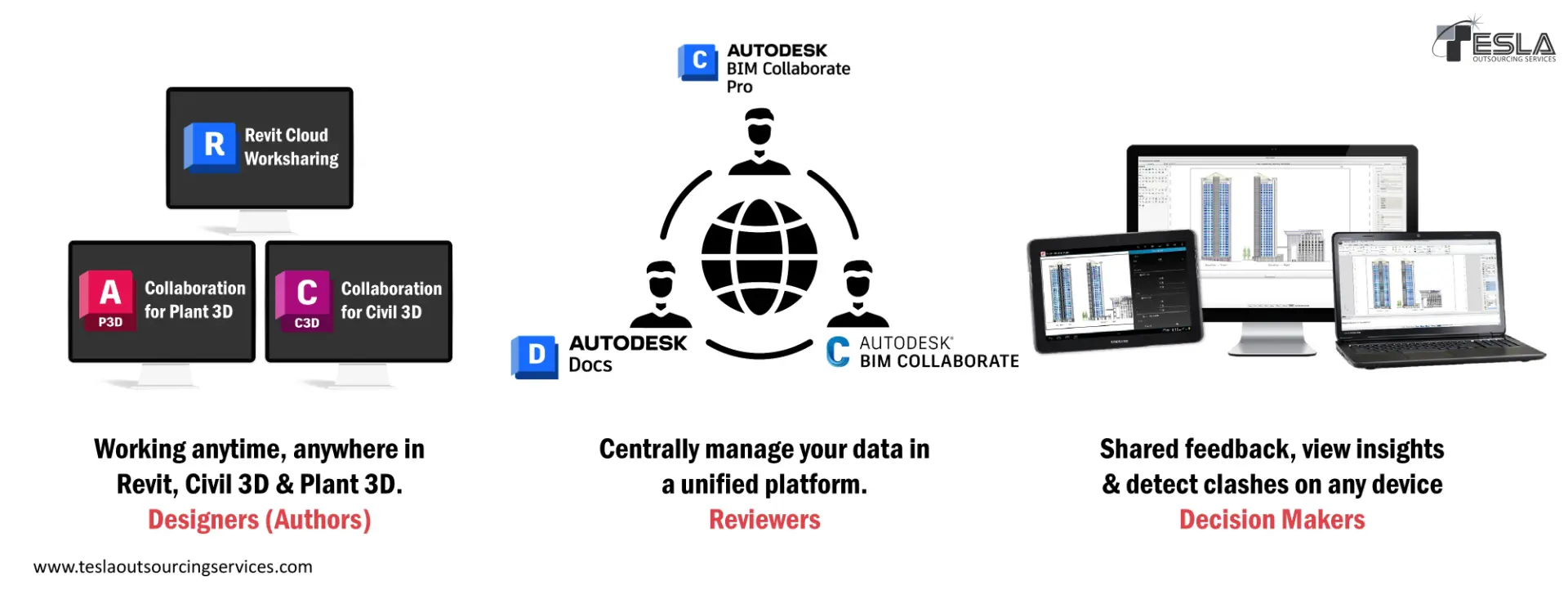
Cloud-based BIM
Stronger Bids and Bigger Opportunities
Capacity limits growth more than skill does. Many firms quietly turn down projects because they lack bandwidth, not expertise. Outsourcing becomes a growth enabler, not just a delivery tool.
With a reliable BIM outsourcing partner, firms can:
- Bid confidently for larger projects.
- Commit to tighter timelines.
- Demonstrate strong BIM capability in proposals.
- Reduce delivery risk in competitive tenders.
Controls are Structured, Not Lost
The fear of loss of control is very common, but the control may lie in the structure, not in the location. In this model, the outsourcing enhances implementation, but the whole strategic responsibility is with the internal teams.
Successful outsourcing models:
- Keep design ownership in-house.
- Define BIM standards clearly.
- Retain review and approval authority.
- Use shared collaboration platforms.
- Maintain regular communication loops.
Outsourcing Works Best as a Partnership
The most successful AEC firms treat outsourcing as a long-term relationship, not a one-off transaction. Eventually, outsourcing feels like working with an extended BIM team, not an external vendor.
Over time:
- External teams learn internal standards.
- Efficiency improves with each project.
- Onboarding effort reduces
- Collaboration becomes seamless.
Conclusion
Outsourcing of BIM modeling in the year 2026 is no longer a reactionary move that is made under pressure. It has taken the form of a proactive and planned approach that will keep the AEC firms competitive in a more challenging and dynamic industry. Since the complexity of BIM needs is constantly increasing in terms of depth, accuracy and speed, the in-house capacity alone acts as a limiting factor to the extent and the rate of scalability of a firm.
What is valuable about outsourcing is not only the extra workforce that it offers but also the flexibility and resilience it offers to the organisation. It allows the companies to respond to workload peaks in the most efficient way, to complete an aggressive project schedule, and to establish a consistent quality without overwhelming the internal teams and committing themselves to long-term costs. It is also a major strength of the market that is continually evolving. This flexibility is a significant strength in a market that is in a state of constant change.
What is even more important, outsourcing changes the way of working of the internal team. Outsourcing most of the production-intensive and repetitive jobs allows the in-house BIM professionals to concentrate on coordination, decision-making, quality control and client contacting. This not only enhances the results of the projects but also results in healthier and more sustainable teams.
With the further development of 2026 and beyond, BIM will continue to gain greater prominence in the delivery of projects, construction and management of assets. Any company that considers outsourcing as a long-term business relationship and not as a temporary solution will be in a better position to expand, be innovative and be reliable at scale. That way, outsourcing of BIM modeling is no longer smart but still a necessary process towards creating a future-ready AEC practice.