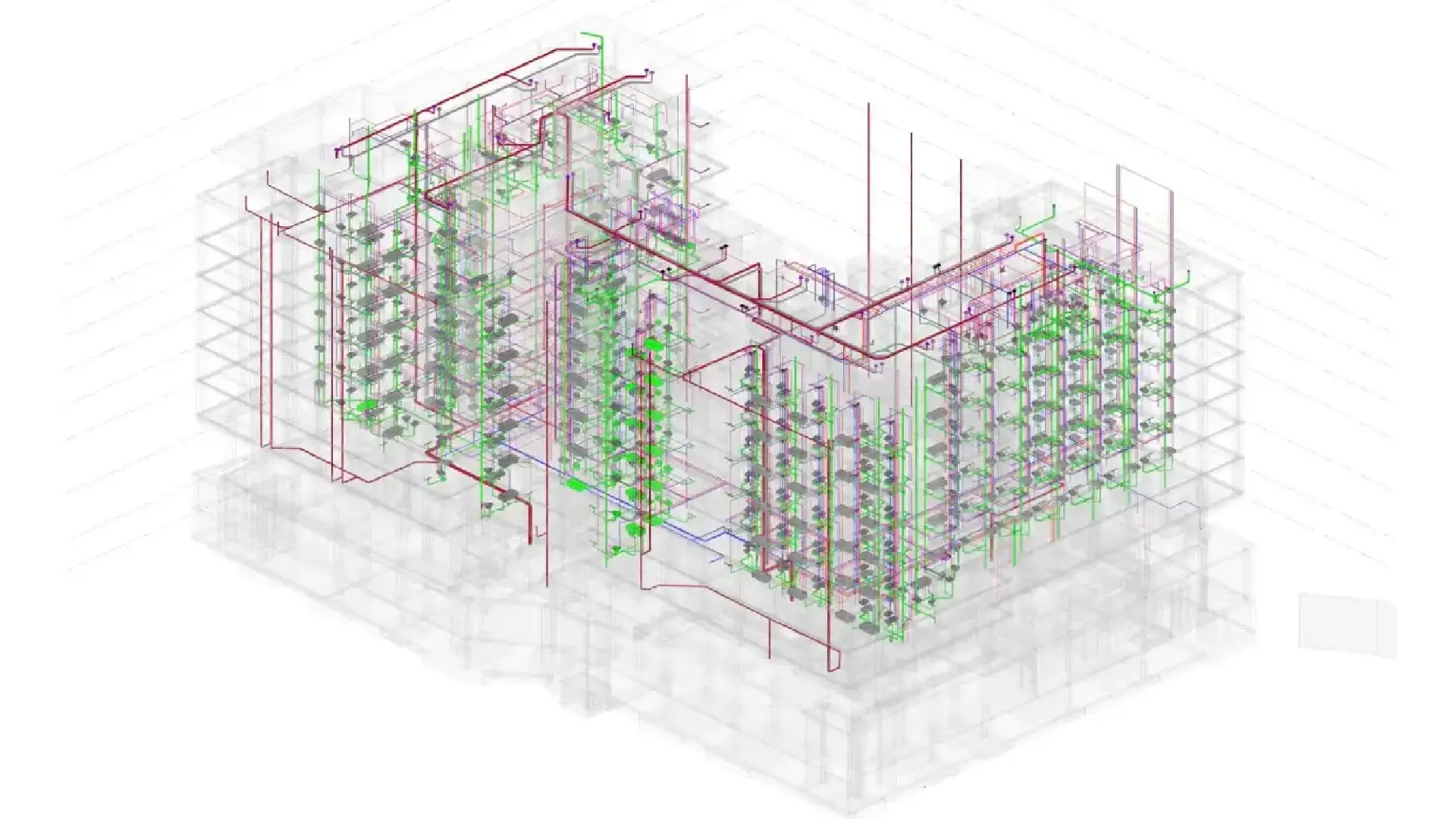
The operating environment of the AEC industry in 2026 is entirely different from what it was five years ago. Projects are more massive, time limits are much stricter, and coordination is much more expected. Customers are no longer measuring success on design quality or building speed but on predictability, the minimum number of surprises, and computer visibility of the project lifecycle.
Meanwhile, companies are experiencing long-term internal limitations. It is not easy to employ qualified BIM practitioners. It is even more challenging to keep them. The level of work from one project phase to another significantly changes, and so, the conventional staffing models are not effective and are risky. In this scenario, the use of in-house BIM teams has proved to be unsustainable for most organisations.
BIM outsourcing has not been a short-term strategy but a fundamental delivery building plan. By 2026, major companies will likely outsource BIM to stabilise their business, ensure project quality, and remain competitive in a more data-driven sphere.
Complexity and Internal Capacity of Projects
The contemporary constructions and the infrastructure projects are intrinsically complicated. Advanced BIM coordination at the first phases is required by high-density MEP systems, prefabricated parts, internalised sustainability specifications, and narrow space limitations.
Nevertheless, internal teams tend to be overstretched on a variety of projects simultaneously. One BIM coordinator can oversee multiple running models, coordination sessions, documentation dates, and field inquiries. The greater the complexity, the higher the chances of overlooked clashes, incomplete data, and rushed deliverables.
Such a discrepancy between what is required by projects and what can be practically provided by internal teams is one of the main forces that will drive BIM outsourcing in 2026. Outsourcing enables companies to connect capacity and complexity without increasing headcount permanently.
McKinsey’s capital-projects research finds 5–15% potential improvement in delivery costs by fixing contracting and delivery practices; using BIM effectively (and outsourcing repeatable CAD/BIM work) is repeatedly highlighted as a practical lever to capture these savings. In short: digital + outsourcing = measurable margin uplift when done right.
What Real BIM Outsourcing Means by 2026
The BIM outsourcing in 2026 does not have much similarity with the earlier outsourcing schemes. It is no longer associated with a scope of work being sent to a third party and waiting to have deliverables back.
Today, BIM outsourcing means:
- Decentralised manufacturing in international groups.
- Ongoing interaction via cloud-based CDEs.
- Conformity to client-specific BIM standards and BEPs.
- Live communication of external and internal teams.
The outsourced BIM teams tend to run within the same digital environment as the internal employees, using the same workflows and file formats and having the same file review process. The extended team requires them to take part in the coordination calls, take care of design changes, and aid with construction queries. The difference between the in-house and the outsourced occurs at the operational level rather than the functional level.
Explore a Flexible Dedicated Staffing Model for BIM Engineers, Architects & MEP Professionals
DRA ModelWhere BIM Outsourcing Fails
Companies that look to outsource responsibility instead of manufacturing usually experience the collapse of coordination and quality problems. Effective outsourcing will depend upon the firm’s internal leadership and strict external implementation. Outsourcing is most effective when the internal staff keep intent, strategy, and quality, and the external staff provide scale and uniformity.
Nonetheless, BIM outsourcing is an immature practice that fails in an unclear or underutilised way. The fact that it does not replace it should also be clarified.
BIM outsourcing is not a replacement for:
- Project leadership
- Design accountability
- Decision-making authority
- BIM standards management and ownership.
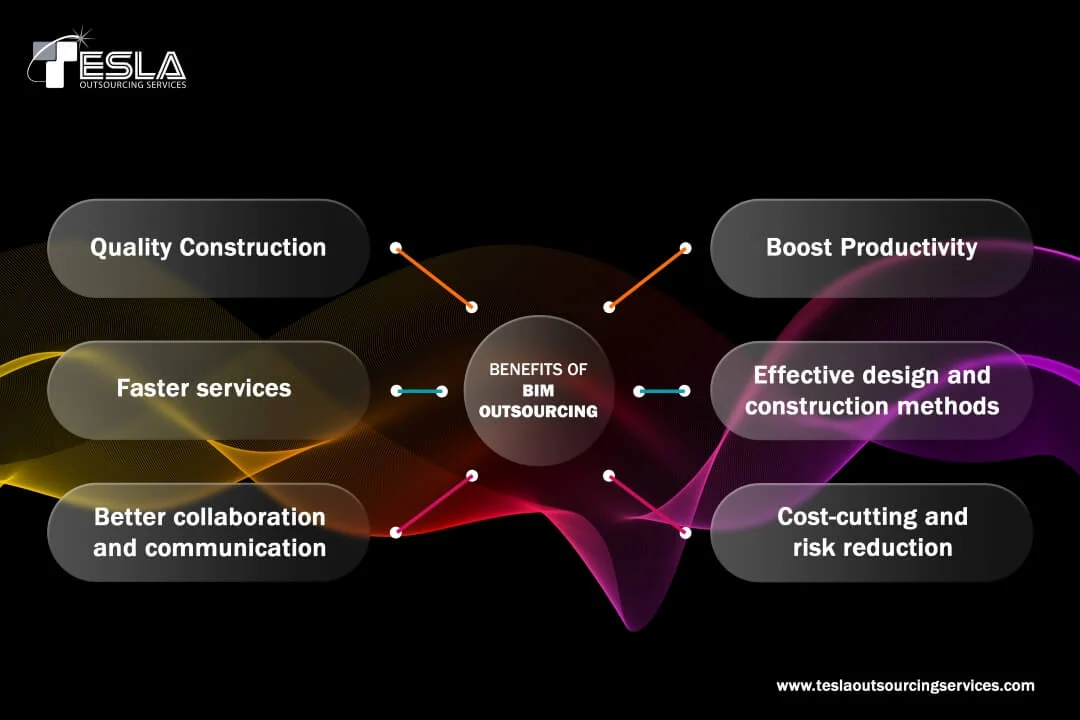
Benefits of BIM Outsourcing
Why BIM Outsourcing Is No Longer Optional
After 2026, BIM outsourcing is no longer a nice-to-have. For most companies, it has become a necessity driven by structural industry forces.
Workforce Volatility
Workloads in projects increase and decrease at a quick rate. Full-time employees are employed to meet the periods of high demand and thus are underused during slower periods. Outsourcing offers flexibility without reducing long-term expenditure.
Skill Scarcity
The talent of BIM experts is lacking, especially the specialists in MEP, medical, and infrastructural works. Outsourcing gives access to highly qualified personnel that would otherwise be hard to hire.
Delivery Risk
Any mistakes in BIM coordination are directly converted into RFIs, rework, and delays. Specialised production teams minimise the chances of hasty and untimely deliverables.
Cost Control
Although cost advantage is not the main motive, outsourcing assists companies in controlling labour costs more accurately by making the fixed costs variable costs.
Empirical studies (peer-reviewed) show that projects using advanced BIM applications in planning/design see significant performance improvements (reduced errors, faster coordination, fewer reworks) — not just “nice to have” visuals. This underpins why firms outsource complex BIM work to specialist teams.
From Capacity Support to Performance Engine
Once firms move past the “should we outsource?” question, the real value of BIM outsourcing becomes visible at the execution level. In 2026, outsourcing does not equate the number of deployed modellers but rather the degree to which the projects can be transported most efficiently through the coordination, documentation, and construction process without many hiccups. The three most important outcomes that are caused directly by well-structured outsourcing in AEC firms involve:
- Speed of delivery
- Quality and coordination accuracy
- Cost predictability
How BIM Outsourcing Accelerates Project Timelines
Speed in BIM delivery is not just about working faster; it is about eliminating bottlenecks. By using outsourced BIM teams, firms can parallelise tasks that would typically have to wait for limited internal resources. While internal teams concentrate on design decisions, coordination, leadership, and client engagement, outsourced teams handle model development, updates, and revisions promptly.
Key mechanisms for acceleration include:
- Continuous progress on the models across different time zones.
- Resolute teams are assigned to a single project instead of juggling multiple jobs.
- Faster response to design changes without disrupting internal workflows.
- Reduced waiting time between coordination cycles.
The result is smoother transitions between project phases. Design development moves into coordination without pauses. There are no last-minute rushes in the construction documentation process.
Why Quality Improves When Execution Is Separated from Decision-Making
One of the most important advantages of outsourcing, which is not always paid attention to, is role clarity. Intent, approvals, and high-level coordination are done by internal teams. Teams that are outsourced are concerned with execution, accuracy, and completeness. This separation makes the cognitive load easier, as well as creating more consistency. In 2026, companies are moving towards considering BIM production as a process that is engineered rather than an artisanal work that relies on individual heroism.
Quality improves because:
- Production teams work against stable standards and checklists.
- Models are reviewed systematically rather than reactively.
- Errors are identified in earlier phases due to focused QA/QC cycles.
- Coordination is no longer personality-driven; it is a process that anyone can repeat easily.
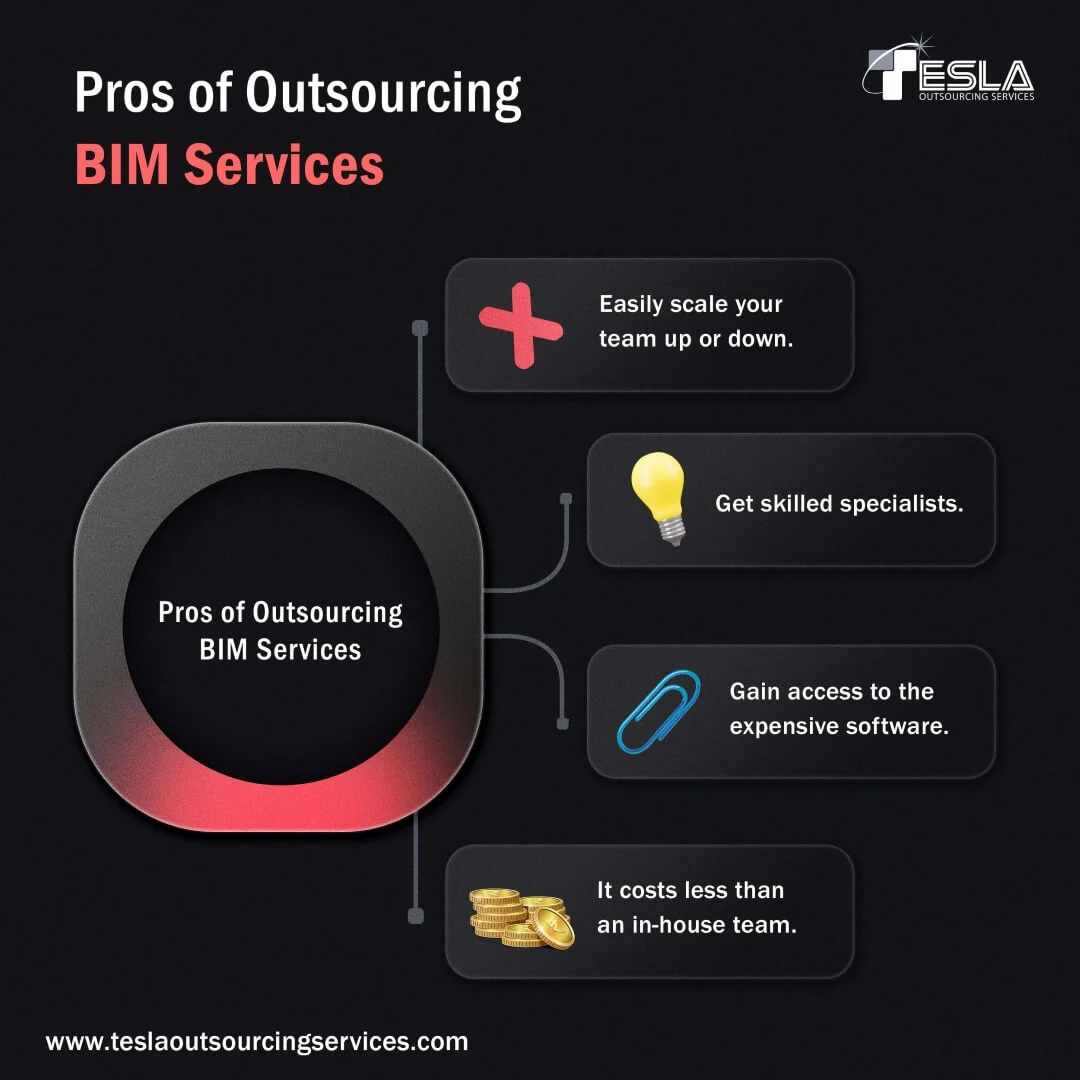
The Pros of BIM Outosurcing
Minimising RFIs, Rework, and Construction Discrepancies
Requests for Information (RFIs) and rework are signs of misalignment between design intent and buildability. Outsourcing Building Information Modelling (BIM) can help minimise these issues by enhancing model maturity before construction starts. This results in fewer site inquiries and less improvisation during the building process. Contractors receive clearer information, which directly reduces both schedule and cost risks.
Outsourced teams typically:
- Improve and complete the coordination before Issued For Construction (IFC).
- Resolve spatial conflicts proactively.
- Improve clarity in complex zones such as plant rooms, shafts, and ceilings. etc.
- Align models with the fabrication and installation process.
Understanding the Cost Structures of BIM Outsourcing in 2026
Costs vary depending on the discipline, complexity, and level of responsibility involved. MEP (Mechanical, Electrical, and Plumbing) coordination usually calls for higher rates than architectural modelling due to the density of systems and exposure to risk. Additionally, healthcare and infrastructure projects tend to have higher prices because of the intense compliance and coordination required.
Understanding cost is one of the most commonly misunderstood aspects of BIM (Building Information Modelling) outsourcing. By 2026, firms will assess outsourcing based on the overall economics of delivery rather than just hourly rates.
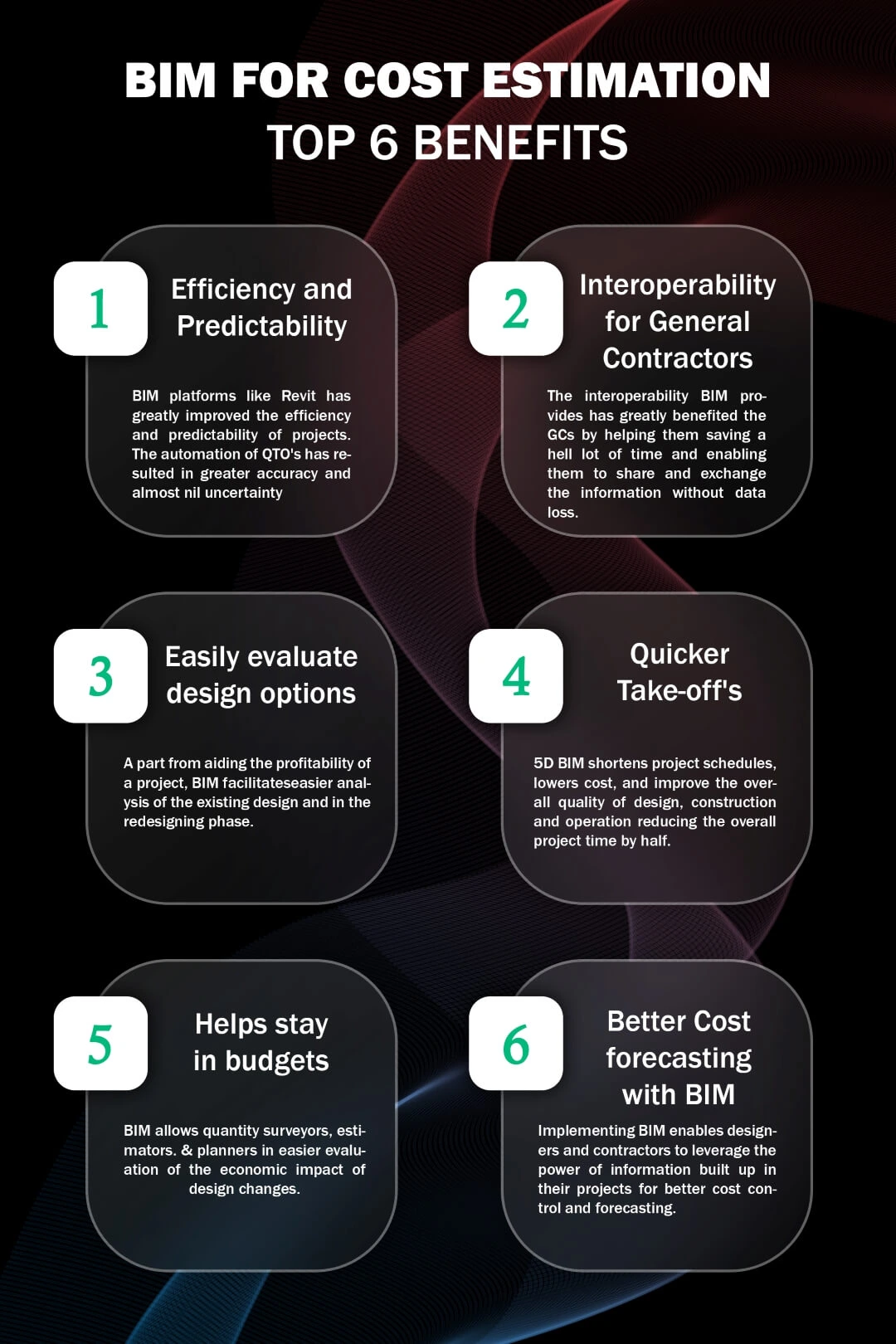
BIM for Cost Estimation
Common engagement models typically include:
- Monthly teams dedicated to long-term projects.
- Hourly models based on discipline for variable workloads.
- Defined deliverables through fixed-scope packages.
Successful companies evaluate outsourcing costs against:
- Internal hiring and training expenses
- Overtime and burnout-related inefficiencies
- Cost of RFIs and rework
- Schedule delay penalties
Discipline-Wise Cost Sensitivities
Knowing these differences would enable firms to make realistic scopes and prevent underpricing and overloading partners. The various BIM disciplines do not respond to outsourcing models in the same way.
- Architectural BIM benefits from outsourcing based on volume and the use of repeatable unit modelling.
- Structural BIM requires a closer alignment with engineering intent and tolerances.
- MEP BIM demands the highest level of coordination and expertise in the domain.
- As-built and handover models benefit from long-term, dedicated teams that ensure consistency.
The Significance of BIM Outsourcing for Design Firms
Design-build is a type of project that shortens time schedules and overlays construction with design. This increases high BIM demand at short durations. In the case of design-build companies, outsourcing does not concern cost as much as continuity in terms of quality.
Outsourcing eases design-build by:
- Maintaining model continuity as design evolves
- Supporting rapid coordination cycles
- Allowing internal teams to focus on decisions instead of production
- Keeping documentation aligned with construction sequencing.
WEF research on digital jobs highlights how global digital work architectures (remote, distributed teams) allow countries/companies to scale specialist capacity quickly — the same dynamics powering offshore/nearshore CAD/BIM teams. In other words: the macro trend of digital jobs is the engine behind scalable outsourcing.
High-Intensity BIM Environments in Healthcare & Hospitality
The healthcare and hospitality projects show the weaknesses of using in-house BIM delivery only. High coordination, precision on the equipment level and strict compliance with regulatory requirements are requirements in hospitals. At the same time, hospitality projects necessitate promptness, uniformity and repetition in the design of numerous units. In both sectors, outsourcing can help mitigate risks, especially since mistakes can be costly and delays are not tolerable.
Outsourcing enables companies to:
- Deploy specialised teams that understand sector requirements.
- Efficiently manage repetitive modelling.
- Maintain consistency across extensive project scopes.
- Adhere to handover deadlines.
The Importance of Cost Discussions Following Workflow Clarity
Companies that view outsourcing as simply “extra hands” tend to overspend and achieve subpar results. In contrast, those who consider it a structured delivery layer are more likely to achieve predictable outcomes. A common mistake businesses make is discussing costs before clearly defining workflows. Outsourcing creates value only when:
- Scopes are clearly defined.
- Responsibilities are clearly outlined.
- Review cycles are scheduled.
- Decision-making authority is understood.
Why Most BIM Outsourcing Efforts Fail at the Governance Stage
By the time firms reach outsourcing maturity, the biggest risks are no longer technical.
They are organisational. Various BIM outsourcing projects fail due to the lack of skills in the partners, but also due to the lack of clarity in terms of expectations, authorities, and accountability. Even good teams do not produce consistent results without good governance.
Successful BIM outsourcing in the year 2026 will be based more on the organisation of work, its reviews, and ownership rather than being motivated by software skills.
Evaluating a BIM Outsourcing Partner in 2026
To evaluate a BIM outsourcing firm, there is a need to ask the right questions. A different perspective is needed compared to the past. Simply reviewing portfolios and software lists is no longer sufficient. What truly matters is how well operations are aligned.
Strong partners demonstrate the following qualities:
- A clear understanding of international BIM standards and project delivery models.
- Work experience should be in Common Data Environments (CDEs) controlled by clients.
- Properly installed Quality Assurance (QA) and Quality Control (QC) is mandatory.
- The capacity to expand teams without losing quality.
- Well-defined communication protocols and escalation paths.
Beyond Capability: Cultural and Process Alignment
The goal is to find a provider that fits your delivery culture.
Firms should evaluate:
- How partners respond to feedback?
- Whether they proactively identify coordination risks
- How do they handle workload spikes?
- Their approach to maintaining the documentation discipline
- Their comfort level collaborating within strict governance.
Clear Scopes and Responsibility Boundaries
If we define clear boundaries, it helps in reducing rework, frustration, and duplication of effort. They also protect internal teams from becoming bottlenecks. One of the most common causes of friction in outsourced BIM projects is unclear scope definition.
Successful firms define:
- What the outsourced team owns fully
- What requires internal approval?
- What decisions are off-limits?
- How are changes requested and tracked?
KPIs That Actually Matter in BIM Outsourcing
Measures of the right metrics must be followed. By 2026, businesses will focus on KPIs, rather than the activity-based ones. Effective KPIs include:
- Coordination cycle time (from issue identification to resolution)
- RFI volume linked to coordination issues
- Model accuracy and completeness at key milestones.
- Rework rates caused by BIM errors
- Turnaround time for design changes
- Adherence to BIM standards and naming conventions
BIM Manager Responsibilities for Outsourced Projects
BIM Managers transition from being implementors to coordinators on outsourced projects. Their success is determined not by the amount of modelling they do, but by how smoothly the delivery process flows across different teams. Strong BIM managers are the most significant factor in achieving successful outsourcing outcomes. As outsourcing becomes the norm, the role of the BIM manager evolves considerably. Rather than concentrating on direct production, BIM managers increasingly focus on:
- Governance and enforcement of standards
- Design and optimisation of workflows
- Leadership coordination
- Oversight of quality
- Monitoring of performance
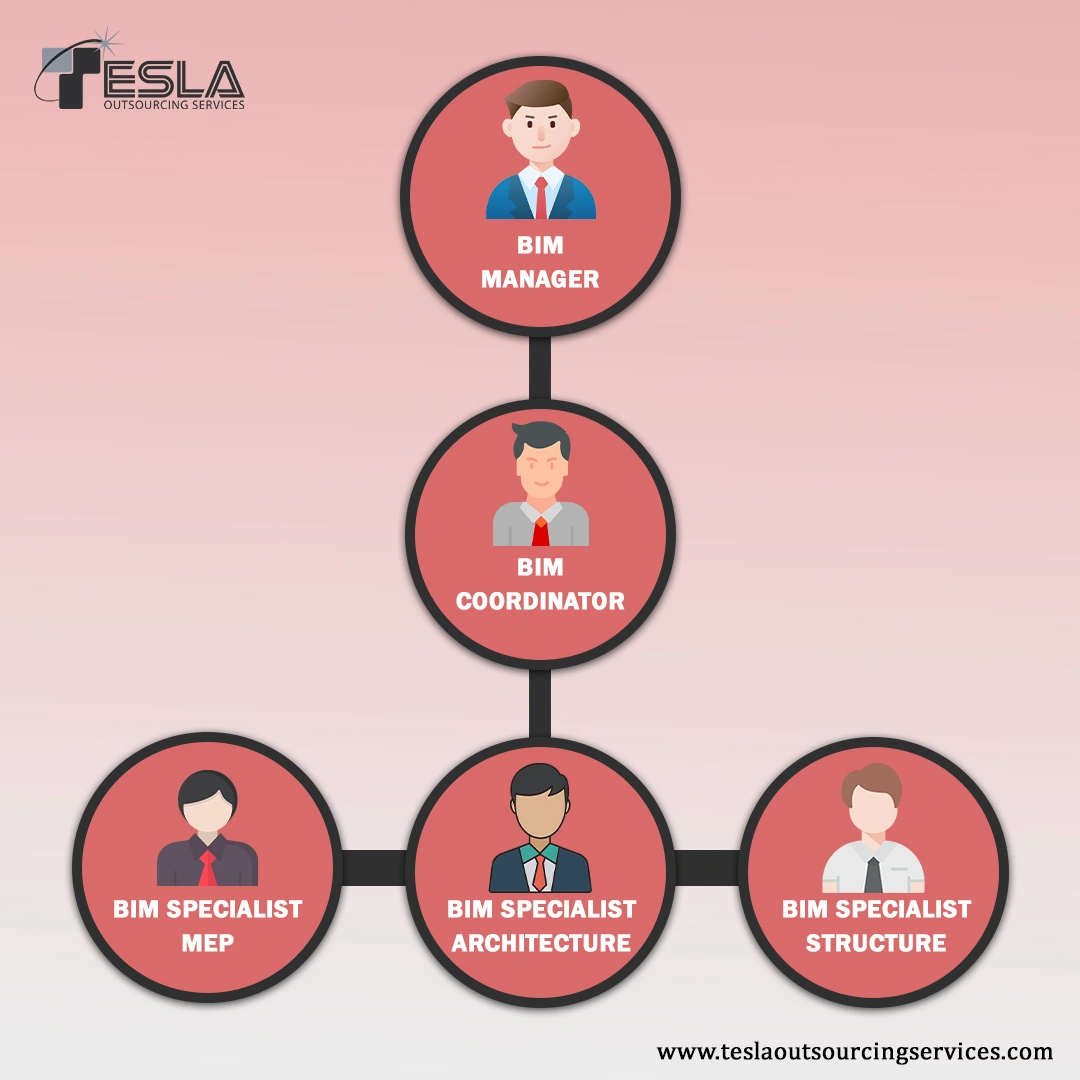
Hierarchy in BIM Outsourcing
Data Protection, Identity Protection, and Zero-trust Processes
The issue of data security cannot be compromised in 2026. Companies have stopped just trusting and instead trust systems. The outsourced teams do not download data locally. They run within the confined locales where access is controlled. This secures intellectual property and eases collaboration. The current outsourcing deals work on zero-trust principles:
- Role-based access controls
- Limited permissions tied to scope
- Secure cloud-based environments
- Activity logging and audit trails
- Clear IP ownership clauses
Transactional Engagements vs. Long-term Partnerships
Companies are also beginning to have their own external teams running in 2026, which are expanding along with their own business. The most successful BIM outsourcing relationships are long-term.
Short-term, project-based engagements often face issues such as:
- High onboarding costs
- Loss of institutional knowledge
- Inconsistent quality
Long-term partnerships enable:
- A better understanding of firm standards
- Quicker onboarding of new projects
- Ongoing performance improvement
- Decreased coordination friction
BIM Outsourcing in Practice
At maturity, BIM outsourcing remains unnoticed. Projects run seamlessly. Coordination challenges are addressed promptly. Internal teams focus on strategy rather than urgent issues. Delivery becomes consistent.
This occurs when outsourcing is viewed as:
- A delivery system
- A governance challenge
- A long-term capability
Conclusion
By the year 2026, BIM outsourcing will no longer be a short-term solution for stressed work in the firms, and it will have well and truly made itself set as a long-term operating model for AEC firms. Due to the growing complexity of projects and shrinking deadlines, the ability to deliver projects on a scalable basis, as well as quality and risk management, has become critical as an element of competitiveness. The ability of firms to strategically outsource BIM by aligning it with governance, performance measures, and ensuring dependable online workflow should help to provide greater predictability and resiliency in projects. Instead of substituting internal teams, smart outsourcing reinforces them, which enables the leaders to concentrate on design intent, coordination, and decision-making, while execution can be organised on a large scale in the background. In the highly exacting and responsible industry, BIM outsourcing in the year 2026 is no longer about cost-saving; it is about creating sustainable and future-ready delivery systems that would accommodate long-term growth.
Stop hiring and start scaling today. Contact us to discover how our Dedicated Resource Arrangement can provide the specialized BIM talent and ISO-compliant workflows needed to stabilize your project delivery and drive long-term growth in 2026.
Contact Us

