
At Tesla Outsourcing Services, we have observed a significant surge in demand for scalable BIM support among North American AEC firms entering 2026. This data signifies a critical shift toward flexible resource models, prompting us to share our perspective on why this transition is accelerating.
BIM outsourcing will be the strategic choice for the future of Architecture, Engineering, and Construction (AEC) companies in North America by 2026. The concept of balancing the workload has changed into a simple operational framework that allows scalability, speed, and resilience in an exquisitely complex building environment.
As project requirements increase, the regulations tighten, the workforce becomes short, and digitalization gains pace, AEC companies in the US and Canada are finding that it is no longer possible to do everything in-house. With BIM outsourcing, companies can remain competitive in terms of quality and control.
This step-by-step blog splits the reasons behind this change, and each point is explained in detail; these features are simplified by clear pointers to make the process easy to understand.
The Evolving Reality of the North American AEC Industry
The industry transformation is a significant shift in the North American AEC. The government and the general private developers are pouring money into upgrading infrastructure, hospitals, commercial premises, data centres, and green developments. On the one hand, this growth brings about opportunity, but on the other hand, a lot of complexity is presented. The current projects are characterized by several consultants, sophisticated building systems, requirements on compliance, and the increased client expectations of precision and transparency.
Traditional working processes are struggling to meet these demands, and hence, BIM is not an extravagance but a necessity. However, it has become hard to run BIM internally at scale, especially when organizations are handling several large-scale projects within a given time.
Some well-known industry challenges in 2026:
- Increased project scale and technical complexity
- More stakeholders and coordination requirements
- Compressed project timelines
- Higher accountability for errors and rework
- Greater reliance on digital collaboration
These forces are compelling the companies to consider other possible staffing options and use BIM outsourcing as a secure way.
BIM 2026: The Modeling Tool Moved to the Project Backbone
BIM in 2026 is not only about the creation of 3D models. It has become one of the key decision-making tool that sustain the whole project’s life cycle. From first design validation up to construction coordination and management of the facility, BIM is rooted in the planning and delivery of projects.
This extended responsibility has increased the size and the complication of the BIM-related activities considerably. It takes many different skills, quality control, and upgrades of software and skills to deal with internally.
BIM now plays a role in:
- Design coordination across architecture, structure, and MEP
- Clash detection and constructability analysis
- Quantity take-offs and cost estimation (5D BIM)
- Construction sequencing and scheduling (4D BIM)
- Sustainability analysis and energy performance
- Asset data management for operations
Outsourcing enables companies to manage this extended scope effectively but keep strategic control within the company.

BIM is not just a Modeling tool
Continued Lack of Qualified BIM professionals
The shortage of skilled BIM talent remains one of the most important reasons that explains the emergence of BIM outsourcing in North America. The source of demand for BIM ability has experienced a faster rate than the workforce pipeline due to increased demand.
According to the Associated General Contractors of America (AGC) Workforce Survey, 91% of construction firms reported difficulty filling salaried and craft positions, citing a severe shortage of skilled digital and BIM-ready talent.
Local recruitment of skilled BIM practitioners can be characterized by high-level salary demands, a time-consuming recruitment process, and high training costs. Retention is still an issue even after employment, as the competition for skilled professionals is high. The advantage of BIM outsourcing is the ability to gain a quick escape, as there are already trained, tested, and production teams available.
Why outsourcing is the answer to the talent gap:
- Access to specialized BIM professionals without long-term hiring
- Reduced dependency on individual employees
- Faster onboarding and project start-up
- Consistent skill levels across disciplines
This makes the project continue even in the case of staff turnover or high workloads.
Increase in Costs and Financial Agility
Operating costs for AEC firms in North America continue to rise, especially in technical roles like BIM Modeling and coordination. Having an in-house BIM staff implies participation in fixed costs regardless of the volumes of the project.
Conversely, BIM outsourcing presents an adaptable cost model that puts the expenses in line with the project requirements. The companies can increase or decrease the services according to the workload without the strain of overhead.
New market research for 2026 indicates that the North American BIM market is projected to grow by 12% annually, with “outsourcing” identified as the primary lever for firms to maintain project margins amidst rising overhead costs.
The financial benefits of outsourcing:
- Lower salary and infrastructure expenses
- Predictable, project-based pricing
- Reduced investment in software licenses and IT systems
- Better cash flow management
The outsourcing in 2026 will not be about saving money but about financial stability and more efficient resources.
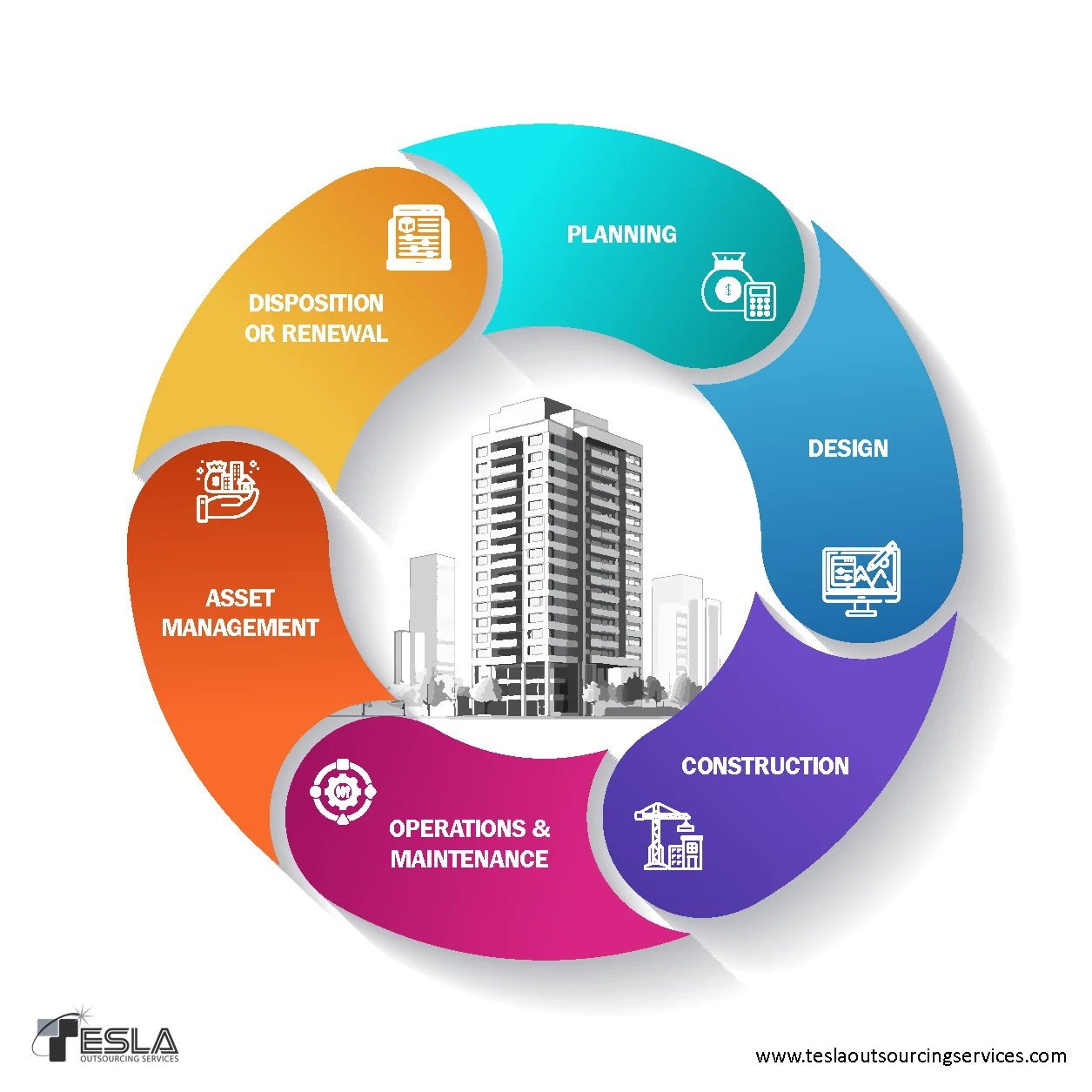
AEC Project Lifecycle
Time-Zone Efficiency in Faster Project Delivery
Time has turned out to be a determining factor in project wins and project delivery. The cost overruns, poor client relations, and opportunities can be lost due to delays.
BIM outsourcing allows firms to capitalize on time zones in the world and set up continuous working schedules. Whereas in-house teams are doing design and coordination during the day, the outsourced teams are doing Modeling, updates, and revisions during the night.
How this improves timelines:
- Faster turnaround on model updates
- Shorter coordination and clash resolution cycles
- Parallel workflows instead of sequential ones
- Better responsiveness to design changes
This method helps firms meet aggressive schedules without the company overloading its internal teams.
Realigning Internal Teams with High-Impact Work
Internal teams that are preoccupied with monotonous BIM production activities have a low ability to think strategically and be innovative. This tends to cause burnout and job dissatisfaction.
Outsourcing BIM tasks will enable companies to leave the rest of the work to be handled by their in-house staff so that they can engage in activities that directly translate to project success and later business expansion.
Tasks that can be given high priority by internal teams include:
- Concept design and design development
- Technical decision-making
- Client coordination and leadership
- Performance and sustainability design
This is a balance which enhances the results of the project and team morale.
Improving BIM Standards and Compliance Expectations
BIM standards in North America were more demanding and formalized in the year 2026. The clients need strict compliance with BIM execution plans, the levels of development, and precise models with data. Skilled BIM outsourcing partners have standard workflow and quality control processes that match these expectations.
Outsourcing benefits associated with compliance:
- Consistent QA/QC procedures
- Minimized risk of coordination mistakes
- Better documentation and audit readiness
- Improved confidence during client reviews
This consistency reduces project risk and enhances credibility.
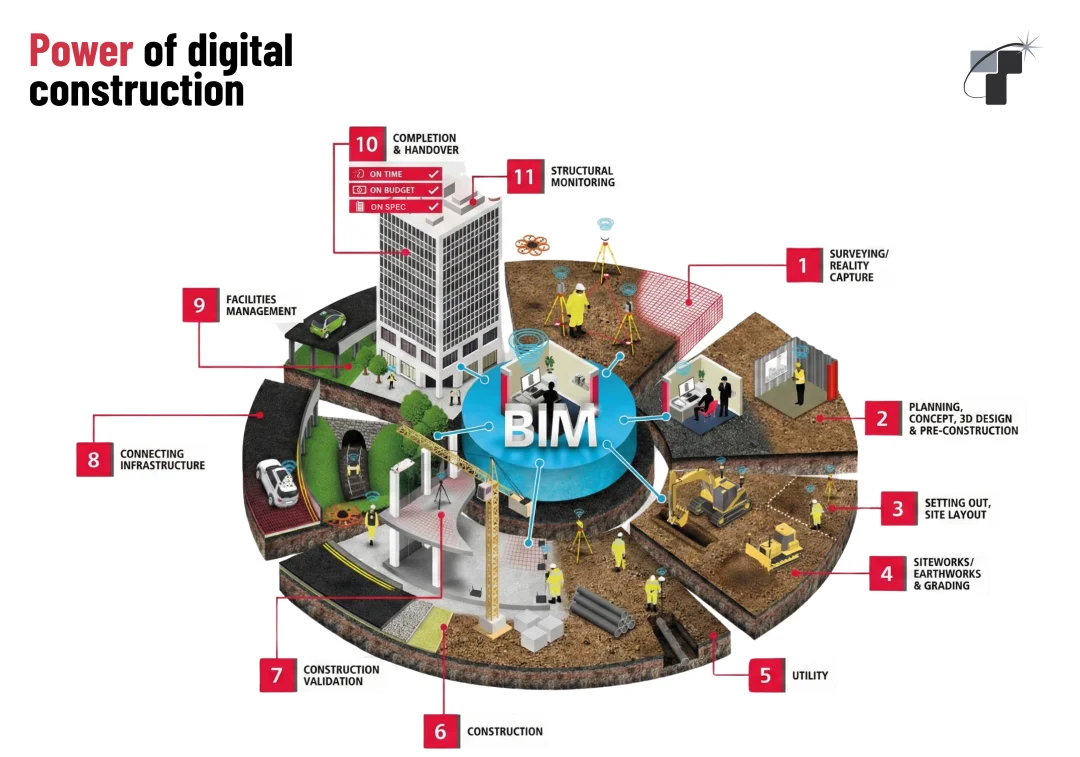
Power of digital construction
Scalability for Complex and Multi-Phase Projects
Large projects rarely have uniform BIM requirements throughout their lifecycle. There are phases when Modeling and coordination are highly needed, and phases when the demands are minimal. BIM outsourcing is flexible in the aspect that allows you to expand the team as needed without interfering with the activities of the business.
Scalability advantages include:
- Rapid resource expansion during peak phases
- Ability to manage multiple projects simultaneously
- Reduced pressure on internal staff
- Smooth transitions between project stages
This is especially valuable for infrastructure, healthcare, and large commercial developments.
Strategic Geographic Advantage and Global Expertise
BIM outsourcing is not just a distant work process; it is a collaborative approach with a global experience and local delivery. Outsourcing partners offer experience on several types of projects, regions, and regulations. The North American companies still have the design intent and client communication control, with the added benefits of international BIM maturity.
Strategic gains include:
- Exposure to international best practices
- Faster adoption of advanced BIM workflows
- Broader technical ability
- Continuous productivity across regions
This hybrid model strengthens competitiveness without compromising authority.
Summing Up!
In 2026, BIM is obviously an enigma that has transformed from a short-term operational solution into a long-term strategic necessity for North American AEC companies. The growing sophistication of the projects, the ongoing lack of talent, the increasing cost of operation, and the escalated demand for digital accuracy have made traditional in-house BIM models challenging to support themselves. Outsourcing is not about sealing the gaps anymore but about creating a more robust and flexible method of operation.
BIM outsourcing allows a smarter compromise of control and flexibility to firms all over the US and Canada. The core design proposals, dealing with the clients and project leadership, are kept in-house, but intensive, technically demanding BIM tasks can be approached by specialized external teams. Specialized external teams can handle intensive and technically demanding BIM tasks. This enables companies to complete projects in a shorter time, cost-efficiently, and sustain quality across various projects and stages.
BIM outsourcing, above all, will enable the AEC firms to concentrate on their actual distinguishing capabilities in a competitive market, namely design excellence, strategic thinking, innovation, and client relationships. With BIM growing outside the Modeling industry into data-driven decision-making and lifecycle management, the firms that incorporate outsourcing into their long-term business strategy will be in a better position to scale, adapt, and lead.
With the busy North American construction environment, BIM outsourcing is no longer a choice. It is a business opportunity that will aid long-term development, productivity, and project sustainability.


