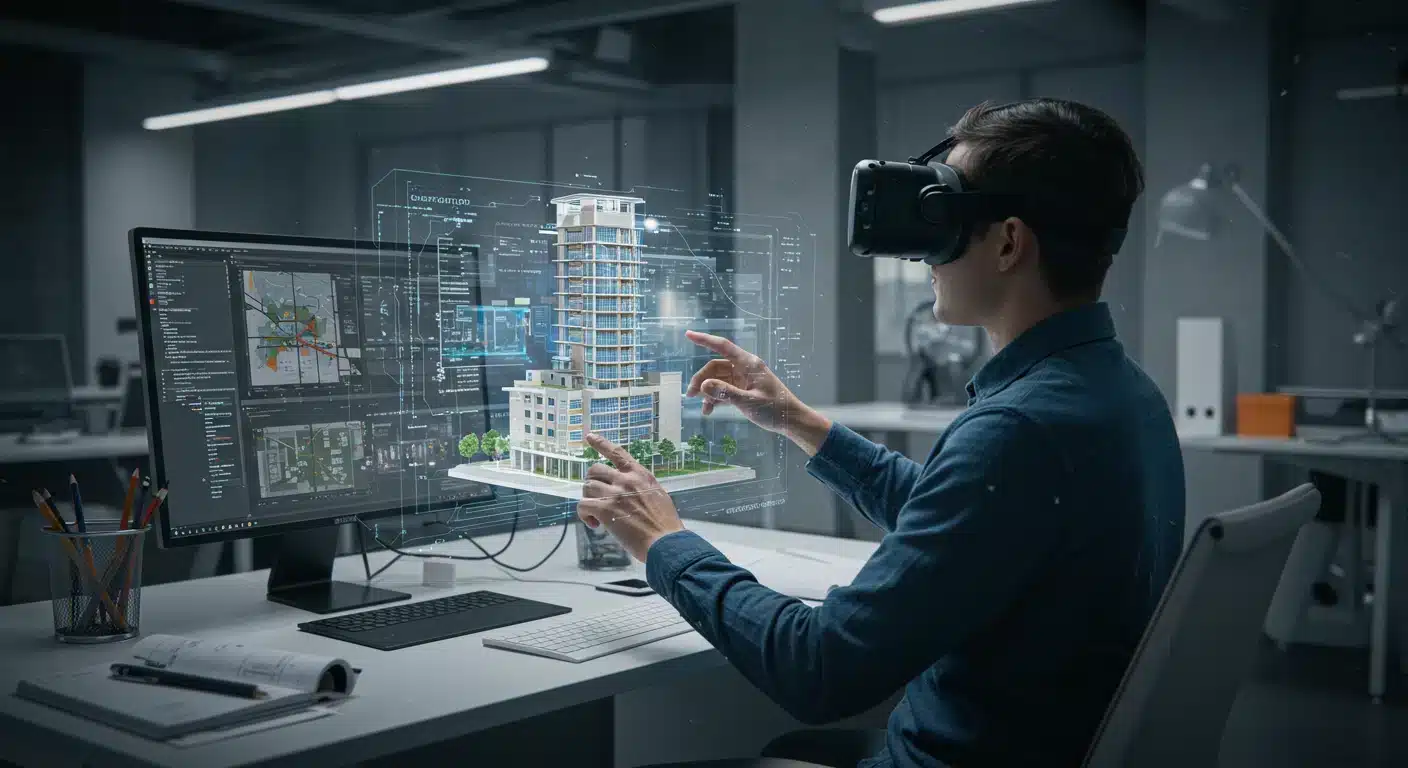
In our previous blog, we explored the fundamental concepts of immersive outsourcing and the future of VR in CAD and BIM. The use of outsourcing has been a hallmark of the AEC industry around the world to support various companies in expanding, reducing expenses, and accessing specific experience. However, with the introduction of CAD with Virtual Reality, outsourcing creates a whole new meaning. Whereas one used to have a set of technical diagrams or fixed 3D visual models, now clients can receive an immersive and interactive design process through the work of experienced teams all over the world.
Outsourcing 3D architectural walkthroughs, city planning simulations, industrial design layouts, real estate selling, and more, VR-CAD service enables companies of all sizes to compete on a new level without costly investments in hardware or human resources. This section of the blog will deep dive into the reasons why outsourcing VR-enabled CAD is developing into a competitive edge, which industries currently enjoy the advantages first, obstacles to be aware of, and the trends that are leading the way forward.
Why VR-Enabled CAD Outsourcing is Strategic
Outsourcing of such fundamental processes as CAD drafting, BIM modeling, and 3D visualization has been practiced in the global AEC industry for a long time now. Whereas Virtual Reality (VR) evolves as a major business point of differentiation in communicating with clients and design development, VR-enabled CAD services outsourcing is gradually becoming a potent business strategy.
This is why that in the case of progressive companies, VR-CAD tasks are increasingly the duties that a company outsources.
Specialized VR-CAD skills and knowledge Access
Making interactive VR out of CAD or BIM models is a very specific practice. It needs the complex of:
- Knowledge of Revit, SketchUp, Rhino, or AutoCAD.
- Integration of VR with engines such as Unity, Unreal Engine, or Enscape.
- Knowledge of user experience and navigation in virtual space.
Adaptable Teams that can handle different-sized projects
The amounts of design work vary; one day you may be working on a small residential renovation, and the next day you may be submitting a bid on an enormous infrastructure project. Creating your own internal VR team that would be able to respond to this variability is not cost-effective and efficient.
Through outsourcing, you have:
- Ramps up fast to implement large or multi-stage projects.
- Once the service has been delivered, scale down with no additional overheads in the long run.
- Access a talent pipeline of various VR-CAD experiences around the world.
Dropping Infrastructure Costs and Operational Costs
An in-house VR workflow is not a cheap setup. You need:
- VR headsets and top-of-the-line computers.
- Software licenses for VR tools and CAD software.
- Continuous education of personnel.
Faster Turnaround Times
Outsourcing to a team that operates in other geographical locations on other time zones simply gives you a longer working day. When your team is having a break, your outsourcing company maintains the work. It is the cause of:
- 24 hours of progression
- Faster designs
- Shorter project delivery time
That outsourcing VR-enabled CAD can extend your working day to nearly 24 hours? While your in-house team rests, offshore partners in different time zones keep projects moving—often cutting delivery timelines by up to 30%.
Better Focus on Core Competencies
The common priorities of the design firms are to manage a client, conceptual design, regulatory approvals, site coordination, and business development. Outsourcing of technical operations such as VR integration releases internal resources so that they can concentrate on:
- Decision relating to high-level design
- Client-facing and branding
- Innovation and Strategy growth
Plug-and-Play Integration with Existing Workflows
Most of the top outsourcing providers have thorough personalized onboarding, and they will adjust to your:
- Naming of files
- Design standards
- Favored computer applications
- Collaboration (Trello, Asana, BIM 360, and so on)
Bids and presentation
Competitive Advantage Nowadays, clients are expecting more than line drawings, and they need to experience the design. Include VR deliverables in your FPs, proposals, or investor presentation, and:
- Wow, your stakeholders’ using walkthroughs
- Make your firm differentiate itself from competitors
- Better position in obtaining high-value projects
Key Applications of VR-CAD in Outsourced Projects
VR-enabled CAD is not limited in its power of creation to only architecture or interior design. The solutions it provides can be used in virtually all sectors of the AEC industry, which provides extensive stakeholders with the opportunity to visualize, simulate, and interact with a complex environment without laying a single brick. Together with the outsourcing efficiency, these capabilities provide companies with a multifunctional tool in optimizing the design process, streamlining approvals, and heightening the level of stakeholder confidence. We will have a look at the use of outsourced VR-CAD to open new horizons of design and enter different industries:
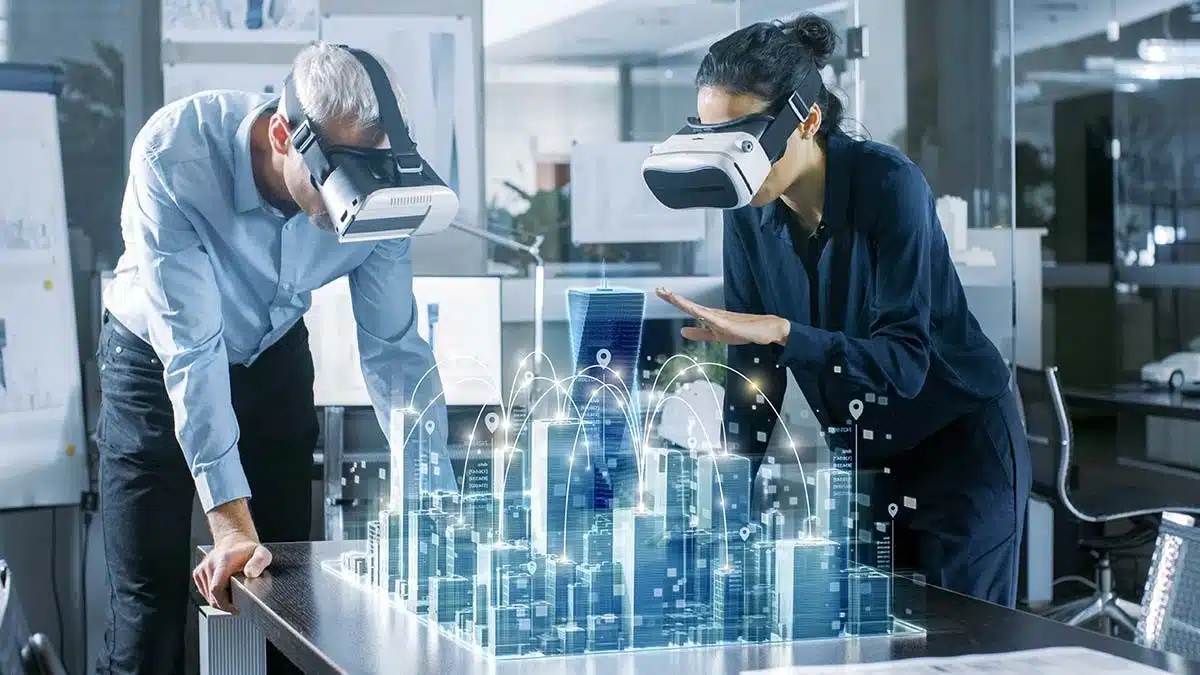
Applications of VR-CAD
Architecture and Urban Planning
Architectural design is where VR-CAD has arguably made the most visible impact. Traditional renderings, even when photorealistic, can’t match the spatial clarity of an immersive walkthrough.
Outsourced VR-CAD teams can take your Revit or SketchUp model and transform it into an experience where:
- Clients can walk through each room in real-time.
- Architects can assess views, daylighting, and spatial flow.
- Developers can simulate multiple design options interactively.
Urban planning adds a macro layer. VR simulations allow for the visualization of:
- Master plans at the city scale.
- Road and zoning layouts.
- Sunpath studies, pedestrian movement, and density analysis.
Example: A government body outsourcing a smart city plan to a VR-CAD team can use virtual simulations for public engagement, gathering feedback from citizens who “walk” through future streetscapes.
Interior Design and Furniture Layouts
Interior designers often struggle to convey mood, texture, and space through traditional 3D views. With VR-enabled CAD:
- Clients can “enter” their living room, kitchen, or office and walk around.
- Furniture can be moved and rearranged live during meetings.
- Material options can be toggled for instant comparison.
Outsourced partners can deliver:
- VR-ready interior walkthroughs
- Custom furniture VR models
- Lighting simulations for ambiance previews
This level of clarity speeds up approvals and minimizes rework.
Tip: Many interior firms now include a VR walkthrough as part of their design pitch, increasing their conversion rate and client satisfaction.
Industrial Plant and Factory Layout Design
In complex industrial environments, accuracy and efficiency are critical. VR-CAD can revolutionize:
- Equipment placement and spatial coordination
- Access pathway and safety clearance checks
- Maintenance simulations (e.g., visualizing how a technician will service a machine)
Outsourcing these VR tasks allows plant engineers and designers to:
- Optimize space usage
- Identify bottlenecks or hazards
- Reduce on-site modification costs
Example: A manufacturing company working with an Indian outsourcing firm can virtually simulate production workflows, ensuring that the machinery layout supports both performance and safety.
Infrastructure and Transportation Projects
From bridges and tunnels to metro lines and airports, infrastructure projects involve large-scale, multi-disciplinary coordination. VR-CAD can bring these projects to life through:
- Full-scale immersive walkthroughs for stakeholders and government agencies
- Virtual inspections of design details before construction
- Traffic simulations within the virtual environment
Outsourced partners can process heavy CAD files into VR-compatible models, making them lighter, interactive, and viewable through platforms like Oculus or web-based VR.
Use Case: A rail authority outsourcing station design models can use VR to test crowd movement and emergency evacuation routes—long before the tracks are laid.
Marketing and Sales of Real Estate
Using outputs of VR-CAD, real estate developers and real estate agents can:
- Demonstrate houses in the pre-construction stages.
- Give customers the chance to design layouts and finishes of their own in virtual showrooms
- Lessen site visitations through VR tour-accompanied visits.
Hiring a VR-CAD professional to do this duty will result in reduced time in delivering the following:
- Model unit walkthroughs
- Apt selector applications
- Plotted the development virtual landscape experiences
Insight: Many offshore VR-CAD providers bundle architectural modeling with marketing VR experiences, giving developers a one-stop solution for design + promotion.
That immersive VR walkthroughs not only improve design approvals but also boost client conversion rates in real estate by over 40%, as potential buyers experience properties virtually before construction even begins?
Medical establishments and schools
The hospital, schools, and universities have a special design requirement based on:
- Circulating efficiency
- Due to hygiene and safety observances
- Wayfinding and user experience
Through VR, outsourced crews can model:
- Movement of the patients between departments.
- Classroom acoustics and designs
- Employee task processes and entrances.
Doctors and educators, as well as facility managers, will be the stakeholders who will be able to navigate through the virtual space and give their feedback before the start of construction.
Explore how teams navigated through the virtual space in a hospital project See Hospital Project
Hospitality, Retail, and Public Spaces
VR is experiential, and this makes it best-suited to atmospheric spaces, branded spaces, and spaces that rely on customer interaction:
- Hotels and resorts can also able to be viewed in terms of layout, light mood, and visitor experience.
- The retail shops can experiment with merchandising displays, traffic flow, and billboard placement.
- The navigation can be imitated with museums and public pavilions.
Through outsourcing such activities, firms can conduct iterations on the customer experience at the initial phase of the design due to the existence of a VR-supported CAD team.
Challenges and Considerations in VR-Enabled Outsourcing
Although there is a huge potential to experience enhanced results by outsourcing Virtual Reality-enabled CAD services, it is not devoid of issues. When integrating immersive design technologies with external partners, one must plan well in ways that products and services are compatible, secure, and efficient.
This is a list of the most common issues enterprises have when outsourcing VR-CAD, and some pragmatic solutions to address those issues:
Data Security and File Management
CAD and VR models often contain confidential design details, IP-sensitive layouts, and proprietary data. Sharing these files with outsourcing partners—especially across borders—raises legitimate concerns about Unauthorized access or leaks, Loss of file ownership, and Improper reuse of project assets
How to address it:
- Collaborate with companies that use ISO/IEC 27001 or similar standards of data security.
- Apply access control on cloud-based file sharing environments (e.g., use BIM 360, Autodesk Docs, SharePoint).
Software Compatibility and File Formats
Most VR-ready CAD-based processes may involve several software programs that must operate in conjunction: Revit, SketchUp, Rhino, Enscape, Unity, Unreal Engine, and so on.
Issues arise when:
- Outsourcing partners don’t use the same versions.
- File formats are incompatible (. RVT, SKP, FBX, .OBJ, .EXE, etc.).
- The transition from CAD to VR platforms leads to data loss (textures, lighting, annotations).
Best practices:
- Establish a shared software stack at the beginning of the engagement.
- Agree on native file formats for CAD and VR outputs.
- Use collaborative platforms (like BIM Collaborate Pro) to avoid file duplication.
Training for Clients and Internal Teams
While your outsourced team may deliver high-quality VR experiences, there’s still a learning curve for your in-house staff and clients. Many stakeholders may:
- Be unfamiliar with VR headsets or navigation controls.
- Misinterpret design decisions due to a lack of VR literacy.
- Avoid engaging with the experience altogether.
Managing Time Zones and Communication
Outsourcing often involves working across multiple time zones, which can cause delays if not managed properly. For example:
- Real-time VR feedback may need to wait 12–24 hours.
- Urgent changes could get delayed without a fast response.
- Lack of regular meetings leads to misalignment in project expectations.
Quality Control and Standardization
Every company has some sort of design specification in terms of fonts, fabrics, rendering settings, lighting types, and VR navigation types. The quality of the outsourced VR products could be patchy without adequate instructions.
In order not to be surprised:
- Posting your CAD and visualization standards guide.
- Ask for a test project or a pilot, instead of entering long-term contracts.
- Design a QA/QC checklist for every VR output.
The Future of VR and CAD in Outsourcing
Currently, VR-enabled CAD is transforming collaboration, communication, and building in the AEC industry. This is, however, only the beginning. With the growing rate of digitalization in the world, the future of outsourced VR-CAD services will be dictated by the next-generation technologies, more integrations, and creative frontiers.
Here’s a cursory look at the future of the industry and how outsourcing partners will find themselves in the middle of it all.
Industry Metaverse
Rise of Digital Twins
This insinuation of digital twins, virtual representations of physical buildings or infrastructure, in the form of real-time, data-rich models is perhaps one of the most potent trends in architecture or engineering today.
Digital twin development is the next packaged service waiting to be implemented by outsourcing firms with CAD, BIM, and VR skills.
Metaverse-Ready Architectural Experiences
As the metaverse gains traction, buildings are not just physical—they are becoming virtual experiences. From NFT art galleries to immersive retail stores, architecture is being redefined for digital interaction.
Outsourcing firms will begin to offer:
- VR-based environments for virtual product launches or exhibitions.
- Fully immersive, interactive designs for digital twins of offices or homes.
- Experiences that blend AR/VR with gamified design walkthroughs.
Integration with AI for Smart Design
Outsourcing teams skilled in both CAD and machine learning will offer AI-enhanced VR outputs that optimize not just form and function, but also performance and lifecycle cost.
Artificial Intelligence is being embedded into VR-CAD tools to assist with:
- Auto-generating interior layouts based on user needs
- Lighting optimization simulations
- Predictive maintenance modeling
Cloud-Based VR Collaboration Hubs
Cloud computing will make VR collaboration more seamless. Instead of relying on powerful local systems, teams will soon work inside browser-based VR platforms that allow real-time co-editing, annotations, and walkthroughs.
Leading outsourcing partners will invest in:
- VR-ready cloud hosting and asset management
- Collaborative design review tools (WebXR, Meta Quest for Business, Autodesk Forma)
- VR project dashboards and automated feedback capture
Democratization of VR Design
As VR headsets become cheaper and more accessible, smaller firms and solo practitioners will adopt immersive tools. Outsourcing partners will serve as the technical backend, enabling:
- Freelancers to offer VR walkthroughs to clients
- Small studios to win big bids with immersive visuals
- Startups to develop product showrooms or concept environments without overhead
Future-Proofing with the Right VR-CAD Partner
In this fast-evolving landscape, outsourcing partners will not just be service providers—they’ll be technology enablers and innovation collaborators. Firms that embrace VR-enabled CAD now are better positioned to:
- Lead immersive presentations
- Deliver high-impact stakeholder experiences
- Offer competitive, tech-forward design services globally
The issue of the technical capability of VR-CAD outsourcing is exciting, but even more important is the aspect of leveling the field. The new immersive VR allows small firms to compete with the bigger studios without investing heavily in this; no need to invest in equipment or personnel. Such opening up of the design innovation process implies increased creativity, overcoming the pace of delivery, and international cooperation on projects of all scopes.
Conclusion
CAD outsourcing with VR is no longer a futuristic accessory, but is now turning into a business design for the AEC industry. With the immersive design coupled with outsourcing flexibility, companies are not only able to complete the project cycle in reduced time, save on costs, and customize experiences that stand out. As Digital Twins, AI, and cloud-based VR advance, future outsourcing will be based on building smarter, more interconnected, and scalable design ecosystems going forward. Firms that adopt this frontier in this era will stand a better chance of leading in the world market of design.
Frequently Asked Questions
Which projects enjoy the maximum use of outsourcing VR-CAD?
Manufacturing of large-scale projects, urban design, and industry buildings, real estate promotion, interior design, and smart city.
Is the security of data an issue in VR-CAD outsourcing?
Yes, but trustworthy outsourcing vendors apply such standards as ISO/IEC 27001, non-disclosure agreements, and secure platforms, such as BIM 360 and SharePoint, to keep confidential information safe.
What are the problems of the companies in outsourcing VR-CAD?
The issues are time zone management, compatibility between software, training clients on how to use VR, and having quality standards with minimal variation.
How does VR-CAD outsourcing look in the future?
Future designs can be expected to integrate Digital Twins, AI design, metaverse-friendly design, and collaboration hubs in the cloud, allowing immersive design to be an addition to companies of all scales.
Unlock Immersive Design Capabilities
Partner with Tesla Outsourcing Services to deliver hyper-realistic walkthroughs and interactive design experiences to your clients. We Offer expert –
- Building Information Modeling
- Architectural 3D Rendering
- Architectural Immersive Walkthrough


